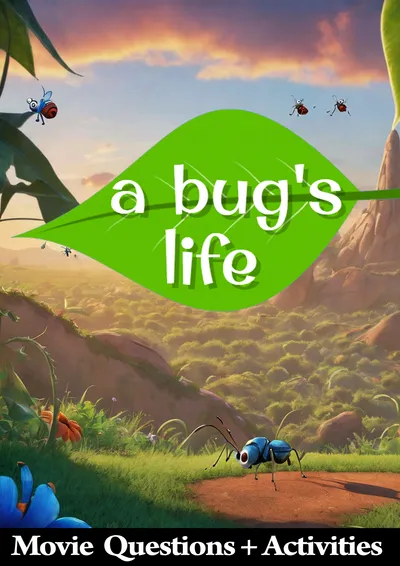
By Mr Hull's Movie Guides
Watch the Trailer

What's Inside the Guide
This is a 9-page classroom-ready resource.
Students form teams of three and are briefed before the movie begins. During viewing, each team tracks the insects they spot and identifies which bugs match the circus performers. A 16-word vocabulary list gives students key terms to look out for, which the class reviews together before the movie starts. Team members also draw a small insect in each of the provided boxes, either during the movie or afterwards.
23 mixed comprehension questions covering the full movie, completed as a team. These can be worked through during the movie or used as a post-viewing review. Answer keys are included.
Individual task. Each student creates a 6-scene storyboard illustrating pivotal events from the movie, with a short written description for each scene. Three copies are printed for the team, one per student.
This part covers two activities.
- Putting character names back in the correct order, then finding them in the word search.
- Each team member drawing and colouring one character from the movie using a specified set of three colours, taking turns to contribute to a shared team output.
“We used this when we were talking about animals and adaptations and the kids loved getting to watch a movie that related to it!”
— Savannah W.
“My students really enjoyed this resource! It was a great addition to my lesson and fit in perfectly with what we were covering. We started as a whole group to introduce the material, and then they were able to work through the rest on their own with confidence. I loved how it encouraged independent thinking and reinforced key concepts in a fun, engaging way. It also sparked some great discussions, and I’ll definitely be using it again!”
— MaRyan G.
Why Watch This Movie With Your Students
Here's what your students naturally take away from the movie, whether through themes, values, ideas, or perspectives.
🐜 A hero students can get behind. Flik is clumsy, inventive, and repeatedly underestimated by the people around him. Students who have ever felt like the odd one out will recognise something of themselves in him. His determination to fix his mistake and prove his worth gives the story a genuine emotional pull.
🤝 Teamwork with real stakes. The circus bugs are funny and completely unprepared for what Flik needs from them, but over the course of the movie they find ways to contribute and step up. The story makes a convincing case that different abilities matter, and that a team can achieve things no individual could manage alone.
💪 Standing up to bullies is a central theme. Hopper and the grasshoppers rule through fear and intimidation. The movie explores why bullies have power and what it takes to challenge them, not through a single dramatic moment but through a gradual shift in confidence across the whole colony.
🐛 A cast of distinct, memorable characters. The circus troupe includes a wide variety of insect species, each with a clear personality. Students notice the differences between them and enjoy tracking their arcs through the story. The variety also gives the insect identification activity in this guide a natural hook.
😄 Funny enough to hold a class. The comedy lands at the right level for grades 1 to 4 without ever feeling babyish. Older students in that range will catch jokes that younger ones miss. It is genuinely entertaining to watch as a group, which makes the classroom atmosphere during viewing noticeably easier to manage.
🎨 Rich visuals that reward close attention. The movie presents an insect-eye view of the world, with scale, colour, and detail that gives students a lot to look at. The storyboard and drawing tasks in this guide ask students to recall and recreate specific scenes and characters, which encourages them to watch with genuine attention.
Age Suitability and Content
This movie is rated G.
⚠️ Things to be aware of:
- Cartoon violence: bugs are punched, knocked down, and put in jeopardy throughout. No blood or injury detail.
- Villain intensity: Hopper and the grasshoppers are genuinely threatening. Some scenes involving intimidation and menacing behaviour may be unsettling for very young or sensitive students.
- Peril: characters face fire, a bird attack, falls, and capture. These scenes are tense but brief.
- Mild language: a few instances of 'poo-poo', 'butt', and 'damn'.
- No sexual content. No substance use of note. No strong language.
Note for educators: Movie details and age ratings in this post are sourced from IMDb, Common Sense Media, and Wikipedia to help ensure accuracy.
How My Movie Guide Helps You Teach It
Click your subject below to see how this guide supports it:
📚 English Language Arts Teachers
🔬 Science Teachers
🎬 Substitute Teachers and Cover Lessons
🏠 Homeschool Parents
💙 SEL Teachers
🌟 Supporting All Learners A movie gives students a story to follow, and the guide gives them questions to work through as they watch. For students with autism, learning difficulties, and mild to severe disabilities, that combination provides a clear focus for the lesson and a concrete way to show understanding. The format can be useful in special education and learning support classrooms, where teachers need activities that give students a defined task during viewing. Find out more about why movies work for diverse learners.
How These Guides Work: From Movie to Lesson
Watching a movie is not a break from learning. It reaches students through sight, sound, and story at once, engaging the brain in ways text alone does not, and the structured work around it is what turns the viewing into a genuine lesson. You can read the research behind this on the Why Movies Work page.
- A Teacher Notes and General Directions page opens the guide with a brief overview of everything inside: what the movie is about, then each part of the guide in order with a short description of what it entails. You know what to expect from the whole resource before you hand out a single page, so you can pick up the guide cold and teach it the same day.
- Answer keys are included for the comprehension question sets, so grading is quick and you are not rewatching the movie to check answers. Some guides also include example answers for the creative and written activities.
- Print and go: classroom ready, with no additional preparation needed. Print one the morning you need it and the lesson is ready.
- Substitute and first-timer friendly. A guide can be handed to a substitute or picked up by a teacher covering the topic for the first time. Nobody running the session needs to have seen the movie.
- Differentiated comprehension sets. Most guides include two or three question sets at different difficulty levels, and most include a multiple-choice option that works well for ESL and ELL students. One class set covers your strongest readers, your strugglers, and your language learners without separate prep.
- Activities that go beyond recall. Each guide includes structured activities that ask students to engage with the movie, not just watch it, ranging from creative and written tasks to discussion and critical thinking questions depending on the guide. That variety matters in a mixed classroom: a student who freezes on a written question set may show real understanding through a drawing or a creative task, and a confident writer gets room to go beyond recall. For the teacher, it turns a movie session into work you can grade: comprehension questions show whether students followed the plot, and the activities beyond them show whether they understood it.