By Mr Hull's Movie Guides
Watch the Trailer

Why Watch This Movie With Your Students
Here's what your students naturally take away from the movie, whether through themes, values, ideas, or perspectives.
🚀 A version of the moon landing built on cost, not celebration. The movie spends most of its runtime on the failures, deaths, and setbacks that came before Apollo 11, rather than treating the landing as an inevitable victory. Students see how much uncertainty and risk defined the space race in practice.
🧑🚀 A reserved, difficult to read central character. Neil Armstrong is shown as someone who processes loss and danger internally rather than through outward emotion, giving students a different kind of protagonist to analyze than most biographical dramas offer.
💔 A family strained by years of danger and distance. Janet Armstrong's perspective runs alongside Neil's throughout the movie, showing the toll his work takes on their marriage and home life. It gives students insight into the space race's impact beyond the astronauts themselves.
⚠️ Fatal accidents shown as a real, recurring part of the program. Colleagues and friends die during testing and training throughout the movie, grounding the space race in genuine danger rather than glossing over its human cost.
🌕 A historically grounded account of the Apollo 11 mission itself. When the mission finally launches, the movie treats the landing with the same restraint and technical detail as everything that came before it, giving students a version of the event closer to how it may have felt to live through.
Age Suitability and Content
This movie is rated PG-13.
⚠️ Things to be aware of:
- Several deaths occur due to mission and equipment failures, most shown off camera, though one fire related death is depicted on screen.
- Occasional strong language, including one emphasized use of a stronger swear word.
- Some adult drinking and chain smoking at social gatherings.
- A married couple kisses and embraces in a few scenes.
- No sexual content.
📋 A free editable parent permission slip is available for this movie. It explains the educational benefits of watching movies in class and includes a space for parental consent. → Download Free Permission Slip on TpT (Free resource)
Note for educators: Movie details and age ratings in this post are sourced from IMDb, Common Sense Media, and Wikipedia to help ensure accuracy.
How My Movie Guide Helps You Teach It
📚 English Language Arts Teachers. First Man fits ELA classes studying biography, historical narrative, or restrained character study, since the guide's comprehension questions track the movie's chronological structure while the interview and newspaper writing tasks push students into creative and informational writing. Two sets of differentiated questions make it straightforward to place students at the right level of challenge for a mixed ability classroom.
🗣️ ESL and ELL Teachers. The guide's shorter 30 question comprehension set works well with ESL and ELL students, giving them a more accessible way to follow the movie's chronology alongside the rest of the class. The reduced question set keeps the same structure as the full version, just with fewer questions to manage.
🔬 Science Teachers. The movie's detailed portrayal of NASA's testing, training, and mission procedures gives Science classes covering astronomy or space exploration a genuine connection to draw from. The guide does not include science specific activities, but the comprehension questions keep students accountable to the technical and procedural detail woven through the story.
🌐 Social Studies Teachers. The movie's setting within the Cold War era space race gives Social Studies classes a concrete entry point into 1960s American history and the politics surrounding the Apollo program. The guide does not include social studies specific activities beyond the comprehension questions, but those questions keep students engaged with the historical context as it unfolds.
🎬 Substitute Teachers and Cover Lessons. The differentiated comprehension questions, critical thinking prompts, and writing tasks are self-explanatory enough for students to work through with minimal guidance, making this a solid option to leave with a substitute teacher.
🏠 Homeschool Parents. The mix of comprehension questions, critical thinking prompts, an interview writing task, and a newspaper article gives a homeschool student a full, varied session of work built around a single movie.
📜 History Teachers. History classes covering the space race, the Cold War, or twentieth century US history will find the movie's setting and events directly relevant to what they teach. The guide's newspaper article activity asks students to write about the moon landing itself, giving them a piece of writing tied directly to the historical event at the center of the movie.
🌟 Supporting All Learners Movie guides can be a wonderfully calm fit for students with autism, learning difficulties, and mild to severe disabilities. The structured format gives every student a clear purpose during viewing, easing uncertainty and allowing them to engage at their own pace. If you teach in a special education or learning support setting, you may find this guide a gentle and practical resource. Find out more about why movies work for diverse learners.
What's Inside the Guide
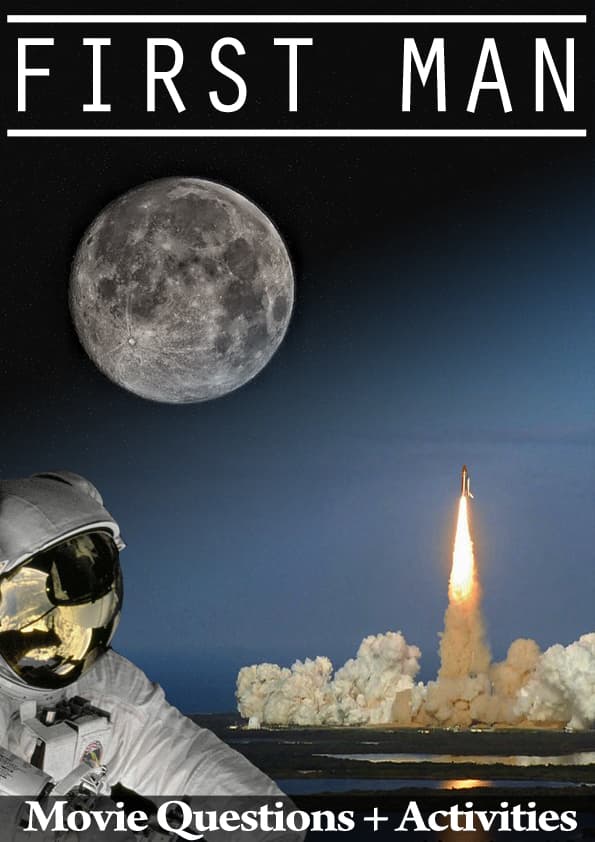
This is a 12-page classroom-ready resource.
Part 1: Comprehension Questions
Two sets of chronological comprehension questions requiring full sentence answers, intended for different grade ranges or for an ESL class: a 50 question set and a 30 question set with 20 questions removed from the full set. Answer keys are included for both.
Part 2: Critical Thinking, Interview, and Newspaper Article
Five additional critical thinking questions with suggested answers included, since student answers may vary. Students also imagine they interviewed Neil Armstrong, writing 10 questions and the answers they expect he would give based on what they learned from the movie. Finally, students write a newspaper article about the moon landing, including a headline and an accompanying picture.
“I let my students watch First Man after their Space Exploration unit in Astronomy. Highly Recommend!”
— Nicole M.
“Good Questions. Good Summative activity at the end.”
— Kepner's History
How These Guides Work: From Movie to Lesson
Watching a movie is not a break from learning. It reaches students through sight, sound, and story at once, engaging the brain in ways text alone does not, and the structured work around it is what turns the viewing into a genuine lesson. You can read the research behind this on the Why Movies Work page.
- A Teacher Notes and General Directions page opens the guide with a brief overview of everything inside: what the movie is about, then each part of the guide in order with a short description of what it entails. You know what to expect from the whole resource before you hand out a single page, so you can pick up the guide cold and teach it the same day.
- Answer keys are included for the comprehension question sets, so grading is quick and you are not rewatching the movie to check answers. Some guides also include example answers for the creative and written activities.
- Print and go: classroom ready, with no additional preparation needed. Print one the morning you need it and the lesson is ready.
- Substitute and first-timer friendly. A guide can be handed to a substitute or picked up by a teacher covering the topic for the first time. Nobody running the session needs to have seen the movie.
- Differentiated comprehension sets. Most guides include two or three question sets at different difficulty levels, and most include a multiple-choice option that works well for ESL and ELL students. One class set covers your strongest readers, your strugglers, and your language learners without separate prep.
- Activities that go beyond recall. Each guide includes structured activities that ask students to engage with the movie, not just watch it, ranging from creative and written tasks to discussion and critical thinking questions depending on the guide. That variety matters in a mixed classroom: a student who freezes on a written question set may show real understanding through a drawing or a creative task, and a confident writer gets room to go beyond recall. For the teacher, it turns a movie session into work you can grade: comprehension questions show whether students followed the plot, and the activities beyond them show whether they understood it.