By Mr Hull's Movie Guides
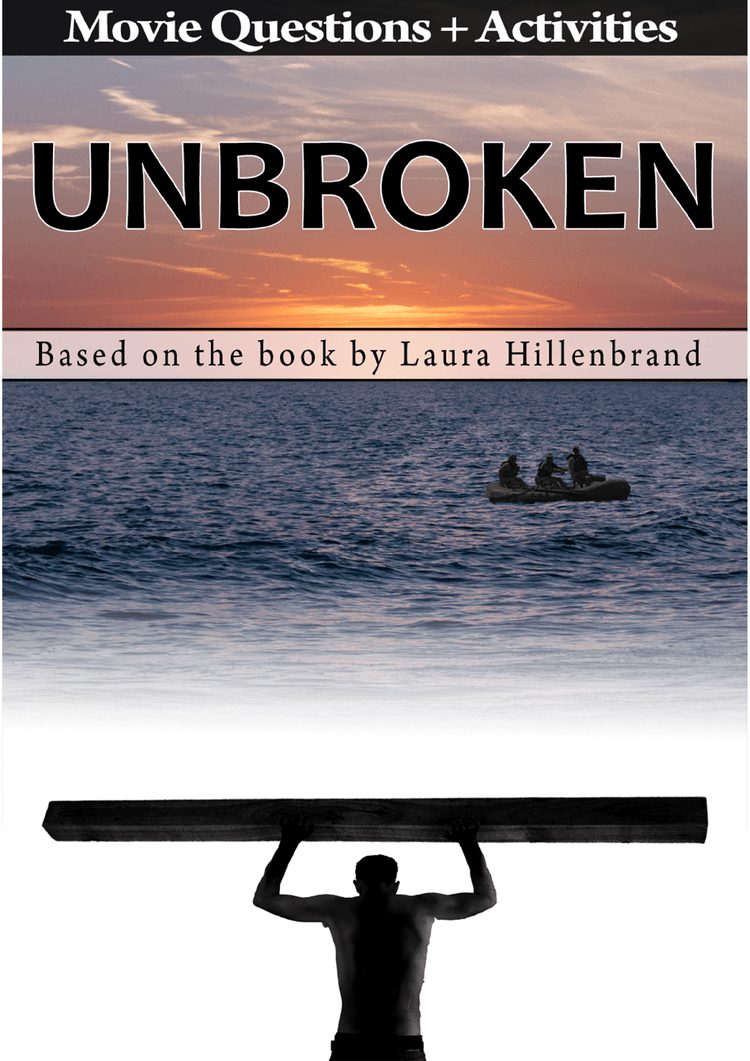
Why Watch This Movie With Your Students
Here's what your students naturally take away from the movie, whether through themes, values, ideas, or perspectives.
✈️ A true story that covers multiple extraordinary chapters. Zamperini's experience moves from the 1936 Berlin Olympics to aerial combat over the Pacific, survival at sea, and years in captivity. Each phase of the story is distinct, and the cumulative effect is a portrait of endurance that students find genuinely difficult to dismiss.
📖 Based on a widely read nonfiction book. Laura Hillenbrand's source text is a staple of school and public library reading lists. Classes that have read the book will find the movie a natural companion, and the adaptation gives teachers a ready-made comparison point for discussing how nonfiction translates to screen.
🌊 The survival sequences are visceral and specific. Forty-seven days adrift in the Pacific, rationing food, fending off shark attacks, and watching a fellow crewman slowly deteriorate. The raft sequences are among the most effectively realised parts of the movie and give students a concrete sense of what survival under extreme conditions involves.
🏕️ The POW camp scenes bring a difficult chapter of history into focus. The treatment of Allied prisoners in Japanese camps is not always covered in depth in secondary history curricula. Unbroken puts a human face on that experience, which makes the historical content more durable for students than a textbook account alone.
🏅 Zamperini is a protagonist worth studying. His background as a petty criminal turned Olympic athlete, and his refusal to be broken by a guard who made him a personal target, gives the story a psychological dimension that goes beyond simple heroism. There is enough complexity in his character to support genuine analytical discussion.
🎬 Technically accomplished filmmaking. Roger Deakins's cinematography gives the Pacific sequences a striking visual quality, and the contrast between the open ocean and the confined brutality of the prison camps is handled with real craft. Students studying film as a medium will find it a useful example of how visual choices serve narrative.
Age Suitability and Content
This movie is rated PG-13.
⚠️ Things to be aware of:
- War violence and sustained depictions of POW mistreatment: prisoners are beaten repeatedly, including with fists, belts, and wooden planks. In one extended scene, the camp commander forces all prisoners to punch Zamperini one by one. Prisoners are subjected to forced labour, exposure to cold, starvation, and prolonged physical stress.
- Aerial combat: bomber sequences include crew members being killed and wounded. A plane crash over the Pacific is depicted in detail.
- Survival peril: shark attacks on the life raft, starvation, and the death of a crewman during the 47 days at sea.
- Racial language: Japanese characters are referred to using derogatory terms by Allied characters, consistent with the historical period.
- No sexual content. No strong language beyond the period-appropriate slurs noted above. No substance use.
📋 A free editable parent permission slip is available for this movie. It explains the educational benefits of watching movies in class and includes a space for parental consent. → Download Free Permission Slip on TpT (Free resource)
Note for educators: Movie details and age ratings in this post are sourced from IMDb, Common Sense Media, and Wikipedia to help ensure accuracy.
How My Movie Guide Helps You Teach It
📚 English Language Arts Teachers. Unbroken is a strong fit for ELA classes working on nonfiction, biography, or book-to-movie adaptation. The guide supports comprehension, sequencing, and narrative writing, with differentiated question sets for mixed-ability classes.
🗣️ ESL and ELL Teachers. The guide includes a set of 29 multiple-choice questions designed with accessibility in mind for ESL and ELL students. Answer keys are included.
🌐 Social Studies Teachers. Unbroken covers WWII, the Pacific theatre, and the treatment of Allied prisoners of war, all areas that fall within the scope of secondary Social Studies curricula. The guide does not include dedicated Social Studies activities, but the comprehension questions give students a structured task during the viewing and keep them accountable to the historical content on screen.
🎬 Substitute Teachers and Cover Lessons. The guide is structured across three clearly labelled parts with answer keys included for all question sets. It works well as a self-contained sub plan for upper secondary classes, with no prior setup required.
🏠 Homeschool Parents. Unbroken offers home learners a rich entry point into WWII history through one man's extraordinary experience. The three-part guide provides differentiated comprehension, discussion, and narrative writing tasks that can be worked through across multiple sessions.
📜 History Teachers. Zamperini's story spans the 1936 Berlin Olympics, WWII aerial combat over the Pacific, and life in Japanese prisoner-of-war camps, giving History classes a ground-level view of events that are often taught at a distance. The guide does not include dedicated history activities, but the comprehension questions provide a structured framework that keeps students engaged with the historical detail throughout the viewing.
🌟 Supporting All Learners Movie guides can be a wonderfully calm fit for students with autism, learning difficulties, and mild to severe disabilities. The structured format gives every student a clear purpose during viewing, easing uncertainty and allowing them to engage at their own pace. If you teach in a special education or learning support setting, you may find this guide a gentle and practical resource. Find out more about why movies work for diverse learners.
What's Inside the Guide
This is a 16-page classroom-ready resource.
Part 1: Comprehension Questions
Three differentiated question sets covering the full movie in chronological order: 50 questions requiring full sentence answers, a shorter 30-question set with 20 questions removed for lower-ability students, and 29 multiple-choice questions with three options each plus one full-sentence final question. Answer keys are included for all three sets.
Part 2: Discussion Questions
Six long-answer questions designed for individual written responses and subsequent class discussion.
Part 3: Storyboard and Synopsis
A 9-scene storyboard in which students illustrate and summarise key events in chronological order, identifying the main idea of each scene. Students then use their completed storyboard as a scaffold to write a structured plot synopsis, practising sequencing, narrative organisation, and clear written expression.
“My students loved this resource! We just finished reading the book and they were excited to watch the movie. I'm so glad this resource was available for them!”
— Kristina F.
“Whenever I show a movie, I always use a movie guide. Thank you for creating this resource.”
— Kathern P.
How These Guides Work: From Movie to Lesson
Watching a movie is not a break from learning. It reaches students through sight, sound, and story at once, engaging the brain in ways text alone does not, and the structured work around it is what turns the viewing into a genuine lesson. You can read the research behind this on the Why Movies Work page.
- A Teacher Notes and General Directions page opens the guide with a brief overview of everything inside: what the movie is about, then each part of the guide in order with a short description of what it entails. You know what to expect from the whole resource before you hand out a single page, so you can pick up the guide cold and teach it the same day.
- Answer keys are included for the comprehension question sets, so grading is quick and you are not rewatching the movie to check answers. Some guides also include example answers for the creative and written activities.
- Print and go: classroom ready, with no additional preparation needed. Print one the morning you need it and the lesson is ready.
- Substitute and first-timer friendly. A guide can be handed to a substitute or picked up by a teacher covering the topic for the first time. Nobody running the session needs to have seen the movie.
- Differentiated comprehension sets. Most guides include two or three question sets at different difficulty levels, and most include a multiple-choice option that works well for ESL and ELL students. One class set covers your strongest readers, your strugglers, and your language learners without separate prep.
- Activities that go beyond recall. Each guide includes structured activities that ask students to engage with the movie, not just watch it, ranging from creative and written tasks to discussion and critical thinking questions depending on the guide. That variety matters in a mixed classroom: a student who freezes on a written question set may show real understanding through a drawing or a creative task, and a confident writer gets room to go beyond recall. For the teacher, it turns a movie session into work you can grade: comprehension questions show whether students followed the plot, and the activities beyond them show whether they understood it.