By Mr Hull's Movie Guides
Watch the Trailer

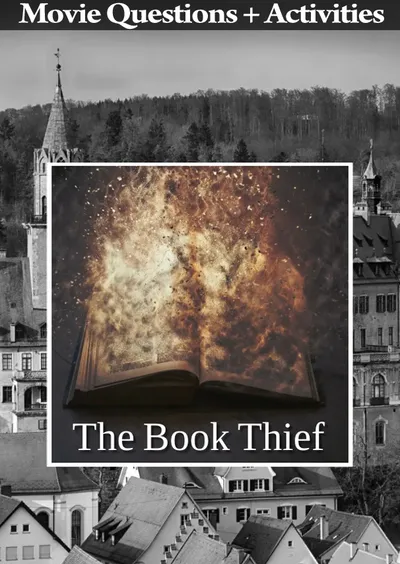
What's Inside the Guide
This is a 12-page classroom-ready resource.
Two sets of differentiated questions covering the events of the movie in chronological order. Answer keys are included for both sets.
- 37 question set requiring full sentence answers.
- 37 multiple choice question set with three possible answers, suitable for ESL and ELL students or for differentiation.
- A 9-scene storyboard in which students illustrate and summarise key events in order, identifying the main idea of each scene.
- A structured synopsis of the movie, written using their completed storyboard as a guide, reinforcing narrative organisation and written expression.
This part covers five creative writing tasks told through the viewpoint of Helga, a fictional German teen.
- Her response to a Nazi officer ordering her to burn her books.
- A recount of her journey to meet a new family in the countryside.
- Designing and labeling a garden air raid shelter.
- A supply list and escape plan for running away with her best friend.
- Imagining how she would celebrate the end of the war.
“Very effective activity in helping students to engage with the the video as we ended our unit on Elie Wiesel's memoir Night.”
— Erin M.
“Amazing resource. It was easy for my students to complete as they watched the movie and also has great prompts of discussion!”
— Veronica C.
Why Watch This Movie With Your Students
Here's what your students naturally take away from the movie, whether through themes, values, ideas, or perspectives.
📚 A story about the power of words and reading. Liesel's journey from illiteracy to voracious reader sits at the heart of the movie. Books become her means of survival, resistance, and connection, making this a natural conversation starter about why stories matter, even in the darkest of times.
🕊️ A different perspective on WWII. Rather than focusing on the battlefield, the movie looks at ordinary German civilians, some complicit, some quietly resistant. That perspective challenges students to think more carefully about how ordinary people respond to extraordinary pressure and injustice.
💛 Characters students genuinely invest in. Liesel, her foster father Hans, her best friend Rudy, and the young Jewish man hidden in the basement all feel fully realised. Students tend to arrive at the end of the movie caring deeply about what happens to them, which makes the emotional weight of the story land.
🎭 Death as narrator is genuinely distinctive. The choice to have Death narrate gives the movie an unusual tone, reflective and melancholy rather than sensational. It prompts students to think about point of view, narrative voice, and how the storyteller shapes the story.
⚖️ Moral courage is modelled without being simplified. Hans and Rosa take a significant personal risk to shelter Max, and they do so quietly, without heroics. That kind of understated moral courage is worth examining with students, particularly alongside the social pressures the characters face.
🏆 Based on a widely taught novel. Markus Zusak's book is a fixture in middle and high school English curricula. Whether students have read it or not, the movie gives them a way in to the story and its themes, and for those who know the book well, comparing the two versions is worthwhile in itself.
Age Suitability and Content
This movie is rated PG-13.
⚠️ Things to be aware of:
- Violence: Nazis are shown terrorising Jews in front of their homes and businesses. A Nazi officer strikes two characters. There are scenes of schoolyard bullying and fights. Bombing raids create sustained tension and anxiety throughout. Multiple character deaths occur, though there is almost no blood and no gore.
- Language: German insults are used throughout, some of which translate to 'dirty swine' and 'a--hole'. English insults include 'stupid', 'idiot', and 'good-for-nothing'. Some insults are used as terms of endearment between characters.
- Drinking, drugs and smoking: Some adult characters smoke cigarettes.
- Romance and intimacy: A boy repeatedly asks a girl for a kiss. By the end of the movie, when both characters are around 14, it is clear they have feelings for each other. One kiss occurs.
- No sexual content beyond the above.
📋 A free editable parent permission slip is available for this movie. It explains the educational benefits of watching movies in class and includes a space for parental consent. → Download Free Permission Slip on TpT (Free resource)
Note for educators: Movie details and age ratings in this post are sourced from IMDb, Common Sense Media, and Wikipedia to help ensure accuracy.
How My Movie Guide Helps You Teach It
Click your subject below to see how this guide supports it:
📚 English Language Arts Teachers
🗣️ ESL and ELL Teachers
🌐 Social Studies Teachers
🎬 Substitute Teachers and Cover Lessons
🏠 Homeschool Parents
💙 SEL Teachers
📜 History Teachers
🌟 Supporting All Learners A movie gives students a story to follow, and the guide gives them questions to work through as they watch. For students with autism, learning difficulties, and mild to severe disabilities, that combination provides a clear focus for the lesson and a concrete way to show understanding. The format can be useful in special education and learning support classrooms, where teachers need activities that give students a defined task during viewing. Find out more about why movies work for diverse learners.
How These Guides Work: From Movie to Lesson
Watching a movie is not a break from learning. It reaches students through sight, sound, and story at once, engaging the brain in ways text alone does not, and the structured work around it is what turns the viewing into a genuine lesson. You can read the research behind this on the Why Movies Work page.
- A Teacher Notes and General Directions page opens the guide with a brief overview of everything inside: what the movie is about, then each part of the guide in order with a short description of what it entails. You know what to expect from the whole resource before you hand out a single page, so you can pick up the guide cold and teach it the same day.
- Answer keys are included for the comprehension question sets, so grading is quick and you are not rewatching the movie to check answers. Some guides also include example answers for the creative and written activities.
- Print and go: classroom ready, with no additional preparation needed. Print one the morning you need it and the lesson is ready.
- Substitute and first-timer friendly. A guide can be handed to a substitute or picked up by a teacher covering the topic for the first time. Nobody running the session needs to have seen the movie.
- Differentiated comprehension sets. Most guides include two or three question sets at different difficulty levels, and most include a multiple-choice option that works well for ESL and ELL students. One class set covers your strongest readers, your strugglers, and your language learners without separate prep.
- Activities that go beyond recall. Each guide includes structured activities that ask students to engage with the movie, not just watch it, ranging from creative and written tasks to discussion and critical thinking questions depending on the guide. That variety matters in a mixed classroom: a student who freezes on a written question set may show real understanding through a drawing or a creative task, and a confident writer gets room to go beyond recall. For the teacher, it turns a movie session into work you can grade: comprehension questions show whether students followed the plot, and the activities beyond them show whether they understood it.