By Mr Hull's Movie Guides
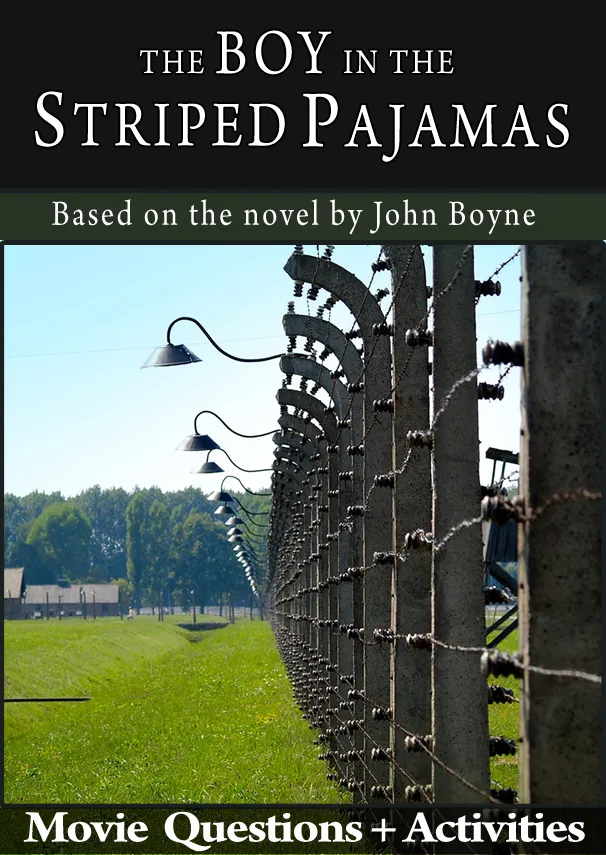
Watch the Trailer

What's Inside the Guide
This is a 15-page classroom-ready resource.
Six questions completed in the 20 minutes before the movie begins, followed by a class discussion. The questions ask students to think about concentration camps, the persecution of Jewish people, and how they might respond to certain situations under a totalitarian regime. They are designed to activate prior knowledge and ethical thinking before the movie starts, not to test factual recall.
A two-page supplementary section for classes who have read John Boyne's novel. This section can be skipped entirely if students have not read the novel.
- Section 1, completed before viewing, asking students what they are curious or nervous to see on screen.
- Sections 2 to 5, completed after viewing, exploring differences between the book and movie, character choices, and overall tone.
Two complete question sets covering the movie in chronological order. Answer keys are included for both sets.
- 23 question set requiring full written answers in complete sentences.
- 22-question multiple-choice version with three options per question, with question 23 requiring a full sentence answer.
- Nine key scenes illustrated and described from the movie in chronological order.
- A structured synopsis of the story, written using their completed storyboard, in their own words.
Students imagine that Bruno's father catches him moments before he crawls under the fence to join Shmuel. Their task is to write an alternative ending, including the father's reaction toward both boys. The task requires students to think carefully about character motivation and what each person in that scene would do and say.
“This was great! I loved that it wasn't just for watching the movie, but had activities for before and afterwards too.”
— Noelia L.
“This helped keep students engaged in the film and was a great way to review their understanding of the Holocaust”
— Gabriel P.
Why Watch This Movie With Your Students
Here's what your students naturally take away from the movie, whether through themes, values, ideas, or perspectives.
👦 Dramatic irony as a teaching tool. The audience understands what is happening at the camp long before Bruno does. Watching him misinterpret what he sees, while knowing the truth, creates a sustained tension that makes the Holocaust feel immediate and real rather than historical and distant. Students who notice how the movie uses that gap engage with it on a completely different level.
🤝 A friendship that crosses every boundary. Bruno and Shmuel are the same age, share the same birthday, and find common ground despite everything separating them. The movie asks students to think about what it means to maintain a friendship under impossible conditions, and what it costs when you fail.
😶 Complicity and moral blindness. Bruno's parents know what is happening at the camp to varying degrees. His mother's gradual realisation, and the way the adults around Bruno manage what they see and say, opens up genuine discussion about how ordinary people participated in, or turned away from, the Holocaust.
📖 Rooted in a widely studied novel. John Boyne's book is taught in many schools, making this movie a natural pairing for classes who have read it. The guide includes an optional Book vs. Movie comparison section for exactly this purpose.
✍️ An ending that demands a response. The final sequence does not resolve comfortably. Students who have tracked Bruno's journey through the movie arrive at the ending with something to say, which makes the written and discussion tasks that follow feel purposeful rather than obligatory.
🕍 The Holocaust told at a human scale. The movie does not deal in statistics. It tells the story of two boys, two families, and a fence. That human scale is what makes it accessible for students who have not yet studied the Holocaust in depth, and what makes it affecting for those who have.
Age Suitability and Content
This movie is rated PG-13.
⚠️ Things to be aware of:
- The movie ends with a deeply upsetting sequence in a gas chamber. Teachers should be aware of this before showing it
- Guards brandish guns and prisoners are threatened. A beating occurs off screen
- Prisoners are shown stripping before being led into a shower block
- Dehumanising language toward Jewish people, accurate to the period and central to the story
- Adult characters drink and smoke throughout, accurate to the time period
- One use of a strong expletive
- Themes of antisemitism, propaganda, genocide, and moral complicity throughout
- Bruno betrays Shmuel in a moment of fear. This is an emotionally significant scene
- No sexual content
📋 A free editable parent permission slip is available for this movie. It explains the educational benefits of watching movies in class and includes a space for parental consent. → Download Free Permission Slip on TpT (Free resource)
Note for educators: Movie details and age ratings in this post are sourced from IMDb, Common Sense Media, and Wikipedia to help ensure accuracy.
How My Movie Guide Helps You Teach It
Click your subject below to see how this guide supports it:
📚 English Language Arts Teachers
🗣️ ESL and ELL Teachers
🌐 Social Studies Teachers
🎬 Substitute Teachers and Cover Lessons
🏠 Homeschool Parents
🌟 Supporting All Learners A movie gives students a story to follow, and the guide gives them questions to work through as they watch. For students with autism, learning difficulties, and mild to severe disabilities, that combination provides a clear focus for the lesson and a concrete way to show understanding. The format can be useful in special education and learning support classrooms, where teachers need activities that give students a defined task during viewing. Find out more about why movies work for diverse learners.
The History connection is based on the movie's Holocaust setting and the pre-viewing discussion section. The guide is not tied to specific History curriculum standards and does not replace subject-specific teaching materials. It works best alongside your own resources as an engagement and accountability tool.
How These Guides Work: From Movie to Lesson
Watching a movie is not a break from learning. It reaches students through sight, sound, and story at once, engaging the brain in ways text alone does not, and the structured work around it is what turns the viewing into a genuine lesson. You can read the research behind this on the Why Movies Work page.
- A Teacher Notes and General Directions page opens the guide with a brief overview of everything inside: what the movie is about, then each part of the guide in order with a short description of what it entails. You know what to expect from the whole resource before you hand out a single page, so you can pick up the guide cold and teach it the same day.
- Answer keys are included for the comprehension question sets, so grading is quick and you are not rewatching the movie to check answers. Some guides also include example answers for the creative and written activities.
- Print and go: classroom ready, with no additional preparation needed. Print one the morning you need it and the lesson is ready.
- Substitute and first-timer friendly. A guide can be handed to a substitute or picked up by a teacher covering the topic for the first time. Nobody running the session needs to have seen the movie.
- Differentiated comprehension sets. Most guides include two or three question sets at different difficulty levels, and most include a multiple-choice option that works well for ESL and ELL students. One class set covers your strongest readers, your strugglers, and your language learners without separate prep.
- Activities that go beyond recall. Each guide includes structured activities that ask students to engage with the movie, not just watch it, ranging from creative and written tasks to discussion and critical thinking questions depending on the guide. That variety matters in a mixed classroom: a student who freezes on a written question set may show real understanding through a drawing or a creative task, and a confident writer gets room to go beyond recall. For the teacher, it turns a movie session into work you can grade: comprehension questions show whether students followed the plot, and the activities beyond them show whether they understood it.