By Mr Hull's Movie Guides
Watch the Trailer

What's Inside the Guide
This is a 15-page classroom-ready resource.
Three sets of differentiated comprehension questions arranged in chronological order with the movie. Answer keys are included for all three sets.
- 45 question set requiring full sentence answers.
- 30 question set requiring full sentence answers.
- 30 multiple choice question set with three possible answers per question, which also works well for ESL and ELL students.
- A 9 scene storyboard of what they believe are the most important parts of the movie, with a brief description written for each scene.
- A synopsis of the movie, written using the completed storyboard as a guide.
Students imagine themselves as junior reporters covering the story of a teenage hacker who nearly started World War III. They write 5 interview questions along with David's full imagined responses, then rework those answers into a dramatic newspaper article, including a drawing.
“Show this if you're looking for something that will really grab the interest of your high school history students!”
— Janet C A.
“Used this as classwork while we state tested for 4 straight days. We are currently in the middle of our Cold War unit and I believe this movie is a perfect, fun fit for the unit. The video guide was very easy to follow along and fostered a great discussion. I also used the modified version for my IEP students and it was very accessible for them to use! Thank you!”
— Maya M.
Why Watch This Movie With Your Students
Here's what your students naturally take away from the movie, whether through themes, values, ideas, or perspectives.
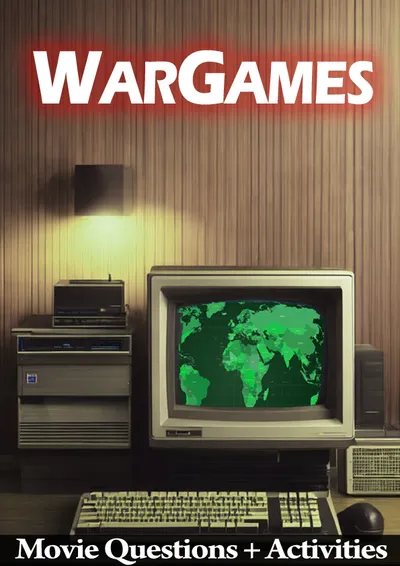
🕹️ A Video Game With Real Stakes. David logs on looking for a new game and instead finds himself playing Global Thermonuclear War against a military supercomputer that cannot tell simulation from reality. The mistake sets off a genuine countdown to nuclear war, turning a familiar teenage habit into the center of a national crisis.
☢️ A Direct Line Into Cold War Anxiety. The movie is built entirely around the fear that defined the Cold War era, that a single miscalculation could trigger a nuclear exchange neither side could win. Students get a concrete, dramatized entry point into a period of history usually taught only through dates and treaties.
🤖 A Question About Handing Control to Machines. NORAD automates its launch decisions to a computer named WOPR because human officers keep refusing to turn the keys in drills. The movie follows what happens when that computer is left to interpret a simulation as a real attack, with no person positioned to catch the mistake.
🧠 A Scientist Who Has Given Up. Dr. Falken, the reclusive researcher who built WOPR, has come to believe nuclear war is inevitable and stopped trying to prevent it. His arc gives students a character who has to be talked back into caring about the outcome, rather than a straightforward hero.
♟️ An Ending Built Around a Single Idea. WOPR is made to play tic tac toe against itself and cycles through every nuclear war scenario it knows, discovering that every one of them ends in a draw. It concludes that some games cannot be won, only avoided, and stands down.
🔓 A Movie Credited With Real World Consequences. WarGames is widely credited with putting hacking and computer security into public conversation, reportedly prompting a national security review and influencing early federal policy on computer security. Students studying technology or media literacy get a rare case where a movie's plot had a documented effect outside the theater.
Age Suitability and Content
This movie is rated PG.
⚠️ Things to be aware of:
- Some strong language and mild profanity occurs throughout the movie.
- A brief scene shows a character holding a gun to another man's head.
- Several adult characters are shown smoking cigarettes.
- There is no sexual content beyond a couple of brief teen kisses.
📋 A free editable parent permission slip is available for this movie. It explains the educational benefits of watching movies in class and includes a space for parental consent. → Download Free Permission Slip on TpT (Free resource)
Note for educators: Movie details and age ratings in this post are sourced from IMDb, Common Sense Media, and Wikipedia to help ensure accuracy.
How My Movie Guide Helps You Teach It
Click your subject below to see how this guide supports it:
📚 English Language Arts Teachers
🗣️ ESL and ELL Teachers
🌐 Social Studies Teachers
🎬 Substitute Teachers and Cover Lessons
🏠 Homeschool Parents
📜 History Teachers
💻 Technology Teachers
🔭 STEM Teachers
🌟 Supporting All Learners A movie gives students a story to follow, and the guide gives them questions to work through as they watch. For students with autism, learning difficulties, and mild to severe disabilities, that combination provides a clear focus for the lesson and a concrete way to show understanding. The format can be useful in special education and learning support classrooms, where teachers need activities that give students a defined task during viewing. Find out more about why movies work for diverse learners.
How These Guides Work: From Movie to Lesson
Watching a movie is not a break from learning. It reaches students through sight, sound, and story at once, engaging the brain in ways text alone does not, and the structured work around it is what turns the viewing into a genuine lesson. You can read the research behind this on the Why Movies Work page.
- A Teacher Notes and General Directions page opens the guide with a brief overview of everything inside: what the movie is about, then each part of the guide in order with a short description of what it entails. You know what to expect from the whole resource before you hand out a single page, so you can pick up the guide cold and teach it the same day.
- Answer keys are included for the comprehension question sets, so grading is quick and you are not rewatching the movie to check answers. Some guides also include example answers for the creative and written activities.
- Print and go: classroom ready, with no additional preparation needed. Print one the morning you need it and the lesson is ready.
- Substitute and first-timer friendly. A guide can be handed to a substitute or picked up by a teacher covering the topic for the first time. Nobody running the session needs to have seen the movie.
- Differentiated comprehension sets. Most guides include two or three question sets at different difficulty levels, and most include a multiple-choice option that works well for ESL and ELL students. One class set covers your strongest readers, your strugglers, and your language learners without separate prep.
- Activities that go beyond recall. Each guide includes structured activities that ask students to engage with the movie, not just watch it, ranging from creative and written tasks to discussion and critical thinking questions depending on the guide. That variety matters in a mixed classroom: a student who freezes on a written question set may show real understanding through a drawing or a creative task, and a confident writer gets room to go beyond recall. For the teacher, it turns a movie session into work you can grade: comprehension questions show whether students followed the plot, and the activities beyond them show whether they understood it.