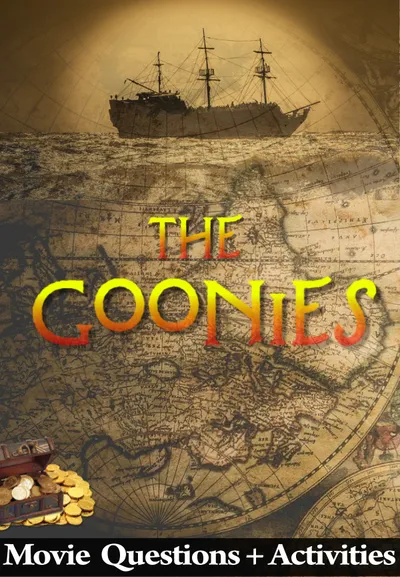
By Mr Hull's Movie Guides
Watch the Trailer
What's Inside the Guide
This is a 16-page classroom-ready resource.
A writing task about pirates in general, completed before the movie begins. Students have around 20 minutes to write, after which the guide suggests going around the room to share answers before starting the movie. Example answers are included.
Two differentiated sets of 26 questions each, in chronological order. Answer keys are included for both sets.
- Full sentence answer question set.
- Multiple choice question set with three options per question, written to work well with ESL and ELL students.
This part covers two activities.
- A short paragraph about each of the Goonies, with example answers included for the character analysis.
- A 9-scene storyboard illustrating key events from the movie, with a short written description for each scene, used to write a synopsis of the movie in their own words.
Designed for early finishers. Students complete a crossword first, then use the crossword answers as the word list for the word search. Answer keys are included for both.
“Great resource for a great movie! Even though some of my students had already seen the movie, this resource really forced them to pay attention. ”
— Kristina F.
“Great resource for a unit I had to design for some students who were technically below our current level. Fit right into my bigger unit, and was a fantastic material for them.”
— Dani C.
Why Watch This Movie With Your Students
Here's what your students naturally take away from the movie, whether through themes, values, ideas, or perspectives.
🗺️ A treasure hunt with real consequences. The Goonies are not adventuring for fun. They are trying to save their homes from being demolished. That stakes-driven motivation gives the treasure hunt a purpose that students can understand immediately. The adventure is exciting, but there is something genuine underneath it.
👥 An ensemble cast where every character has a role. Mikey is the dreamer, Brand is the reluctant older brother, Data is the gadget inventor, Mouth is the talker, Chunk is the heart of the group. Each character brings something different, and students tend to find at least one they identify with. The group dynamic is what drives the story.
⚙️ Booby traps, underground caverns, and a pirate ship. The set design and practical effects in The Goonies are ambitious for their time. Students are taken through skeleton-filled chambers, an organ built from bones, a marble chute, and a waterslide that leads to a full-scale pirate ship. The movie rewards attention, which is useful in a classroom setting.
🤝 Friendship and loyalty tested under pressure. The group argues, panics, and doubts each other throughout. What keeps them together is loyalty rather than agreement. The relationship between Mikey and Brand, and between Chunk and Sloth, gives the movie its emotional weight alongside the adventure.
🏘️ A story about community and belonging. The Goonies are outsiders in their own town, and they know their neighbourhood is being taken from them by people with more money and power. That sense of fighting for something you belong to gives the movie a layer that goes beyond the treasure hunt.
🏴☠️ Pirates as a subject students already have opinions about. The pirate genre carries cultural weight that students bring into the room with them. One-Eyed Willy is a specific invention of the movie, but the idea of buried treasure, booby traps, and a legendary pirate ship taps into something students already find compelling. That readiness to engage is worth something in a classroom.
Age Suitability and Content
This movie is rated PG.
⚠️ Things to be aware of:
- Language: Frequent strong language throughout, including multiple uses of 's--t' and 'bulls--t' from both children and adults, as well as 'damn', 'goddamn', 'ass', and 'hell'. Common Sense Media notes this language is significant and more than the PG rating now implies.
- Violence and scariness: The movie opens with a shootout. Children are in sustained peril throughout, pursued by criminals. The underground caverns contain crushed and impaled skeletons. One character discovers a frozen dead body. Death and injury are repeatedly threatened. Some sequences may be intense for younger or more sensitive students.
- Sexual content: A teen boy adjusts a mirror to see up a teen girl's skirt without her consent. Kissing between teenage characters. Off-colour humour involving a nude classical statue's genitalia. Panties are briefly visible in the mirror scene.
- Alcohol, drugs, and smoking: Not present.
- Other: A character named Sloth has a facial difference and is kept chained in a basement by his own family, treated as a monster. The film also includes fat-phobic jokes directed at a character named Chunk, and the character Data falls into a 'geeky Asian' stereotype. The Fratelli family is portrayed as a stereotype of Italian Americans as criminals. Teachers may wish to be aware of these elements.
📋 A free editable parent permission slip is available for this movie. It explains the educational benefits of watching movies in class and includes a space for parental consent. → Download Free Permission Slip on TpT (Free resource)
Note for educators: Movie details and age ratings in this post are sourced from IMDb, Common Sense Media, and Wikipedia to help ensure accuracy.
How My Movie Guide Helps You Teach It
Click your subject below to see how this guide supports it:
📚 English Language Arts Teachers
🗣️ ESL and ELL Teachers
🎬 Substitute Teachers and Cover Lessons
🏠 Homeschool Parents
🌟 Supporting All Learners A movie gives students a story to follow, and the guide gives them questions to work through as they watch. For students with autism, learning difficulties, and mild to severe disabilities, that combination provides a clear focus for the lesson and a concrete way to show understanding. The format can be useful in special education and learning support classrooms, where teachers need activities that give students a defined task during viewing. Find out more about why movies work for diverse learners.
How These Guides Work: From Movie to Lesson
Watching a movie is not a break from learning. It reaches students through sight, sound, and story at once, engaging the brain in ways text alone does not, and the structured work around it is what turns the viewing into a genuine lesson. You can read the research behind this on the Why Movies Work page.
- A Teacher Notes and General Directions page opens the guide with a brief overview of everything inside: what the movie is about, then each part of the guide in order with a short description of what it entails. You know what to expect from the whole resource before you hand out a single page, so you can pick up the guide cold and teach it the same day.
- Answer keys are included for the comprehension question sets, so grading is quick and you are not rewatching the movie to check answers. Some guides also include example answers for the creative and written activities.
- Print and go: classroom ready, with no additional preparation needed. Print one the morning you need it and the lesson is ready.
- Substitute and first-timer friendly. A guide can be handed to a substitute or picked up by a teacher covering the topic for the first time. Nobody running the session needs to have seen the movie.
- Differentiated comprehension sets. Most guides include two or three question sets at different difficulty levels, and most include a multiple-choice option that works well for ESL and ELL students. One class set covers your strongest readers, your strugglers, and your language learners without separate prep.
- Activities that go beyond recall. Each guide includes structured activities that ask students to engage with the movie, not just watch it, ranging from creative and written tasks to discussion and critical thinking questions depending on the guide. That variety matters in a mixed classroom: a student who freezes on a written question set may show real understanding through a drawing or a creative task, and a confident writer gets room to go beyond recall. For the teacher, it turns a movie session into work you can grade: comprehension questions show whether students followed the plot, and the activities beyond them show whether they understood it.