By Mr Hull's Movie Guides
What's Inside the Guide
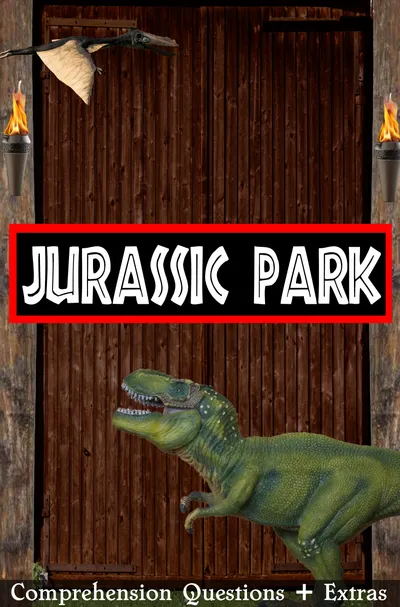
This is a 12-page classroom-ready resource.
Two differentiated sets of questions covering the full movie in chronological order. Answer keys are included for both sets.
- 30 question set requiring full sentence answers.
- 30 multiple choice question set with three possible answers each.
- A 9-scene storyboard where students illustrate and summarise key events in order.
- A structured synopsis of the movie, written using their completed storyboard, practising narrative organisation and written expression.
This part covers three activities.
- Designing a new enclosure for one of the dinosaurs and labeling important features with explanations.
- A recount from the perspective of a lucky guest visiting the park before it reopens.
- Creating a new dinosaur species by mixing DNA and completing a profile for their creation.
“I used this to enforce the concepts of biotechnology using Jurassic park. This allowed students to following along and the creative assignments allowed my artistic students to show their skills.”
— Alyssa R.
“My students really enjoyed the creative activities. It was a nice mix of comprehension and application activities. Great resource! Thank you!”
— Katie K.
Why Watch This Movie With Your Students
Here's what your students naturally take away from the movie, whether through themes, values, ideas, or perspectives.
🧬 The science is the story. Jurassic Park is built on a real scientific concept: the idea of extracting DNA from prehistoric blood preserved in amber. The movie engages students in questions about genetics and cloning in a way that feels urgent rather than abstract. Dr Ian Malcolm's warnings about chaos theory and the limits of human control give the science a philosophical dimension that sticks.
🦖 The dinosaurs are still convincing. The visual effects won the Academy Award for Best Visual Effects in 1994 and hold up well enough that students rarely question them. The T-Rex reveal in the rain is one of the most effective sequences in blockbuster cinema, and the velociraptor kitchen scene is genuinely tense in a way that keeps even reluctant viewers watching.
⚠️ It asks whether we should, not just whether we can. The moral question at the centre of the movie is not whether cloning dinosaurs is possible but whether it is wise. Jeff Goldblum's Ian Malcolm argues throughout that the park's creators were so focused on what they could achieve that they never stopped to consider the consequences. That tension between scientific capability and ethical responsibility is a conversation worth having in class.
👧 The children are central to the story. Lex and Tim are not background characters. They are in the middle of the danger for most of the movie, and they solve problems that adults cannot. Students respond to seeing young people portrayed as capable and brave under pressure, and it keeps them invested in the outcome.
📖 It is based on a novel worth knowing about. Michael Crichton's 1990 novel goes much deeper into the science and the ethics than the movie has time for. The adaptation makes interesting choices about what to keep and what to change, which makes it a useful comparison for older students studying how stories move between formats.
🌿 Nature wins. By the end of the movie, the park is a ruin and the scientists are lucky to be alive. The movie does not frame this as a disaster so much as an inevitable consequence of trying to control something that was never meant to be controlled. That message, that nature will find a way regardless of human plans, resonates well beyond the classroom.
Age Suitability and Content
This movie is rated PG-13.
⚠️ Things to be aware of:
- Violence: People and animals are hunted and eaten by dinosaurs throughout the movie. There are multiple deaths, several jump-scares, and extended chase sequences. One scene involves a severed arm. There is little blood or gore, but the threat level is high and sustained.
- Language: Infrequent swearing includes 'shit,' 'hell,' 'damn,' 'son of a bitch,' and 'goddamn.' Some mild potty humour.
- Drinking and smoking: A character smokes cigarettes in several scenes. Adults drink in a few scenes. Neither is depicted as significant.
- Sex and nudity: Women in bikinis briefly visible on a computer screen. Mild flirtation between adult characters. No sexual content.
- No drug use.
📋 A free editable parent permission slip is available for this movie. It explains the educational benefits of watching movies in class and includes a space for parental consent. → Download Free Permission Slip on TpT (Free resource)
Note for educators: Movie details and age ratings in this post are sourced from IMDb, Common Sense Media, and Wikipedia to help ensure accuracy.
How My Movie Guide Helps You Teach It
Click your subject below to see how this guide supports it:
📚 English Language Arts Teachers
🗣️ ESL and ELL Teachers
🔬 Science Teachers
🎬 Substitute Teachers and Cover Lessons
🏠 Homeschool Parents
🔭 STEM Teachers
🌟 Supporting All Learners A movie gives students a story to follow, and the guide gives them questions to work through as they watch. For students with autism, learning difficulties, and mild to severe disabilities, that combination provides a clear focus for the lesson and a concrete way to show understanding. The format can be useful in special education and learning support classrooms, where teachers need activities that give students a defined task during viewing. Find out more about why movies work for diverse learners.
How These Guides Work: From Movie to Lesson
Watching a movie is not a break from learning. It reaches students through sight, sound, and story at once, engaging the brain in ways text alone does not, and the structured work around it is what turns the viewing into a genuine lesson. You can read the research behind this on the Why Movies Work page.
- A Teacher Notes and General Directions page opens the guide with a brief overview of everything inside: what the movie is about, then each part of the guide in order with a short description of what it entails. You know what to expect from the whole resource before you hand out a single page, so you can pick up the guide cold and teach it the same day.
- Answer keys are included for the comprehension question sets, so grading is quick and you are not rewatching the movie to check answers. Some guides also include example answers for the creative and written activities.
- Print and go: classroom ready, with no additional preparation needed. Print one the morning you need it and the lesson is ready.
- Substitute and first-timer friendly. A guide can be handed to a substitute or picked up by a teacher covering the topic for the first time. Nobody running the session needs to have seen the movie.
- Differentiated comprehension sets. Most guides include two or three question sets at different difficulty levels, and most include a multiple-choice option that works well for ESL and ELL students. One class set covers your strongest readers, your strugglers, and your language learners without separate prep.
- Activities that go beyond recall. Each guide includes structured activities that ask students to engage with the movie, not just watch it, ranging from creative and written tasks to discussion and critical thinking questions depending on the guide. That variety matters in a mixed classroom: a student who freezes on a written question set may show real understanding through a drawing or a creative task, and a confident writer gets room to go beyond recall. For the teacher, it turns a movie session into work you can grade: comprehension questions show whether students followed the plot, and the activities beyond them show whether they understood it.