By Mr Hull's Movie Guides

Watch the Trailer
Why Watch This Movie With Your Students
Here's what your students naturally take away from the movie, whether through themes, values, ideas, or perspectives.
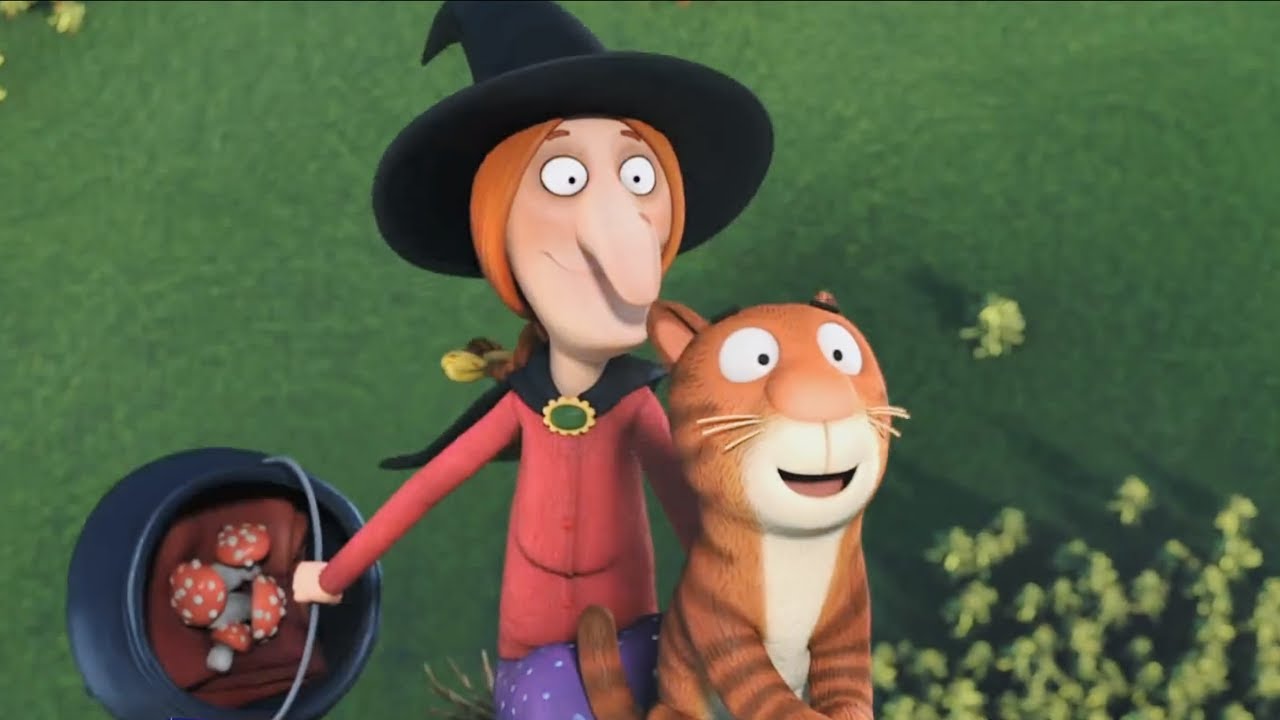
🧙 Kindness that comes back around. The witch's generosity toward the animals she meets is repaid directly when they save her from the dragon. Students see a clear, cause and effect example of how helping others can come back to help you.
🐸 A repeating story structure. The same pattern, losing something, meeting an animal, and inviting them aboard, repeats three times before the story's turning point, giving younger students an easy structure to predict and follow along with.
🐱 A jealous cat learns to share. The witch's cat grows increasingly annoyed as more animals join the broom, giving students a relatable, low stakes example of learning to accept and welcome others.
🐉 A brief moment of real tension. The dragon's appearance introduces genuine, if short lived, peril into an otherwise gentle story, giving students a small taste of suspense before the story resolves happily.
📖 A faithful book to movie adaptation. As a close adaptation of Julia Donaldson's popular picture book, the movie pairs naturally with a classroom read aloud of the original story for a book to movie comparison.
Age Suitability and Content
This movie is rated G.
⚠️ Things to be aware of:
- A dragon captures the witch and threatens to eat her, which may be briefly frightening for younger or more sensitive viewers, though the moment resolves quickly and happily.
- No sexual content, strong language, or substance use.
Note for educators: Movie details and age ratings in this post are sourced from IMDb, Common Sense Media, and Wikipedia to help ensure accuracy.
How My Movie Guide Helps You Teach It
📚 English Language Arts Teachers. The movie's short runtime, repeating structure, and rhyming narration make it a strong fit for an ELA class working on sequencing and comprehension with younger readers. The guide's four differentiated comprehension question sets and storyboard task give students multiple ways to demonstrate understanding, and the acrostic writing activity ties directly to the movie's title.
🗣️ ESL and ELL Teachers. The multiple choice question sets, available in both 15 and 30 question versions, work well for ESL and ELL students, giving them a lower-barrier way to follow the story's simple, repeating plot. The storyboard task also gives language learners a way to demonstrate understanding of the sequence of events without relying solely on written English.
🎬 Substitute Teachers and Cover Lessons. Hand it to a substitute and walk away. The four differentiated comprehension question sets, storyboard, and writing activities all come with clear instructions, and answer keys are included for the comprehension questions, so a substitute can run the full session without having seen the movie.
🏠 Homeschool Parents. Room on the Broom's short runtime and gentle story make it an easy addition to a home learning day, especially alongside a reading of Julia Donaldson's original picture book. The guide's acrostic writing activity and favorite character drawing task work well for a single student, and the differentiated comprehension questions let them work at whatever level suits them.
🌟 Supporting All Learners Movie guides can be a wonderfully calm fit for students with autism, learning difficulties, and mild to severe disabilities. The structured format gives every student a clear purpose during viewing, easing uncertainty and allowing them to engage at their own pace. If you teach in a special education or learning support setting, you may find this guide a gentle and practical resource. Find out more about why movies work for diverse learners.
What's Inside the Guide
This is a 12-page classroom-ready resource.
Four differentiated sets of chronological comprehension questions. Answer keys are included for all sets.
- 15 question multiple choice version.
- 30 question multiple choice version.
- 15 question full sentence version.
- 30 question full sentence version.
Students create a 9-scene storyboard illustrating pivotal events from the movie, with a short description explaining the main idea of each scene, using the comprehension questions to help guide the sequencing.
This part covers two activities.
- Writing sentences using the beginning letters of the words ROOM ON THE BROOM, with an example given for the first one, followed by writing about a time they felt happy, sad, or excited while watching the movie.
- Drawing their favorite character and writing about them using guided question prompts.
“My students had a blast with this resource!”
— Teaching Upon Grace (TPT Seller)
“So cute!”
— Gardners Gang (TPT Seller)
How These Guides Work: From Movie to Lesson
Watching a movie is not a break from learning. It reaches students through sight, sound, and story at once, engaging the brain in ways text alone does not, and the structured work around it is what turns the viewing into a genuine lesson. You can read the research behind this on the Why Movies Work page.
- A Teacher Notes and General Directions page opens the guide with a brief overview of everything inside: what the movie is about, then each part of the guide in order with a short description of what it entails. You know what to expect from the whole resource before you hand out a single page, so you can pick up the guide cold and teach it the same day.
- Answer keys are included for the comprehension question sets, so grading is quick and you are not rewatching the movie to check answers. Some guides also include example answers for the creative and written activities.
- Print and go: classroom ready, with no additional preparation needed. Print one the morning you need it and the lesson is ready.
- Substitute and first-timer friendly. A guide can be handed to a substitute or picked up by a teacher covering the topic for the first time. Nobody running the session needs to have seen the movie.
- Differentiated comprehension sets. Most guides include two or three question sets at different difficulty levels, and most include a multiple-choice option that works well for ESL and ELL students. One class set covers your strongest readers, your strugglers, and your language learners without separate prep.
- Activities that go beyond recall. Each guide includes structured activities that ask students to engage with the movie, not just watch it, ranging from creative and written tasks to discussion and critical thinking questions depending on the guide. That variety matters in a mixed classroom: a student who freezes on a written question set may show real understanding through a drawing or a creative task, and a confident writer gets room to go beyond recall. For the teacher, it turns a movie session into work you can grade: comprehension questions show whether students followed the plot, and the activities beyond them show whether they understood it.