By Mr Hull's Movie Guides
Watch the Trailer

What's Inside the Guide
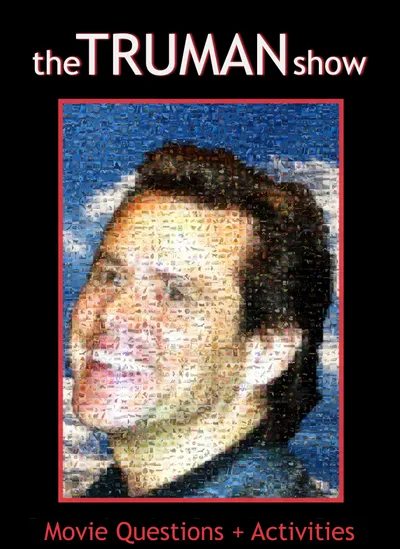
This is a 17-page classroom-ready resource.
Two differentiated sets of comprehension questions in chronological order. Answer keys are included for both sets.
- 30 question set requiring full sentence answers.
- 29 multiple choice question set with 3 possible answers, plus 1 additional full sentence answer question. The multiple choice set works well for ESL and ELL students.
This part covers two activities. Example answers are included for the discussion questions.
- Five critical thinking questions connecting the movie to society, answered in pairs before coming together as a class to discuss and debate each question.
- A brief overview of Plato's Allegory of the Cave alongside five comparative questions, asking students to analyze how Truman's journey out of the studio set mirrors the journey of the prisoner leaving the cave to find the truth.
- A nine scene storyboard illustrating key events in chronological order, identifying the main idea of each scene while building sequencing and plot understanding skills.
- A structured plot summary of the movie, written using their completed storyboard as a guide, reinforcing narrative organization and clear written expression.
This part covers three activities.
- Designing a new character to interact with Truman, providing a name, a sketch, and a background profile, then explaining how the character is introduced and their specific role in the show.
- A fan letter to one of the actors from the perspective of a dedicated viewer, including specific reasons and evidence to prove they are the show's biggest fan.
- Outlining the sequence of events and preparations Truman used to escape, explaining how he managed his secret rehearsals while convincing the audience his behavior was normal.
“Love the range of activities in this product. It is nice to have the short answer to use a movie watching guide and then the long answer reflection page. Kids loved the crossword too.”
— Jennifer B.
“The activities and study guide questions are rigorous without being overwhelming. My students really enjoyed the create-a-character activity!”
— Samantha M.
Why Watch This Movie With Your Students
Here's what your students naturally take away from the movie, whether through themes, values, ideas, or perspectives.
📺 A life built entirely for an audience. Truman has no idea that every person in his life is an actor and every event around him has been staged for a global television audience since the day he was born. Students get a stark, concrete example of a life shaped by observation rather than genuine choice.
🔍 Small inconsistencies that build into real doubt. The story never hands Truman one big reveal, instead letting him notice a repeated jogger, a studio light falling from the sky, and other tiny cracks that eventually add up to real suspicion. It gives students a model for how skepticism develops, piece by piece rather than all at once.
🌊 A fear used to keep someone contained. Truman's fear of water, planted after a staged childhood tragedy, functions as an invisible wall keeping him from ever leaving Seahaven. Students can examine how control does not always look like a locked door, sometimes it looks like a carefully installed fear.
🏛️ A story that mirrors a two-thousand-year-old philosophical idea. Truman's situation, a person raised entirely inside a constructed reality who has to decide whether to leave it once he suspects the truth, closely parallels Plato's Allegory of the Cave. It gives students a way to see an old philosophical idea play out in a story they can watch.
🚪 A choice between comfort and truth. When Truman finally reaches the edge of his world, he is offered the option to stay in a safe, curated life or step into an uncertain, unscripted one. Students are left to weigh which choice they would make themselves.
🎭 A satire that still lands decades later. The movie pokes fun at product placement, manufactured spectacle, and audiences who watch someone's entire life for entertainment, ideas that only became more relevant as media changed after the movie's release. Students can examine how a piece of satire can end up describing the future more accurately than its own present.
Age Suitability and Content
This movie is rated PG.
⚠️ Things to be aware of:
- Moderate language throughout, including several uses of a stronger swear word and other mild profanities.
- A flashback shows a character's father apparently drowning during a storm, and a later storm puts the main character in serious danger at sea.
- Tense scenes involving arguing, pushing, and a sharp object briefly held near a character's neck.
- Characters are shown drinking beer and smoking cigarettes at several points.
- Sexual content is limited to kissing, close dancing, and brief innuendo, with no nudity shown.
📋 A free editable parent permission slip is available for this movie. It explains the educational benefits of watching movies in class and includes a space for parental consent. → Download Free Permission Slip on TpT (Free resource)
Note for educators: Movie details and age ratings in this post are sourced from IMDb, Common Sense Media, and Wikipedia to help ensure accuracy.
How My Movie Guide Helps You Teach It
Click your subject below to see how this guide supports it:
📚 English Language Arts Teachers
🗣️ ESL and ELL Teachers
🌐 Social Studies Teachers
🎬 Substitute Teachers and Cover Lessons
🏠 Homeschool Parents
🎭 Theater Teachers
🌟 Supporting All Learners A movie gives students a story to follow, and the guide gives them questions to work through as they watch. For students with autism, learning difficulties, and mild to severe disabilities, that combination provides a clear focus for the lesson and a concrete way to show understanding. The format can be useful in special education and learning support classrooms, where teachers need activities that give students a defined task during viewing. Find out more about why movies work for diverse learners.
How These Guides Work: From Movie to Lesson
Watching a movie is not a break from learning. It reaches students through sight, sound, and story at once, engaging the brain in ways text alone does not, and the structured work around it is what turns the viewing into a genuine lesson. You can read the research behind this on the Why Movies Work page.
- A Teacher Notes and General Directions page opens the guide with a brief overview of everything inside: what the movie is about, then each part of the guide in order with a short description of what it entails. You know what to expect from the whole resource before you hand out a single page, so you can pick up the guide cold and teach it the same day.
- Answer keys are included for the comprehension question sets, so grading is quick and you are not rewatching the movie to check answers. Some guides also include example answers for the creative and written activities.
- Print and go: classroom ready, with no additional preparation needed. Print one the morning you need it and the lesson is ready.
- Substitute and first-timer friendly. A guide can be handed to a substitute or picked up by a teacher covering the topic for the first time. Nobody running the session needs to have seen the movie.
- Differentiated comprehension sets. Most guides include two or three question sets at different difficulty levels, and most include a multiple-choice option that works well for ESL and ELL students. One class set covers your strongest readers, your strugglers, and your language learners without separate prep.
- Activities that go beyond recall. Each guide includes structured activities that ask students to engage with the movie, not just watch it, ranging from creative and written tasks to discussion and critical thinking questions depending on the guide. That variety matters in a mixed classroom: a student who freezes on a written question set may show real understanding through a drawing or a creative task, and a confident writer gets room to go beyond recall. For the teacher, it turns a movie session into work you can grade: comprehension questions show whether students followed the plot, and the activities beyond them show whether they understood it.