By Mr Hull's Movie Guides
Watch the Trailer

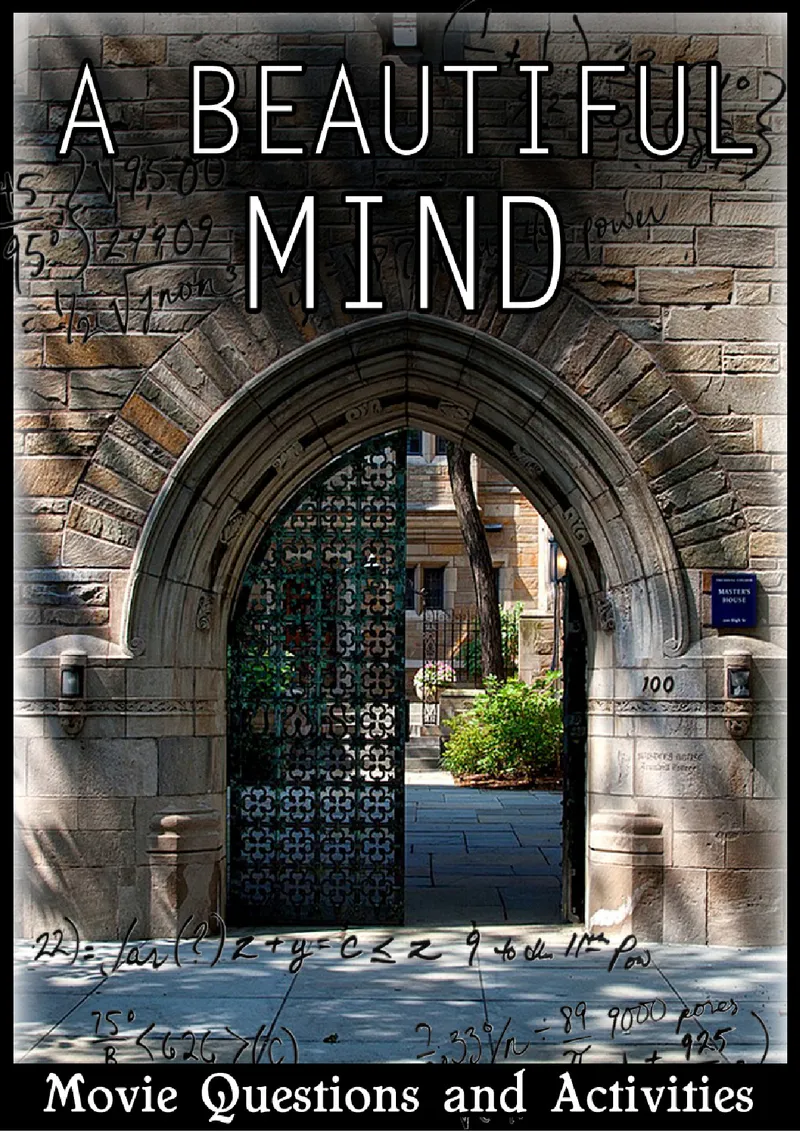
What's Inside the Guide
This is a 15-page classroom-ready resource.
Two differentiated sets of questions in chronological order. Answer keys included for both sets.
- 25 question set requiring full sentence answers.
- 25 multiple choice question set with 3 possible answers, suited to differentiation and ESL students.
- A 9-scene storyboard illustrating pivotal events from the movie, with a short description for each scene.
- A synopsis of the movie, written using their completed storyboard as a guide, in their own words.
This part covers four linked tasks.
- Analytical Short Answers: 3 questions exploring Nash's bar theory, his paranoia, and his approach to medication, with example answers included.
- The Parcher Report: a creative essay task requiring students to write a Cold War-era coded report from Nash's perspective.
- Real vs. Reel: a comparison T-chart contrasting the movie's portrayal with the actual historical life of John Nash.
- Game Theory Challenge: a practical Prisoner's Dilemma activity applying Nash's Nobel Prize-winning logic to a real-world scenario.
“I love this resource to keep my students engaged in the movie. They were asking questions and paying close attention to be able to answer the questions. I like how it goes in order of the movie so the students are able to answer the questions along the way. I have used this resource several times now.”
— Corstiana P.
“I used this movie in Psych class. The students really enjoyed the film and the activity. Great resource!”
— Mac History Lessons
Why Watch This Movie With Your Students
Here's what your students naturally take away from the movie, whether through themes, values, ideas, or perspectives.
🧠 A portrait of mental illness that is honest without being sensational. The movie depicts schizophrenia through Nash's perspective, which means students do not watch his illness from a safe distance. The hallucinations feel real because the movie presents them as real, and the moment the truth becomes clear is genuinely disorienting. That experience gives students something more useful than a textbook description.
🔢 Mathematical genius made visible and human. Nash's mind is shown at work throughout the movie, and the movie earns genuine respect for what he achieves. Students who have never considered what it might feel like to see patterns and connections that no one else can see come away with a different sense of what mathematical thinking is.
❄️ The Cold War as a lived experience, not a history lesson. Nash's work and his apparent recruitment by the US government place him at the centre of Cold War anxieties about Soviet espionage and nuclear threat. The paranoia of the era bleeds directly into his personal experience, which makes the historical context feel immediate rather than distant.
💍 A marriage tested in ways students do not expect. Alicia Nash's decision to stay with John through decades of illness, institutionalisation, and uncertainty is the emotional backbone of the movie. Her story raises questions about loyalty, love, and what it means to support someone who is suffering, which students tend to find more affecting than the mathematical plot.
🏆 A true story with a genuinely earned ending. Nash received the Nobel Prize in Economics in 1994, more than thirty years after his breakdown. The movie earns that ending because it does not pretend the road to it was straightforward. Students see a life that was genuinely difficult, which makes the final scenes land differently than a conventional triumph would.
🌀 The movie itself asks students to think critically about what they are watching. Because the narrative is constructed from Nash's unreliable perspective, students cannot simply accept what they see on screen. The movie rewards active watching and raises questions about how stories are told and whose point of view shapes what we believe to be true.
Age Suitability and Content
This movie is rated PG-13.
⚠️ Things to be aware of:
- Schizophrenia and psychosis are depicted throughout, including extended hallucination sequences, paranoid delusions, and a prolonged breakdown. These scenes are presented from Nash's perspective and may be unsettling for some students.
- One brief, partially seen sexual encounter between Nash and Alicia. Non-graphic and not lingered on.
- Moderate violence: a car chase with gunfire, a physical altercation between Nash and a colleague, and a scene in which Nash accidentally knocks Alicia and their infant against a wall during a psychotic episode. No gore.
- Nash briefly bangs his head against a window in frustration. No serious injury shown.
- Mild language including 'damn', 'hell', and a small number of stronger words.
- Nash is shown receiving insulin shock therapy and taking psychiatric medication. His struggle with medication side effects is a recurring theme.
- No drug use. No sustained sexual content beyond the above.
📋 A free editable parent permission slip is available for this movie. It explains the educational benefits of watching movies in class and includes a space for parental consent. → Download Free Permission Slip on TpT (Free resource)
Note for educators: Movie details and age ratings in this post are sourced from IMDb, Common Sense Media, and Wikipedia to help ensure accuracy.
How My Movie Guide Helps You Teach It
Click your subject below to see how this guide supports it:
📚 English Language Arts Teachers
🗣️ ESL and ELL Teachers
🌐 Social Studies Teachers
🎬 Substitute Teachers and Cover Lessons
🏠 Homeschool Parents
💙 SEL Teachers
📜 History Teachers
🔭 STEM Teachers
🌟 Supporting All Learners A movie gives students a story to follow, and the guide gives them questions to work through as they watch. For students with autism, learning difficulties, and mild to severe disabilities, that combination provides a clear focus for the lesson and a concrete way to show understanding. The format can be useful in special education and learning support classrooms, where teachers need activities that give students a defined task during viewing. Find out more about why movies work for diverse learners.
This guide is not a subject-specific curriculum resource for Maths, Science, or Social Studies. It works well for accountability during the movie and as a cross-curricular activity. The Maths task applies Nash's game theory logic practically, but the guide does not cover mathematical concepts in depth.
How These Guides Work: From Movie to Lesson
Watching a movie is not a break from learning. It reaches students through sight, sound, and story at once, engaging the brain in ways text alone does not, and the structured work around it is what turns the viewing into a genuine lesson. You can read the research behind this on the Why Movies Work page.
- A Teacher Notes and General Directions page opens the guide with a brief overview of everything inside: what the movie is about, then each part of the guide in order with a short description of what it entails. You know what to expect from the whole resource before you hand out a single page, so you can pick up the guide cold and teach it the same day.
- Answer keys are included for the comprehension question sets, so grading is quick and you are not rewatching the movie to check answers. Some guides also include example answers for the creative and written activities.
- Print and go: classroom ready, with no additional preparation needed. Print one the morning you need it and the lesson is ready.
- Substitute and first-timer friendly. A guide can be handed to a substitute or picked up by a teacher covering the topic for the first time. Nobody running the session needs to have seen the movie.
- Differentiated comprehension sets. Most guides include two or three question sets at different difficulty levels, and most include a multiple-choice option that works well for ESL and ELL students. One class set covers your strongest readers, your strugglers, and your language learners without separate prep.
- Activities that go beyond recall. Each guide includes structured activities that ask students to engage with the movie, not just watch it, ranging from creative and written tasks to discussion and critical thinking questions depending on the guide. That variety matters in a mixed classroom: a student who freezes on a written question set may show real understanding through a drawing or a creative task, and a confident writer gets room to go beyond recall. For the teacher, it turns a movie session into work you can grade: comprehension questions show whether students followed the plot, and the activities beyond them show whether they understood it.