By Mr Hull's Movie Guides
Watch the Trailer
What's Inside the Guide
This is a 17-page classroom-ready resource.
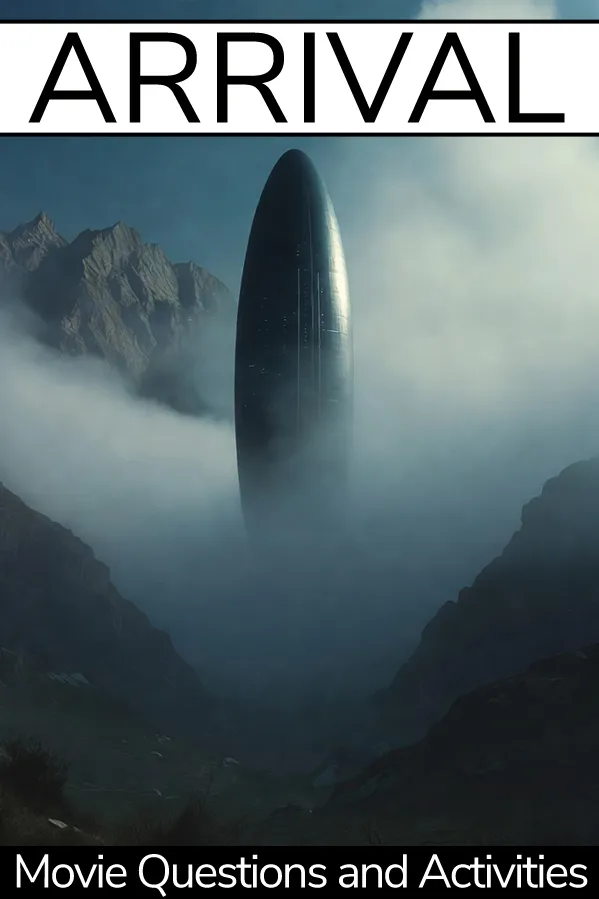
Before watching, students imagine what would happen if gigantic alien ships suddenly appeared around the world. The task asks them to choose emotional responses, predict how different people might react, answer critical thinking questions about the scenario, and draw what they think the alien ships and possibly the aliens might look like, with a short written description. It is designed to activate imagination and curiosity before the movie begins.
Three complete question sets covering the movie in chronological order. Answer keys are included for all three sets.
- 45 full-sentence question set, tracking the story from beginning to end.
- 30-question version, with 15 questions removed from the 45-question set.
- 30-question multiple-choice set with three options per question, suited to language learners or students who benefit from a more structured format.
Five deep reflection questions designed for pair or small group discussion. The questions explore the movie's main themes including communication, time and memory, fear, language, destiny, and human connection. Designed to be used after viewing, either as a spoken discussion activity or as a written response task.
This part covers three activities.
- Nine key scenes illustrated and described from the movie covering the beginning, middle, and end, with a short description of the main idea each scene represents.
- A synopsis of the movie, written using their storyboard as a guide, in their own words.
- A structured movie review including a rating, strengths, weaknesses, a recommendation, and a small poster design.
Why Watch This Movie With Your Students
Here's what your students naturally take away from the movie, whether through themes, values, ideas, or perspectives.
🗣️ Language as the central subject. This is a movie where a linguist is the hero and the ability to communicate is what saves the world. For ELA classrooms, that is an extraordinary hook. Language is not just a backdrop in this movie. It is the central subject, which makes it a natural fit for ELA classrooms
🧠 Genuinely challenges how students think. Arrival asks students to consider whether the language you speak shapes the way you think and experience time. This is based on real linguistic theory (the Sapir-Whorf hypothesis) and students who engage with it come away thinking differently about communication itself.
🌍 A powerful message about fear and conflict. The movie's central argument is that fear and miscommunication drive nations toward war, while patience, curiosity, and empathy offer a different path. For Social Studies classrooms, that is a discussion worth having in any year.
👩🔬 A strong female lead in a STEM role. Louise Banks is intelligent, methodical, and determined. She approaches an impossible problem using the tools of her discipline. For students who rarely see that kind of character at the centre of a major science fiction movie, it is quietly significant.
⏳ Time and memory handled in an unexpected way. The way Arrival uses time in its storytelling catches most students off guard. It rewards attention and repays discussion. Students who think they understood it the first time often discover they missed something important.
✍️ A story that only gets richer the more you think about it. Arrival does not resolve neatly. The ending raises questions about choice, fate, and what we would do if we could see our future clearly. Those questions sit with students in a way that most movies do not manage.
Age Suitability and Content
This movie is rated PG-13.
⚠️ Things to be aware of:
- A young girl is shown dying from a serious illness across several flashback scenes, including hospital settings. Emotionally intense and likely to affect sensitive students
- Scenes of global panic, civil unrest, and rioting shown in news footage style
- Mild language including four uses of the f-word, which is the primary reason for the PG-13 rating, plus damn, hell, and bastard
- An adult character drinks wine at home
- Tense military standoff sequences with implied threat of global conflict
- The movie's non-linear structure and philosophical themes may be disorienting for some students on first viewing
- No sexual content. A man and woman form a bond culminating in a hug
📋 A free editable parent permission slip is available for this movie. It explains the educational benefits of watching movies in class and includes a space for parental consent. → Download Free Permission Slip on TpT (Free resource)
Note for educators: Movie details and age ratings in this post are sourced from IMDb, Common Sense Media, and Wikipedia to help ensure accuracy.
How My Movie Guide Helps You Teach It
Click your subject below to see how this guide supports it:
📚 English Language Arts Teachers
🗣️ ESL and ELL Teachers
🔬 Science Teachers
🌐 Social Studies Teachers
🎬 Substitute Teachers and Cover Lessons
🏠 Homeschool Parents
🌟 Supporting All Learners A movie gives students a story to follow, and the guide gives them questions to work through as they watch. For students with autism, learning difficulties, and mild to severe disabilities, that combination provides a clear focus for the lesson and a concrete way to show understanding. The format can be useful in special education and learning support classrooms, where teachers need activities that give students a defined task during viewing. Find out more about why movies work for diverse learners.
This guide is built around the movie's narrative and themes. The science and social studies connections are genuine but the guide is not tied to specific subject-area curriculum standards. For those teachers it works best alongside your own subject materials as an accountability and engagement tool during viewing.
How These Guides Work: From Movie to Lesson
Watching a movie is not a break from learning. It reaches students through sight, sound, and story at once, engaging the brain in ways text alone does not, and the structured work around it is what turns the viewing into a genuine lesson. You can read the research behind this on the Why Movies Work page.
- A Teacher Notes and General Directions page opens the guide with a brief overview of everything inside: what the movie is about, then each part of the guide in order with a short description of what it entails. You know what to expect from the whole resource before you hand out a single page, so you can pick up the guide cold and teach it the same day.
- Answer keys are included for the comprehension question sets, so grading is quick and you are not rewatching the movie to check answers. Some guides also include example answers for the creative and written activities.
- Print and go: classroom ready, with no additional preparation needed. Print one the morning you need it and the lesson is ready.
- Substitute and first-timer friendly. A guide can be handed to a substitute or picked up by a teacher covering the topic for the first time. Nobody running the session needs to have seen the movie.
- Differentiated comprehension sets. Most guides include two or three question sets at different difficulty levels, and most include a multiple-choice option that works well for ESL and ELL students. One class set covers your strongest readers, your strugglers, and your language learners without separate prep.
- Activities that go beyond recall. Each guide includes structured activities that ask students to engage with the movie, not just watch it, ranging from creative and written tasks to discussion and critical thinking questions depending on the guide. That variety matters in a mixed classroom: a student who freezes on a written question set may show real understanding through a drawing or a creative task, and a confident writer gets room to go beyond recall. For the teacher, it turns a movie session into work you can grade: comprehension questions show whether students followed the plot, and the activities beyond them show whether they understood it.