By Mr Hull's Movie Guides
Watch the Trailer

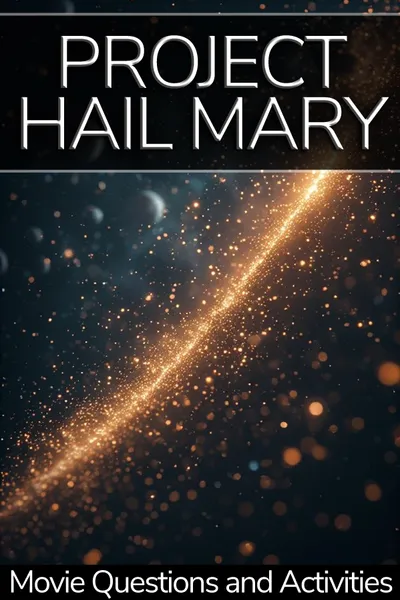
What's Inside the Guide
This is a 23-page classroom-ready resource.
Students use imagination and prior knowledge to think critically about how the world might respond to an unexplained anomaly slowly draining the Sun's energy. Includes problem-solving questions, critical thinking about global crisis and personal sacrifice, and a creative drawing task.
All answer keys included
- 58 questions requiring full sentence answers
- 40 questions requiring full sentence answers (the same set with 18 questions removed)
- 40 multiple choice questions with 3 possible answers each
Five reflection questions exploring themes of friendship, sacrifice, identity and communication, with example answers included. Designed for individual reflection or class discussion.
Students complete a table on Joseph Campbell's 12 stages, identifying how Grace's story follows the Hero's Journey. Includes space for notes and drawings, guiding questions, and an archetype identification task (Hero, Mentor, Shadow, Ally, Shapeshifter).
A 9-scene storyboard task with descriptions, a synopsis writing task using the storyboard as a guide, and a structured movie review with rating, strengths, weaknesses, recommendation, and a poster design.
A two-page supplementary section for classes that have read Andy Weir's novel. Section 1 is completed before viewing, and Sections 2 to 5 are completed after. Can be skipped entirely if you're only watching the movie.
“I enjoyed finding one on line I could use on a current film.”
— Patricia S.
Why Watch This Movie With Your Students
Here's what your students naturally take away from the movie, whether through themes, values, ideas, or perspectives.
🔬 Real scientific thinking in action. Grace doesn't solve problems with a superpower. He solves them with curiosity, patience, and the scientific method. Students see hypotheses tested, mistakes made, and solutions found through persistence. It is a genuinely positive portrayal of scientific thinking.
🌍 Sacrifice and the bigger picture. Grace didn't volunteer for this mission. He was forced into it, yet rises to the challenge. The movie raises powerful questions about duty, responsibility, and what we owe to each other when the stakes are existential.
🤝 Friendship across difference. At the heart of the movie is the relationship between Grace and Rocky, an alien from a completely different world with different senses, language, and biology. Watching them find a way to communicate and cooperate is an affecting story of connection that students respond to strongly.
🧠 Identity and memory. Grace rebuilds his sense of self from nothing, piece by piece. The movie opens deep questions about what makes us who we are, perfect for older students ready to think philosophically.
🦸 A story that rewards close attention. Grace's memory returns in fragments, and the movie cuts between past and present in a way that keeps students actively piecing things together. It is the kind of structure that rewards attention and makes rewatching genuinely worthwhile.
Age Suitability and Content
This movie is rated PG-13.
⚠️ Things to be aware of:
- Two crew members die (shown as bodies discovered, not graphically)
- Themes of global catastrophe and potential extinction
- Mild peril and tension throughout
- No strong language or sexual content
📋 A free editable parent permission slip is available for this movie. It explains the educational benefits of watching movies in class and includes a space for parental consent. → Download Free Permission Slip on TpT (Free resource)
Note for educators: Movie details and age ratings in this post are sourced from IMDb, Common Sense Media, and Wikipedia to help ensure accuracy.
How My Movie Guide Helps You Teach It
Click your subject below to see how this guide supports it:
📚 English Language Arts Teachers
🗣️ ESL and ELL Teachers
🔬 Science Teachers
🌐 Social Studies Teachers
🎬 Substitute Teachers and Cover Lessons
🏠 Homeschool Parents
🔭 STEM Teachers
🌟 Supporting All Learners A movie gives students a story to follow, and the guide gives them questions to work through as they watch. For students with autism, learning difficulties, and mild to severe disabilities, that combination provides a clear focus for the lesson and a concrete way to show understanding. The format can be useful in special education and learning support classrooms, where teachers need activities that give students a defined task during viewing. Find out more about why movies work for diverse learners.
If you teach science or social studies and need curriculum-specific worksheets tied to your standards, this guide will not replace those. It is best used alongside your own subject materials to keep students focused during the movie itself.
How These Guides Work: From Movie to Lesson
Watching a movie is not a break from learning. It reaches students through sight, sound, and story at once, engaging the brain in ways text alone does not, and the structured work around it is what turns the viewing into a genuine lesson. You can read the research behind this on the Why Movies Work page.
- A Teacher Notes and General Directions page opens the guide with a brief overview of everything inside: what the movie is about, then each part of the guide in order with a short description of what it entails. You know what to expect from the whole resource before you hand out a single page, so you can pick up the guide cold and teach it the same day.
- Answer keys are included for the comprehension question sets, so grading is quick and you are not rewatching the movie to check answers. Some guides also include example answers for the creative and written activities.
- Print and go: classroom ready, with no additional preparation needed. Print one the morning you need it and the lesson is ready.
- Substitute and first-timer friendly. A guide can be handed to a substitute or picked up by a teacher covering the topic for the first time. Nobody running the session needs to have seen the movie.
- Differentiated comprehension sets. Most guides include two or three question sets at different difficulty levels, and most include a multiple-choice option that works well for ESL and ELL students. One class set covers your strongest readers, your strugglers, and your language learners without separate prep.
- Activities that go beyond recall. Each guide includes structured activities that ask students to engage with the movie, not just watch it, ranging from creative and written tasks to discussion and critical thinking questions depending on the guide. That variety matters in a mixed classroom: a student who freezes on a written question set may show real understanding through a drawing or a creative task, and a confident writer gets room to go beyond recall. For the teacher, it turns a movie session into work you can grade: comprehension questions show whether students followed the plot, and the activities beyond them show whether they understood it.