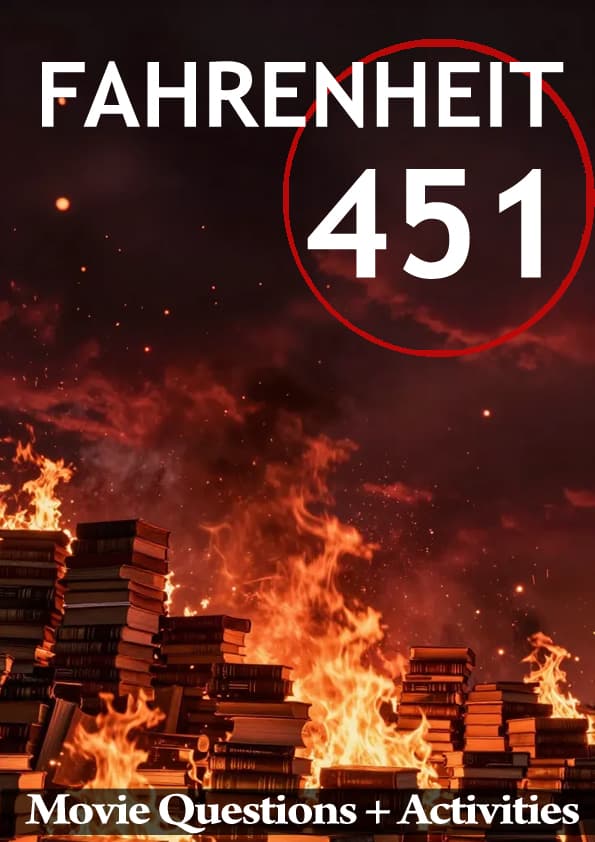
By Mr Hull's Movie Guides

Watch the Trailer

Why Watch This Movie With Your Students
Here's what your students naturally take away from the movie, whether through themes, values, ideas, or perspectives.
🔥 A society where firemen burn books instead of saving buildings. The central premise inverts something students take for granted, that firefighters protect things, into a system built on destruction. That inversion makes the logic of censorship and state control concrete and easy to examine.
📚 A close adaptation of the Ray Bradbury novel. Truffaut's 1966 version follows the source text more faithfully than later adaptations, making it a strong companion to a novel study. Students who have read the book can compare how each medium handles the same scenes, characters, and ideas.
🧍 A protagonist whose change of mind drives the entire story. Montag begins the movie as a true believer who finds real satisfaction in his work. His gradual questioning, then disillusionment, then active resistance gives students a clear character arc to track across the whole movie.
🏙️ A vision of conformity where entertainment has replaced thought. Montag's wife is absorbed in wall-sized television screens and has no interest in anything outside them. The contrast between her world and Clarisse's, or the book people's, makes the movie's argument about passivity and control visible and discussable.
🌲 An ending built around an unusual form of resistance. The people outside the city do not fight the government with weapons but by memorizing books, becoming living libraries. That image of preservation through memory gives students something specific and thought-provoking to consider as the movie closes.
Age Suitability and Content
This movie is rated PG.
⚠️ Things to be aware of:
- A woman sets herself on fire rather than let her books be taken, shown on screen.
- Montag kills a character using fire late in the movie.
- Mild violence in a small number of scenes, including a chase sequence.
- No significant language, sexual content, or drug use.
📋 A free editable parent permission slip is available for this movie. It explains the educational benefits of watching movies in class and includes a space for parental consent. → Download Free Permission Slip on TpT (Free resource)
Note for educators: Movie details and age ratings in this post are sourced from IMDb, Common Sense Media, and Wikipedia to help ensure accuracy.
How My Movie Guide Helps You Teach It
📚 English Language Arts Teachers. Fahrenheit 451 is a strong fit for ELA classes studying dystopian fiction, censorship, or book-to-movie adaptation, and works particularly well as a culminating activity after a novel study. The guide covers a wide range of writing tasks across its three parts, from differentiated comprehension questions through to creative narrative writing, with three question sets to support mixed-ability classes.
🗣️ ESL and ELL Teachers. The 30-question multiple choice set is well-suited to ESL and ELL students, offering structured answer choices that reduce writing demand while keeping students accountable to the movie's plot. The movie's deliberate pacing and clear visual storytelling also support language learners following a story with relatively little fast-moving dialogue.
🌐 Social Studies Teachers. The movie's portrait of a government that controls its population through the destruction of knowledge connects to Social Studies discussions of censorship, civil liberties, and the relationship between information and power. The guide does not include Social Studies-specific activities, but the comprehension questions and writing tasks keep students engaged with those themes throughout.
🎬 Substitute Teachers and Cover Lessons. The guide's three-part structure is clear enough to hand to a substitute teacher with minimal briefing. Students can work through their chosen question set independently while watching, and the answer keys make follow-up straightforward for the regular classroom teacher.
🏠 Homeschool Parents. Three differentiated question sets make it easy to match the guide to the student's level, and all three include answer keys for independent or parent-led review. The writing tasks in Parts 2 and 3 extend naturally into longer independent projects.
🌟 Supporting All Learners Movie guides can be a wonderfully calm fit for students with autism, learning difficulties, and mild to severe disabilities. The structured format gives every student a clear purpose during viewing, easing uncertainty and allowing them to engage at their own pace. If you teach in a special education or learning support setting, you may find this guide a gentle and practical resource. Find out more about why movies work for diverse learners.
What's Inside the Guide
This is a 14-page classroom-ready resource.
Part 1: Comprehension Questions
Three differentiated question sets in chronological order: 45 questions requiring full sentence answers, a shorter 30-question version with 15 questions removed, and a 30-question multiple choice set with 3 answer options per question. Answer keys are included for all three sets.
Part 2: Storyboard and Synopsis Writing
Students create a 9-scene storyboard illustrating pivotal events from the movie, with a short description for each scene explaining the main idea it represents. Using the completed storyboard as a guide, students then write a synopsis of the movie.
Part 3: Creative Writing
Two writing tasks. In the first, students imagine they live in a world where books are banned and can only hide five books in their apartment. They write about each book they choose and explain why they want to keep it. In the second, students write a first-person recount of a typical call-out from the perspective of a fireman, taking them from the alarm call through to searching for and burning books, including any obstacles they encounter.
“My students read the Fahrenheit 451 Novel, examined the graphic novel version, and watched the 1966 version of the movie. I wanted my students to notice the differences and similarities in each of these and to grasp the overall themes that were conveyed as well. This movie guide was an excellent way for my students to keep track of the details of the movie, so that they could use it as a means for discussion and further exploration of themes and symbols at the end of the unit. Great resource! I will be using it again this year!”
— Igniting Instruction (TPT Seller)
“I was able to use this resource to further engage my students with the themes of Fahrenheit 451. This was perfect to use as one of my end of unit activities!”
— Rebecca T.
How These Guides Work: From Movie to Lesson
Watching a movie is not a break from learning. It reaches students through sight, sound, and story at once, engaging the brain in ways text alone does not, and the structured work around it is what turns the viewing into a genuine lesson. You can read the research behind this on the Why Movies Work page.
- A Teacher Notes and General Directions page opens the guide with a brief overview of everything inside: what the movie is about, then each part of the guide in order with a short description of what it entails. You know what to expect from the whole resource before you hand out a single page, so you can pick up the guide cold and teach it the same day.
- Answer keys are included for the comprehension question sets, so grading is quick and you are not rewatching the movie to check answers. Some guides also include example answers for the creative and written activities.
- Print and go: classroom ready, with no additional preparation needed. Print one the morning you need it and the lesson is ready.
- Substitute and first-timer friendly. A guide can be handed to a substitute or picked up by a teacher covering the topic for the first time. Nobody running the session needs to have seen the movie.
- Differentiated comprehension sets. Most guides include two or three question sets at different difficulty levels, and most include a multiple-choice option that works well for ESL and ELL students. One class set covers your strongest readers, your strugglers, and your language learners without separate prep.
- Activities that go beyond recall. Each guide includes structured activities that ask students to engage with the movie, not just watch it, ranging from creative and written tasks to discussion and critical thinking questions depending on the guide. That variety matters in a mixed classroom: a student who freezes on a written question set may show real understanding through a drawing or a creative task, and a confident writer gets room to go beyond recall. For the teacher, it turns a movie session into work you can grade: comprehension questions show whether students followed the plot, and the activities beyond them show whether they understood it.