By Mr Hull's Movie Guides
Watch the Trailer

Why Watch This Movie With Your Students
Here's what your students naturally take away from the movie, whether through themes, values, ideas, or perspectives.
🚢 A lesser known chapter of WWII. Most WWII movies focus on ground combat or the air war, but this one puts students inside the Battle of the Atlantic, the longest continuous battle of the war and one students are less likely to have already studied.
⚓ Command decisions under extreme pressure. Captain Krause has to make rapid, high stakes decisions with incomplete information and no time to second guess himself. Students see what leadership looks like when there is no room for hesitation.
🎯 Sustained tension instead of spectacle. The movie builds its tension through repeated submarine attacks over several days rather than a single climactic battle, giving students a sense of how exhausting and relentless this kind of warfare was.
🧭 A crew of very young sailors. Many of the Navy service members shown are young, barely more than teenagers themselves, which gives students a striking point of comparison and a reminder of who was asked to carry this responsibility.
🤝 Teamwork with no room for conflict. The crew works together under Krause's leadership without infighting or personal drama getting in the way, giving students a clear example of a team functioning under genuine stress.
Age Suitability and Content
This movie is rated PG-13.
⚠️ Things to be aware of:
- Sustained naval combat includes torpedo attacks, explosions, and ships shown burning and sinking, though the violence is largely distant rather than close up.
- A brief funeral at sea is shown for three sailors who died during the attacks.
- Brief strong language includes one use each of damn, hell, and a single use of a stronger swear word, which the sailor immediately apologizes for.
- No sexual content and no drug or alcohol use.
📋 A free editable parent permission slip is available for this movie. It explains the educational benefits of watching movies in class and includes a space for parental consent. → Download Free Permission Slip on TpT (Free resource)
Note for educators: Movie details and age ratings in this post are sourced from IMDb, Common Sense Media, and Wikipedia to help ensure accuracy.
How My Movie Guide Helps You Teach It
📚 English Language Arts Teachers. As a movie based on C.S. Forester's novel The Good Shepherd, this pairs naturally with an ELA unit built around book to movie comparison. The guide's three differentiated comprehension question sets cover the story in chronological order, and the storyboard and synopsis task gives students a structured way to practice sequencing and summarizing.
🗣️ ESL and ELL Teachers. The 30-question multiple choice set works well for ESL and ELL students, giving them a lower-barrier way to follow the movie's tense but relatively straightforward plot. The storyboard task also gives language learners a way to demonstrate understanding of the story's sequence without relying solely on written English.
🎬 Substitute Teachers and Cover Lessons. Hand it to a substitute and walk away. The three differentiated comprehension question sets, storyboard, synopsis, and sea battle game all come with clear instructions, and answer keys are included for the comprehension questions, so a substitute can run the full session without having seen the movie.
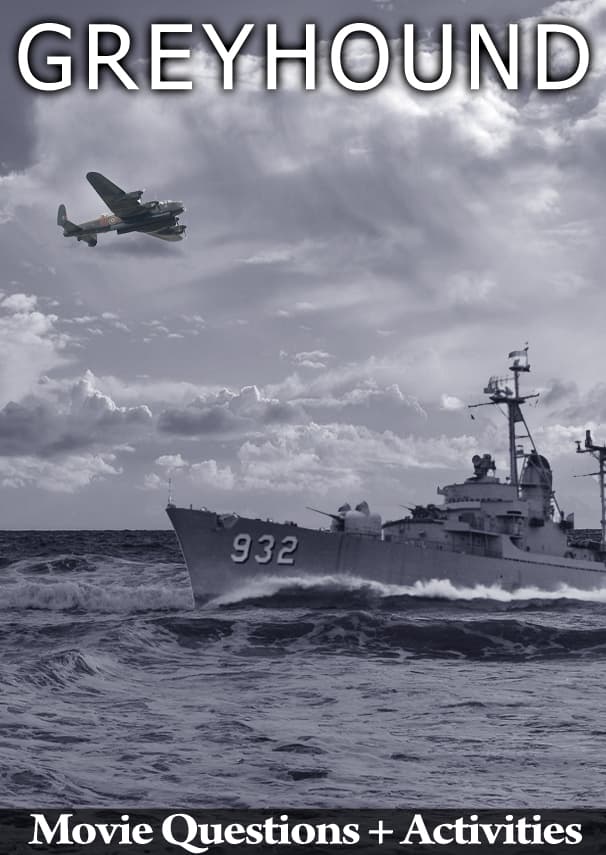
🏠 Homeschool Parents. Greyhound's tight, 91 minute runtime and focused story make it manageable for a single home learning session, and the themes around leadership and responsibility under pressure can open up real conversation between a parent and a teen. The guide's differentiated question sets let a single student work at whatever level suits them, and the sea battle game can be adapted into a solo challenge or played with a parent or sibling as the second player.
📜 History Teachers. The movie's focus on the Battle of the Atlantic gives Social Studies and World History teachers a way to bring a specific, less commonly taught chapter of WWII into the classroom. The guide does not include dedicated World History activities, but the comprehension questions keep students accountable and attentive throughout.
🌟 Supporting All Learners Movie guides can be a wonderfully calm fit for students with autism, learning difficulties, and mild to severe disabilities. The structured format gives every student a clear purpose during viewing, easing uncertainty and allowing them to engage at their own pace. If you teach in a special education or learning support setting, you may find this guide a gentle and practical resource. Find out more about why movies work for diverse learners.
What's Inside the Guide
This is a 14-page classroom-ready resource.
Three differentiated sets of chronological comprehension questions. Answer keys are included for all three sets.
- 40 full sentence question set.
- Shorter 30 question version.
- 30 question multiple choice set well suited to ESL and ELL students.
- A 9 scene storyboard of what they consider the most important moments in the movie, with a brief description for each scene.
- A synopsis of the story, written using that storyboard as the basis.
A just for fun paired activity in which students choose to play as submarines or destroyers and take turns guessing coordinates to try to sink their opponent's vessels. Instructions are included.
How These Guides Work: From Movie to Lesson
Watching a movie is not a break from learning. It reaches students through sight, sound, and story at once, engaging the brain in ways text alone does not, and the structured work around it is what turns the viewing into a genuine lesson. You can read the research behind this on the Why Movies Work page.
- A Teacher Notes and General Directions page opens the guide with a brief overview of everything inside: what the movie is about, then each part of the guide in order with a short description of what it entails. You know what to expect from the whole resource before you hand out a single page, so you can pick up the guide cold and teach it the same day.
- Answer keys are included for the comprehension question sets, so grading is quick and you are not rewatching the movie to check answers. Some guides also include example answers for the creative and written activities.
- Print and go: classroom ready, with no additional preparation needed. Print one the morning you need it and the lesson is ready.
- Substitute and first-timer friendly. A guide can be handed to a substitute or picked up by a teacher covering the topic for the first time. Nobody running the session needs to have seen the movie.
- Differentiated comprehension sets. Most guides include two or three question sets at different difficulty levels, and most include a multiple-choice option that works well for ESL and ELL students. One class set covers your strongest readers, your strugglers, and your language learners without separate prep.
- Activities that go beyond recall. Each guide includes structured activities that ask students to engage with the movie, not just watch it, ranging from creative and written tasks to discussion and critical thinking questions depending on the guide. That variety matters in a mixed classroom: a student who freezes on a written question set may show real understanding through a drawing or a creative task, and a confident writer gets room to go beyond recall. For the teacher, it turns a movie session into work you can grade: comprehension questions show whether students followed the plot, and the activities beyond them show whether they understood it.