By Mr Hull's Movie Guides
Watch the Trailer
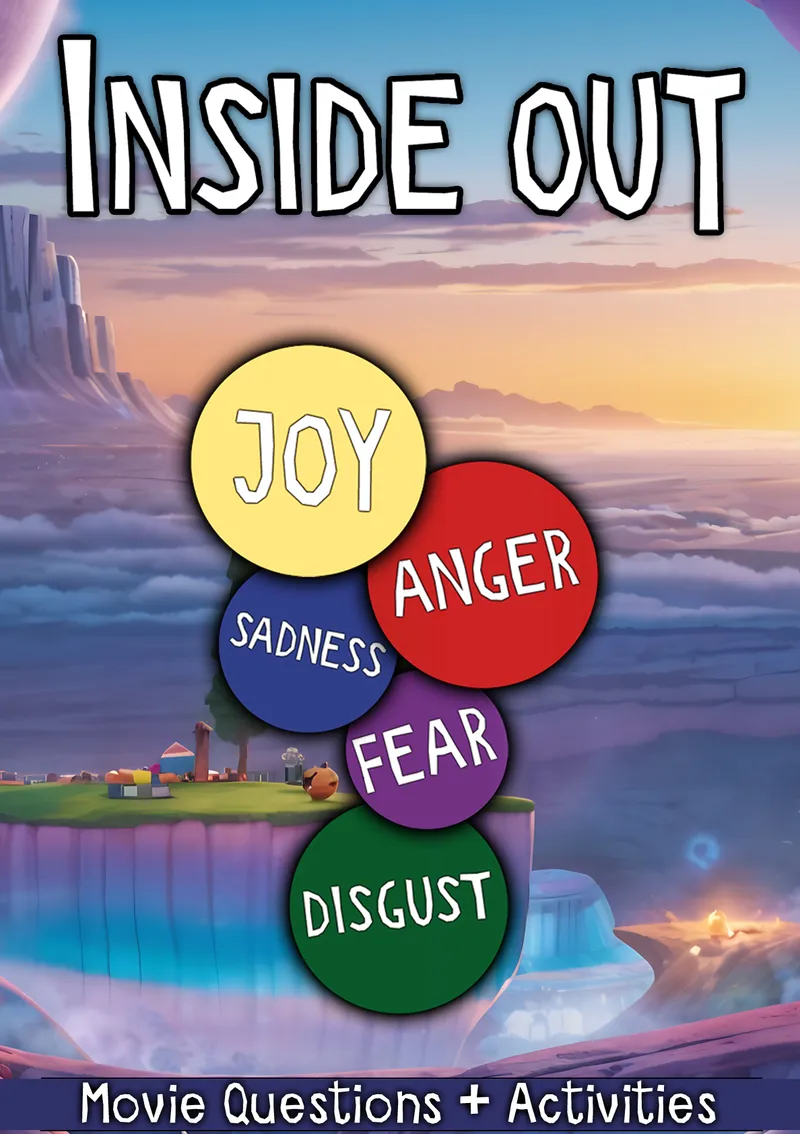
What's Inside the Guide
This is a 12-page classroom-ready resource.
Two complete sets of 23 questions covering the movie in chronological order. Answer keys are included for both sets.
- Full written answer question set.
- Multiple-choice version with the same questions in a more structured format, suited to ESL students or those who benefit from additional scaffolding.
Students are divided into groups of five, with each student taking one of the five emotion characters: Joy, Sadness, Anger, Fear, or Disgust. Each student completes a worksheet for their character, which should take around 30 to 45 minutes. This section works best completed individually before groups come together for Part 3.
Students regroup by emotion, so all the Joys together, all the Sadnesses, and so on. Each group creates a poster for their emotion that brings together the work from Part 2, including drawn character images, personality island descriptions, emotion-related vocabulary, and a colour-themed title. Example posters are linked from the guide to help groups understand the standard expected.
Each group presents their emotion poster to the rest of the class. This brings the activity to a natural close and gives every student an opportunity to share their thinking with the group.
“Students had a great time filling these out during the movie. I handed out the emotions at random, which the kids really had a good time with.”
— Abby P.
“My students enjoyed working through this activity after watching the movie and at the conclusion of a unit regarding emotions.”
— Elizabeth D.
Why Watch This Movie With Your Students
Here's what your students naturally take away from the movie, whether through themes, values, ideas, or perspectives.
🧠 A concrete vocabulary for talking about emotions. Joy, Sadness, Anger, Fear, and Disgust give students specific, named characters to attach their own emotional experiences to. That makes conversations about feelings far more accessible than abstract discussion, particularly for students who find it difficult to articulate how they feel.
🏠 A story students recognise immediately. Moving to a new place, feeling pressure to seem happy when you are not, struggling to connect with parents during a stressful time. Riley's situation is specific but the emotional experience is universal. Students engage with it quickly because it does not feel distant from their own lives.
👥 Five distinct characters, each with a genuine point of view. Joy, Sadness, Anger, Fear, and Disgust are not interchangeable. Each has a clear personality, motivation, and role in Riley's story. Students who pay attention to how each emotion behaves come away with a much richer understanding of the movie's argument.
😢 Sadness matters as much as Joy. The movie's central argument is that you cannot fully appreciate happiness without also allowing sadness. That is not a message students encounter often in children's media, and the movie earns it rather than simply stating it.
🎬 A story that works on two levels at once. Inside Out functions as a comedy adventure on the surface and as a genuinely thoughtful exploration of emotional development underneath. Students who engage with both levels come away with more than they expected from an animated movie.
🏃 Running away does not fix anything. Riley's decision to board a bus home to Minnesota is a turning point the movie handles with real honesty. Students understand why she does it and why it is wrong, which makes it worth discussing rather than just watching.
Age Suitability and Content
This movie is rated PG.
⚠️ Things to be aware of:
- Several of Riley's fears are shown visually, including a giant clown, dead rats, and a dark basement staircase
- Bridges, islands, and a train crumbling or falling. Characters fall into a dark void representing Riley's memory dump
- A key character fades from existence permanently while helping others. This is handled sensitively but may upset younger or more sensitive students
- Riley runs away from home and boards a bus alone
- Riley and her parents argue due to stress. Riley yells at them
- Anger's head bursts into flames when upset and at one point blows out a window
- Sadness engages in negative self-talk throughout
- A dog is split in half cartoonishly in a dream sequence, showing bone
- Mild language: shut up, moron, nitwit, idiot, dumb. Anger implies a curse word which is bleeped
- No drinking, drugs, or sexual content
Note for educators: Movie details and age ratings in this post are sourced from IMDb, Common Sense Media, and Wikipedia to help ensure accuracy.
How My Movie Guide Helps You Teach It
Click your subject below to see how this guide supports it:
📚 English Language Arts Teachers
🗣️ ESL and ELL Teachers
🎬 Substitute Teachers and Cover Lessons
🏠 Homeschool Parents
🎭 Theater Teachers
💙 SEL Teachers
🌟 Supporting All Learners A movie gives students a story to follow, and the guide gives them questions to work through as they watch. For students with autism, learning difficulties, and mild to severe disabilities, that combination provides a clear focus for the lesson and a concrete way to show understanding. The format can be useful in special education and learning support classrooms, where teachers need activities that give students a defined task during viewing. Find out more about why movies work for diverse learners.
This guide is built around the movie's story and characters. The SEL connections are genuine and central to the guide's design, but it is not tied to specific SEL curriculum frameworks or standards. For science teachers using it as an enrichment activity, note that the movie is not biologically accurate in how it depicts memory and emotion. It works best as an engagement and accountability tool during viewing.
How These Guides Work: From Movie to Lesson
Watching a movie is not a break from learning. It reaches students through sight, sound, and story at once, engaging the brain in ways text alone does not, and the structured work around it is what turns the viewing into a genuine lesson. You can read the research behind this on the Why Movies Work page.
- A Teacher Notes and General Directions page opens the guide with a brief overview of everything inside: what the movie is about, then each part of the guide in order with a short description of what it entails. You know what to expect from the whole resource before you hand out a single page, so you can pick up the guide cold and teach it the same day.
- Answer keys are included for the comprehension question sets, so grading is quick and you are not rewatching the movie to check answers. Some guides also include example answers for the creative and written activities.
- Print and go: classroom ready, with no additional preparation needed. Print one the morning you need it and the lesson is ready.
- Substitute and first-timer friendly. A guide can be handed to a substitute or picked up by a teacher covering the topic for the first time. Nobody running the session needs to have seen the movie.
- Differentiated comprehension sets. Most guides include two or three question sets at different difficulty levels, and most include a multiple-choice option that works well for ESL and ELL students. One class set covers your strongest readers, your strugglers, and your language learners without separate prep.
- Activities that go beyond recall. Each guide includes structured activities that ask students to engage with the movie, not just watch it, ranging from creative and written tasks to discussion and critical thinking questions depending on the guide. That variety matters in a mixed classroom: a student who freezes on a written question set may show real understanding through a drawing or a creative task, and a confident writer gets room to go beyond recall. For the teacher, it turns a movie session into work you can grade: comprehension questions show whether students followed the plot, and the activities beyond them show whether they understood it.