By Mr Hull's Movie Guides
Watch the Trailer
What's Inside the Guide
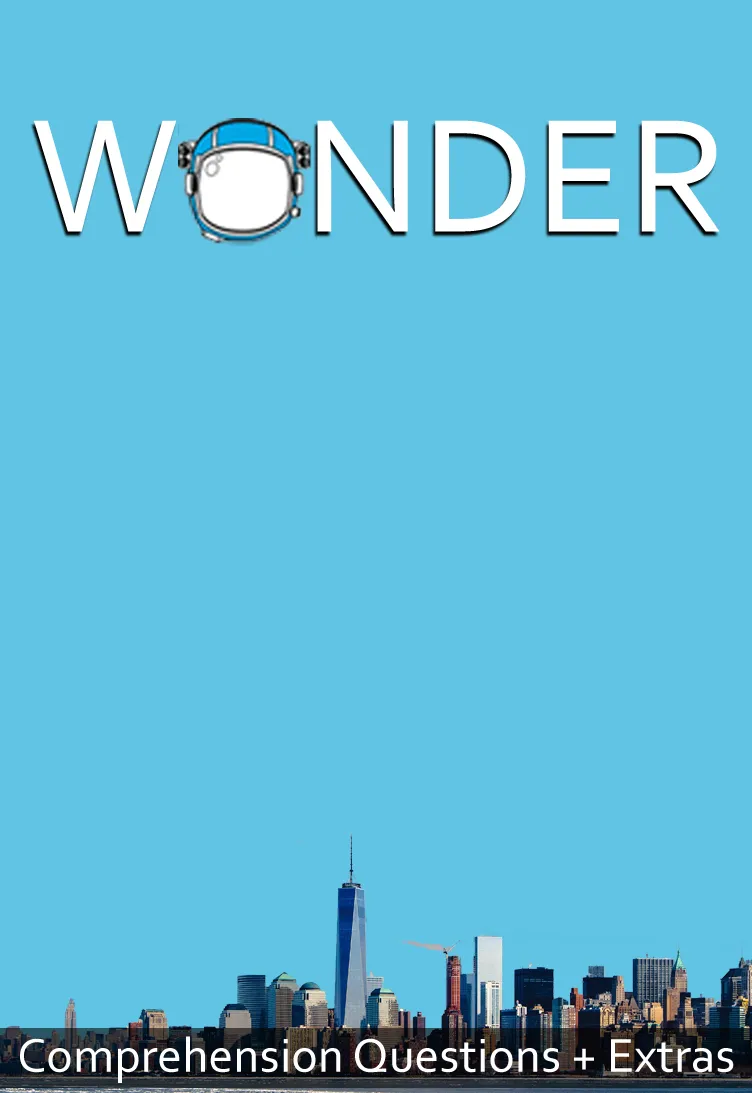
This is a 16-page classroom-ready resource.
Three differentiated sets of questions in chronological order. Answer keys included for all three sets.
- 45 question set requiring written answers.
- 30 question set, with 15 removed from the 45-question set for a shorter version.
- 30 multiple choice question set with 3 possible answers, suited to differentiation and ESL students.
5 additional questions asking students to provide their opinion and a brief explanation of their thinking. Example answers included, with a note that responses may vary.
This part covers two perspective-taking writing tasks.
- Imagining they are Jack after Auggie overhears him say something cruel, writing an apology letter to Auggie explaining what he said and what he plans to do to make it up, and including a drawing of the two making up.
- A short diary entry from the perspective of each student who gave Auggie a tour of the school before term started, taking into account each character's personality and their experience of the tour.
A word search and crossword puzzle using 15 key words from the movie. Answer key included.
“I am a high school teacher in a mild to moderate special education setting. My students thoroughly enjoyed this resource, and it proved to be extremely helpful in supporting their learning.”
— Nadia R.
“This guide helped keep my students engaged and on-task while we watched the movie. It was an easy way to take a grade during the week. I used some of the writing prompt questions for classroom discussions and for morning work. The crossword puzzle was a great activity to end the movie week!”
— Ali R.
Why Watch This Movie With Your Students
Here's what your students naturally take away from the movie, whether through themes, values, ideas, or perspectives.
👁️ A story told from multiple perspectives, not just one. The movie follows Auggie's sister Via, his friend Jack, and other characters in their own chapters, giving students a structural lesson in how the same events look different depending on who is living them. That shift in perspective is one of the most teachable things about the movie.
🤝 Friendship portrayed with real complexity. The friendships in Wonder are not straightforward. Jack Will likes Auggie but says something cruel to fit in. Summer chooses Auggie when nobody else will. These are not simple acts of kindness or cruelty, they are the kind of ambiguous social decisions students recognise from their own lives.
😂 Genuinely funny as well as emotional. Auggie's voice is warm and funny, and the movie earns its emotional moments partly because it does not treat them as the only register available. Students who expect a tearjerker find themselves laughing more than they anticipated, which makes the harder scenes land with more weight.
📖 A strong companion to the novel. Wonder is widely taught as a classroom text, and the movie follows the novel's structure closely enough to work as a companion. Students who have read the book will find the adaptation faithful; those who have not will have a solid basis for reading it.
🌟 A cast that gives students real characters to write about. Auggie, Via, Jack, Summer, Miranda, and Julian are all drawn with enough specificity that students can write from their perspectives convincingly. The movie gives them the voice, motivation, and context they need to take those characters somewhere new.
💬 It opens up conversations about difference without making it a lecture. Wonder handles Auggie's facial difference with honesty. Students see how people react, how it isolates him, and how it shapes every interaction, but the movie never reduces him to a lesson. He is a person first, and the story treats him that way throughout.
Age Suitability and Content
This movie is rated PG.
⚠️ Things to be aware of:
- Bullying is depicted throughout, including name-calling, deliberate exclusion, and mean comments about Auggie's appearance. Some of the language used by other students is cruel, including words like 'freak' and 'Darth Hideous'.
- A fight scene between two tween boys involving punching. Brief and not graphic.
- Mild language including 'shut up', 'oh my God', 'jerk', 'sucks', and a small number of slightly stronger words.
- Emotional scenes involving grief, loneliness, and family stress. Some students may find these upsetting.
- A background storyline involves a character's parents going through a difficult divorce, with references to a parent drinking.
- No sexual content, gore, or substance use beyond the above.
📋 A free editable parent permission slip is available for this movie. It explains the educational benefits of watching movies in class and includes a space for parental consent. → Download Free Permission Slip on TpT (Free resource)
Note for educators: Movie details and age ratings in this post are sourced from IMDb, Common Sense Media, and Wikipedia to help ensure accuracy.
How My Movie Guide Helps You Teach It
Click your subject below to see how this guide supports it:
📚 English Language Arts Teachers
🗣️ ESL and ELL Teachers
🎬 Substitute Teachers and Cover Lessons
🏠 Homeschool Parents
🎭 Theater Teachers
💙 SEL Teachers
🌟 Supporting All Learners A movie gives students a story to follow, and the guide gives them questions to work through as they watch. For students with autism, learning difficulties, and mild to severe disabilities, that combination provides a clear focus for the lesson and a concrete way to show understanding. The format can be useful in special education and learning support classrooms, where teachers need activities that give students a defined task during viewing. Find out more about why movies work for diverse learners.
How These Guides Work: From Movie to Lesson
Watching a movie is not a break from learning. It reaches students through sight, sound, and story at once, engaging the brain in ways text alone does not, and the structured work around it is what turns the viewing into a genuine lesson. You can read the research behind this on the Why Movies Work page.
- A Teacher Notes and General Directions page opens the guide with a brief overview of everything inside: what the movie is about, then each part of the guide in order with a short description of what it entails. You know what to expect from the whole resource before you hand out a single page, so you can pick up the guide cold and teach it the same day.
- Answer keys are included for the comprehension question sets, so grading is quick and you are not rewatching the movie to check answers. Some guides also include example answers for the creative and written activities.
- Print and go: classroom ready, with no additional preparation needed. Print one the morning you need it and the lesson is ready.
- Substitute and first-timer friendly. A guide can be handed to a substitute or picked up by a teacher covering the topic for the first time. Nobody running the session needs to have seen the movie.
- Differentiated comprehension sets. Most guides include two or three question sets at different difficulty levels, and most include a multiple-choice option that works well for ESL and ELL students. One class set covers your strongest readers, your strugglers, and your language learners without separate prep.
- Activities that go beyond recall. Each guide includes structured activities that ask students to engage with the movie, not just watch it, ranging from creative and written tasks to discussion and critical thinking questions depending on the guide. That variety matters in a mixed classroom: a student who freezes on a written question set may show real understanding through a drawing or a creative task, and a confident writer gets room to go beyond recall. For the teacher, it turns a movie session into work you can grade: comprehension questions show whether students followed the plot, and the activities beyond them show whether they understood it.