By Mr Hull's Movie Guides
Watch the Trailer

What's Inside the Guide
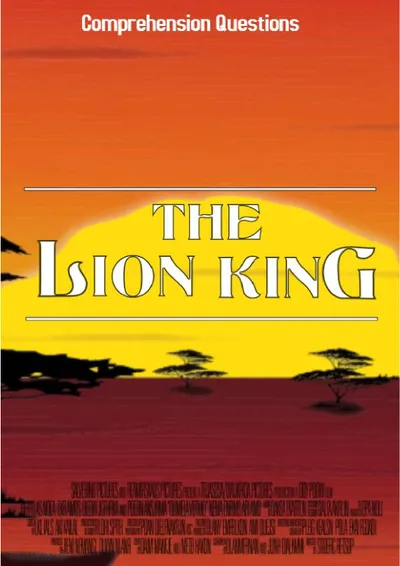
This is a 7-page classroom-ready resource.
Students draw a lion and a king before the movie begins, then describe their drawings using adjectives. The teacher leads a short class discussion about where lions are from and other animals found in Africa, writing responses on the board. During the movie, students have space to write down any animals they spot and any words they do not understand.
10 comprehension questions, the majority multiple choice, covering the full movie. Students also write a short paragraph about their favourite character. Answer keys are included.
Students match movie characters and animals to real-life animal photographs. This task connects the animated characters to the actual species they represent.
Students solve eight clues to identify words hidden in the word search. Seven additional words are pre-listed. No answer key is included for this section.
“Used this with one of my SPED students. They LOVED being able to show what they knew while using a movie that was familiar and comfortable.”
— Tonja B.
“Great activity as a follow along with the movie, used with the movie on a sub day and students loved it”
— Sarah B.
Why Watch This Movie With Your Students
Here's what your students naturally take away from the movie, whether through themes, values, ideas, or perspectives.
🦁 A story about courage that lands with younger students. Simba's journey from a cub running from his guilt to an adult who returns to face it is easy for students in grades 1 to 3 to follow and feel. The stakes are clear, the characters are vivid, and the resolution is earned rather than given.
💔 Loss and grief handled with care. The death of Mufasa is one of the most emotionally significant moments in Disney animation. The movie does not shy away from Simba's grief, but it treats it honestly and gives the story real weight. For young students, this can be a meaningful and age-appropriate introduction to discussing loss.
🎵 Songs that are woven into the story. The music in The Lion King does genuine narrative work. Each song advances the plot or develops a character, rather than pausing the story. Students who are already familiar with the songs engage more closely with the scenes around them.
🐘 A rich African setting full of recognisable animals. The Pride Lands are populated with a wide variety of African wildlife, from wildebeest and elephants to meerkats and warthogs. Students notice the animals throughout and the variety gives the identification tasks in the guide a natural anchor in the movie itself.
😄 Genuinely funny supporting characters. Timon and Pumbaa give the movie its comic energy, and their friendship with Simba provides warmth and lightness across the second half. The humour works at this age group without undercutting the story's more serious moments.
⚖️ Themes of responsibility and justice that are easy to discuss. Scar's manipulation of Simba, the suffering of the pride under his rule, and Simba's eventual choice to return are all clear and concrete. Students at this age can articulate why Scar is wrong and why Simba's return matters, which makes the moral of the story genuinely accessible.
Age Suitability and Content
This movie is rated G.
⚠️ Things to be aware of:
- Death of a parent: Mufasa is killed in a wildebeest stampede. Simba finds his father's body. This is the movie's most emotionally intense moment and may be upsetting for sensitive younger students.
- Villain threat: Scar and his hyena allies are genuinely menacing. The hyenas are portrayed as aggressive and threatening throughout, and their behaviour toward the young cubs is frightening in places.
- Cartoon violence: animal confrontations including swipes, chases, and a final fight between Simba and Scar. No blood shown.
- Mild language: name-calling including 'stupid', 'idiot', 'dumb', and 'ugly'.
- No sexual content. No substance use.
Note for educators: Movie details and age ratings in this post are sourced from IMDb, Common Sense Media, and Wikipedia to help ensure accuracy.
How My Movie Guide Helps You Teach It
Click your subject below to see how this guide supports it:
📚 English Language Arts Teachers
🔬 Science Teachers
🎬 Substitute Teachers and Cover Lessons
🏠 Homeschool Parents
💙 SEL Teachers
🌟 Supporting All Learners A movie gives students a story to follow, and the guide gives them questions to work through as they watch. For students with autism, learning difficulties, and mild to severe disabilities, that combination provides a clear focus for the lesson and a concrete way to show understanding. The format can be useful in special education and learning support classrooms, where teachers need activities that give students a defined task during viewing. Find out more about why movies work for diverse learners.
This guide was written as a general classroom movie guide. The animal identification and matching tasks connect naturally to a Science unit on African wildlife, but teachers looking for dedicated science questions will not find them here.
How These Guides Work: From Movie to Lesson
Watching a movie is not a break from learning. It reaches students through sight, sound, and story at once, engaging the brain in ways text alone does not, and the structured work around it is what turns the viewing into a genuine lesson. You can read the research behind this on the Why Movies Work page.
- A Teacher Notes and General Directions page opens the guide with a brief overview of everything inside: what the movie is about, then each part of the guide in order with a short description of what it entails. You know what to expect from the whole resource before you hand out a single page, so you can pick up the guide cold and teach it the same day.
- Answer keys are included for the comprehension question sets, so grading is quick and you are not rewatching the movie to check answers. Some guides also include example answers for the creative and written activities.
- Print and go: classroom ready, with no additional preparation needed. Print one the morning you need it and the lesson is ready.
- Substitute and first-timer friendly. A guide can be handed to a substitute or picked up by a teacher covering the topic for the first time. Nobody running the session needs to have seen the movie.
- Differentiated comprehension sets. Most guides include two or three question sets at different difficulty levels, and most include a multiple-choice option that works well for ESL and ELL students. One class set covers your strongest readers, your strugglers, and your language learners without separate prep.
- Activities that go beyond recall. Each guide includes structured activities that ask students to engage with the movie, not just watch it, ranging from creative and written tasks to discussion and critical thinking questions depending on the guide. That variety matters in a mixed classroom: a student who freezes on a written question set may show real understanding through a drawing or a creative task, and a confident writer gets room to go beyond recall. For the teacher, it turns a movie session into work you can grade: comprehension questions show whether students followed the plot, and the activities beyond them show whether they understood it.