By Mr Hull's Movie Guides
Watch the Trailer

What's Inside the Guide
This is a 12-page classroom-ready resource.
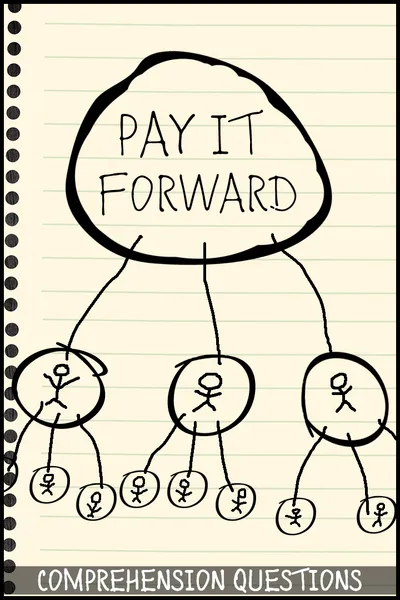
Two differentiated sets of 20 questions each, in chronological order. Answer keys are included for both sets. Question 9 asks students to draw the pay it forward chart and explain how the concept works.
- Full sentence answer question set.
- Multiple choice question set with three options per question, written to work well with ESL and ELL students.
- A 9-scene storyboard illustrating key moments from the movie, with a short written description for each scene explaining the main idea it represents.
- A synopsis of the movie, written using their completed storyboard as a guide, in their own words.
This part covers two open-ended writing tasks.
- Imagining they have been asked to pay it forward to three people and writing what they would do for each of them.
- Identifying something they want to change in the world, explaining why they want it changed, and describing how they think it could happen.
“Loved this resource! I showed this movie to a peer counseling class and they loved the message. The resource was a great touch to ensure they understood and followed along. ”
— Brooke P.
“I've been doing Pay It Forward activities with my students for years and this added to overall understanding of the message of paying it forward.”
— Paula T.
Why Watch This Movie With Your Students
Here's what your students naturally take away from the movie, whether through themes, values, ideas, or perspectives.
🤝 A genuinely teachable concept at its centre. The pay it forward idea is simple enough for students to grasp quickly and complex enough to generate real discussion. Trevor's three-step plan raises immediate questions about whether kindness can scale, and whether good intentions are enough. The movie does not give easy answers.
👦 A student-aged protagonist navigating a difficult home life. Trevor lives with a mother struggling with alcoholism and an absent, abusive father. Students see him managing circumstances that feel unfair while still choosing to act generously. That contrast between his situation and his choices gives the movie its emotional weight.
📚 Rooted in a real Social Studies classroom assignment. The whole story begins with a teacher asking his class to think of something that could change the world and put it into action. That framing makes the movie relevant to any classroom where students are asked to think beyond themselves. The assignment Trevor receives is one any student could imagine getting.
👨👩👦 Three layered performances that carry the story. Haley Joel Osment plays Trevor with a convincing mix of maturity and vulnerability. Helen Hunt and Kevin Spacey play adults dealing with their own damage. The relationships between the three of them develop slowly and feel earned, which keeps students invested across the full 123 minutes.
💔 An ending that stays with students. The movie does not resolve tidily. The ending is surprising, and for many students it is genuinely upsetting. That emotional response is worth something in a classroom: it creates an opening to talk about what the story meant, and whether the pay it forward idea outlasts what happens to Trevor.
🌍 Themes that connect to writing and personal reflection. The movie asks students to think about what they would change in the world if they could, and what they would do about it. Those are questions worth writing about. The guide's creative writing tasks build directly on that impulse.
Age Suitability and Content
This movie is rated PG-13.
⚠️ Things to be aware of:
- Violence: A character is stabbed and dies from the injury. There is blood. Boys bully another student by knocking him down, kicking him, and throwing him into a dumpster. A mother slaps her son in a moment of anger. A man describes physical abuse he suffered as a child, which left visible burn scars on his face and chest. A woman stands on a bridge on the verge of suicide.
- Language: Frequent strong language throughout, including 'bullsh*t', 'b*tch', 'd*ckhead', and others. The N-word is used once. A tween uses the word 'f*g' toward a bully.
- Alcohol and drugs: A central character struggles with alcoholism and hides vodka around the house. Another character is a recovering heroin addict with visible track marks. Beer and alcohol are consumed in bar scenes. Marijuana is also shown. Cigarette smoking throughout.
- Sexual content: A scene in which a woman is shown on top of a man in bed as they begin to undress. Brief sexual references, including comments about a mother sleeping around. A woman is shown in her bra. Scantily dressed women appear in a nightclub scene.
- Other: A character's severe burn scars are shown and discussed. A stranger approaches a young boy in a way that implies potential danger, though nothing occurs. Domestic abuse is referenced in detail.
📋 A free editable parent permission slip is available for this movie. It explains the educational benefits of watching movies in class and includes a space for parental consent. → Download Free Permission Slip on TpT (Free resource)
Note for educators: Movie details and age ratings in this post are sourced from IMDb, Common Sense Media, and Wikipedia to help ensure accuracy.
How My Movie Guide Helps You Teach It
Click your subject below to see how this guide supports it:
📚 English Language Arts Teachers
🗣️ ESL and ELL Teachers
🌐 Social Studies Teachers
🎬 Substitute Teachers and Cover Lessons
🏠 Homeschool Parents
💙 SEL Teachers
🌟 Supporting All Learners A movie gives students a story to follow, and the guide gives them questions to work through as they watch. For students with autism, learning difficulties, and mild to severe disabilities, that combination provides a clear focus for the lesson and a concrete way to show understanding. The format can be useful in special education and learning support classrooms, where teachers need activities that give students a defined task during viewing. Find out more about why movies work for diverse learners.
How These Guides Work: From Movie to Lesson
Watching a movie is not a break from learning. It reaches students through sight, sound, and story at once, engaging the brain in ways text alone does not, and the structured work around it is what turns the viewing into a genuine lesson. You can read the research behind this on the Why Movies Work page.
- A Teacher Notes and General Directions page opens the guide with a brief overview of everything inside: what the movie is about, then each part of the guide in order with a short description of what it entails. You know what to expect from the whole resource before you hand out a single page, so you can pick up the guide cold and teach it the same day.
- Answer keys are included for the comprehension question sets, so grading is quick and you are not rewatching the movie to check answers. Some guides also include example answers for the creative and written activities.
- Print and go: classroom ready, with no additional preparation needed. Print one the morning you need it and the lesson is ready.
- Substitute and first-timer friendly. A guide can be handed to a substitute or picked up by a teacher covering the topic for the first time. Nobody running the session needs to have seen the movie.
- Differentiated comprehension sets. Most guides include two or three question sets at different difficulty levels, and most include a multiple-choice option that works well for ESL and ELL students. One class set covers your strongest readers, your strugglers, and your language learners without separate prep.
- Activities that go beyond recall. Each guide includes structured activities that ask students to engage with the movie, not just watch it, ranging from creative and written tasks to discussion and critical thinking questions depending on the guide. That variety matters in a mixed classroom: a student who freezes on a written question set may show real understanding through a drawing or a creative task, and a confident writer gets room to go beyond recall. For the teacher, it turns a movie session into work you can grade: comprehension questions show whether students followed the plot, and the activities beyond them show whether they understood it.