By Mr Hull's Movie Guides
Watch the Trailer

Why Watch This Movie With Your Students
Here's what your students naturally take away from the movie, whether through themes, values, ideas, or perspectives.
🚀 A survival story grounded in real science. Watney's solutions to staying alive on Mars, growing food, generating water, managing oxygen, are based on real scientific principles, giving the movie an educational backbone underneath the drama.
🧠 Problem-solving shown step by step. Rather than skipping to solutions, the movie shows Watney working through each problem methodically, including the setbacks and failed attempts along the way.
😂 Humor that carries through extreme circumstances. Watney's wit and self-deprecating humor run through even the most dangerous moments, giving the movie a tone that balances its high stakes.
🌍 A global effort working toward one goal. Alongside Watney's story, the movie follows the NASA teams and international partners working to bring him home, showing large-scale cooperation under pressure.
⏳ Tension built from limited resources and time. Much of the movie's tension comes from Watney's dwindling supplies and the long timelines involved in any rescue attempt, giving students a sense of just how unforgiving the environment is.
🤝 A story about what people are willing to do for one another. The lengths multiple teams go to in order to save a single person give the movie its emotional core, without losing its focus on the science involved.
Age Suitability and Content
This movie is rated PG-13.
⚠️ Things to be aware of:
- Strong language is used throughout, including multiple uses of the F-word.
- One scene shows Watney removing a piece of debris from his own body and treating the wound, with some blood shown.
- A brief, non-sexual shot shows Watney's bare body from behind.
- Several scenes involve intense peril, including a storm, explosions, and life-threatening situations.
- No drinking, drug use, or smoking is present.
📋 A free editable parent permission slip is available for this movie. It explains the educational benefits of watching movies in class and includes a space for parental consent. → Download Free Permission Slip on TpT (Free resource)
Note for educators: Movie details and age ratings in this post are sourced from IMDb, Common Sense Media, and Wikipedia to help ensure accuracy.
How My Movie Guide Helps You Teach It
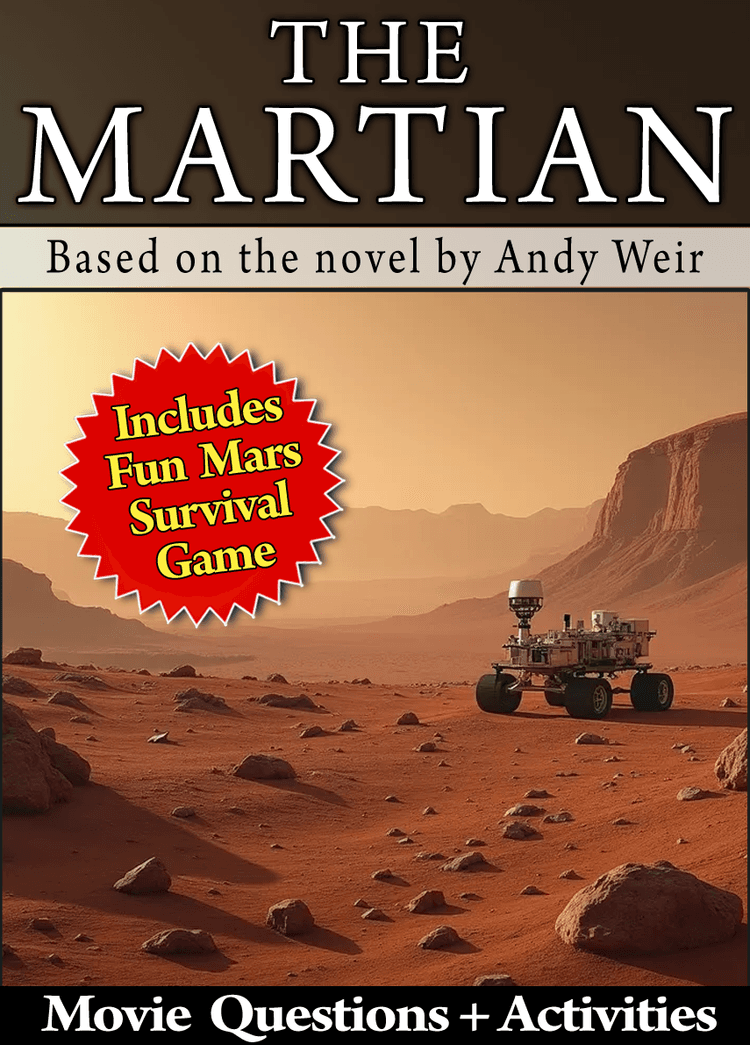
📚 English Language Arts Teachers. The Martian suits ELA classes focused on narrative structure, problem-and-solution storytelling, and character voice, particularly Watney's first-person logs. The guide covers comprehension questions, a storyboard and synopsis task, and an extended creative writing activity in the form of a survival game with journal entries, with differentiated question sets across three levels.
🗣️ ESL and ELL Teachers. The guide's multiple-choice comprehension set may work well for ESL and ELL students, giving them a structured way to follow the story's events without relying on extended written responses.
🔬 Science Teachers. The movie's survival strategies, including growing crops in Martian soil, generating water, and managing oxygen and power, connect directly to Science content on chemistry, biology, and problem-solving. The guide includes a dedicated Mars survival game in which students apply scientific reasoning to make decisions about tools and strategies, extending well beyond the comprehension questions.
🎬 Substitute Teachers and Cover Lessons. With three differentiated comprehension sets, a storyboard and synopsis task, and a multi-day survival game with clear teacher instructions, the guide offers enough structured material to support a substitute teacher across one or more lessons.
🏠 Homeschool Parents. The comprehension and writing tasks work well for individual home learners, though the survival game is designed for groups of 2 to 5 students and would need adapting, for example by pairing with siblings, co-op groups, or family members, for home use.
💙 SEL Teachers. The movie's themes of resilience, problem-solving under pressure, and teamwork connect well to SEL goals. The guide's survival game asks students to work in groups, make decisions together, and reflect on their choices and emotional responses through journal entries, giving SEL skills a direct outlet in a guided activity.
🔭 STEM Teachers. Watney's survival depends on botany, chemistry, orbital mechanics, and engineering in combination, making The Martian a multi-disciplinary STEM story that shows how different technical fields connect in practice. STEM classes will find it gives them a cross-discipline narrative that no single subject label fully captures. The guide's comprehension questions give students a structured framework for watching.
🌟 Supporting All Learners Movie guides can be a wonderfully calm fit for students with autism, learning difficulties, and mild to severe disabilities. The structured format gives every student a clear purpose during viewing, easing uncertainty and allowing them to engage at their own pace. If you teach in a special education or learning support setting, you may find this guide a gentle and practical resource. Find out more about why movies work for diverse learners.
What's Inside the Guide
This is a 20-page classroom-ready resource.
Part 1: Comprehension Questions
Three differentiated sets of questions in chronological order. The first set contains 52 questions requiring full sentence answers. The second set contains 35 questions drawn from the first set with 17 removed. The third set contains 35 multiple-choice questions with three possible answers each, noted as suitable for ESL and ELL students. Answer keys are included for all three sets.
Part 2: Storyboard and Synopsis
Students draw a 9-scene storyboard of what they consider the most important parts of the movie, with a brief description for each scene, using the comprehension questions to help with sequencing. Using the storyboard as a guide, students then write a synopsis of the movie.
Part 3: Mars Survival Game
An extended creative writing activity for groups of 2 to 5 students, with detailed teacher instructions. Students choose tools, face daily challenges, and strategize to survive 5 sols until rescue, documenting each sol's events, strategies, and emotional responses in journal entries. Groups read their entries aloud after each sol, and the teacher scores the realism and effectiveness of each group's survival plan, with totals tallied after 5 sols to give a final score.
How These Guides Work: From Movie to Lesson
Watching a movie is not a break from learning. It reaches students through sight, sound, and story at once, engaging the brain in ways text alone does not, and the structured work around it is what turns the viewing into a genuine lesson. You can read the research behind this on the Why Movies Work page.
- A Teacher Notes and General Directions page opens the guide with a brief overview of everything inside: what the movie is about, then each part of the guide in order with a short description of what it entails. You know what to expect from the whole resource before you hand out a single page, so you can pick up the guide cold and teach it the same day.
- Answer keys are included for the comprehension question sets, so grading is quick and you are not rewatching the movie to check answers. Some guides also include example answers for the creative and written activities.
- Print and go: classroom ready, with no additional preparation needed. Print one the morning you need it and the lesson is ready.
- Substitute and first-timer friendly. A guide can be handed to a substitute or picked up by a teacher covering the topic for the first time. Nobody running the session needs to have seen the movie.
- Differentiated comprehension sets. Most guides include two or three question sets at different difficulty levels, and most include a multiple-choice option that works well for ESL and ELL students. One class set covers your strongest readers, your strugglers, and your language learners without separate prep.
- Activities that go beyond recall. Each guide includes structured activities that ask students to engage with the movie, not just watch it, ranging from creative and written tasks to discussion and critical thinking questions depending on the guide. That variety matters in a mixed classroom: a student who freezes on a written question set may show real understanding through a drawing or a creative task, and a confident writer gets room to go beyond recall. For the teacher, it turns a movie session into work you can grade: comprehension questions show whether students followed the plot, and the activities beyond them show whether they understood it.