By Mr Hull's Movie Guides
Watch the Trailer
What's Inside the Guide
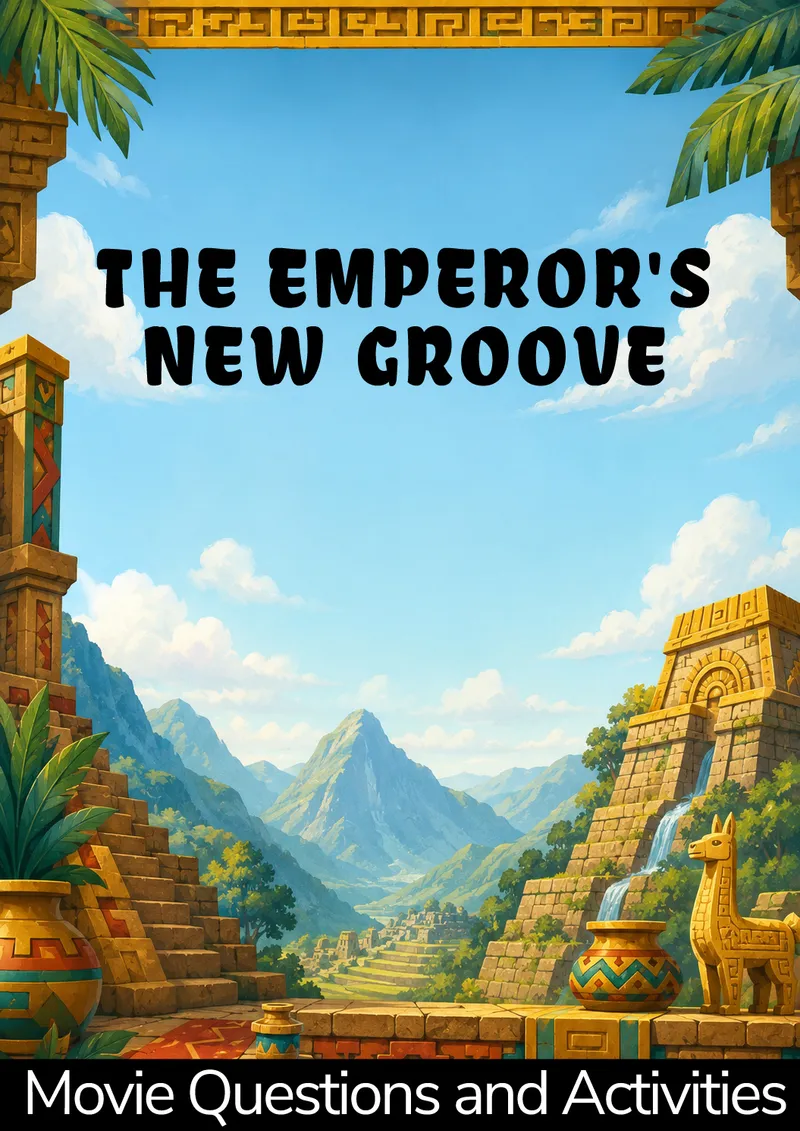
This is a 17-page classroom-ready resource.
Students read a short informational passage about the real Inca civilisation, covering where and when they lived, their emperor, language, buildings, animals, and food. They then answer 10 short-answer comprehension questions. Answer key included.
Two differentiated comprehension question sets. All answer keys included.
- 30 question set requiring full sentence answers.
- 30 multiple choice question set with 3 possible answers each.
This part covers three activities. Example answers are included.
- Mapping Kuzco's journey onto 8 stages across Departure, Initiation, and Return, drawing scenes and writing notes for each.
- 3 reflection questions.
- An archetype matching activity, followed by a class discussion.
Students create a 9-scene storyboard illustrating pivotal events from the beginning, middle, and end of the movie. Each scene includes a short sentence describing the action. The comprehension questions guide sequencing.
This part covers two activities. Answers are included for the word search.
- Writing sentences using the beginning of each letter in the word GROOVE, then writing about moments when a character felt surprised, worried, and happy.
- A word search with 15 words connected to the movie, where students first unscramble 10 words then use 5 clues to find the rest.
Why Watch This Movie With Your Students
Here's what your students naturally take away from the movie, whether through themes, values, ideas, or perspectives.
🦙 A character transformation students can track. Kuzco starts the movie as a deeply self-centred character. By the end, he has genuinely changed. Students can track that transformation scene by scene, making this a strong text for studying character development, cause and effect, and the consequences of our choices.
🤝 Friendship and empathy in action. The relationship between Kuzco and Pacha is the heart of the movie. Pacha helps Kuzco despite having every reason not to. This gives students rich material for discussing kindness, loyalty, and what it means to treat people well even when they don't deserve it.
🏛️ A real historical connection. The movie is set in a world inspired by the Inca Empire of South America. The culture, architecture, and social hierarchy shown throughout are rooted in a real civilisation, which gives the comedy genuine grounding. Students who know something about the Incas engage with the world differently.
😂 Humour as a teaching tool. The movie's comedy is genuinely clever, full of timing, irony, and self-awareness. For younger students especially, a funny movie lowers the barrier to engagement. They don't feel like they're doing school work, but they are.
🦸 A story structure students can map. Kuzco's story passes through the Departure, Initiation, and Return phases of the Hero's Journey. Seeing those stages in a comedy gives students an accessible way into story structure across a range of ability levels.
Age Suitability and Content
This movie is rated G.
⚠️ Things to be aware of:
- Mild cartoon peril and slapstick violence
- A villain who attempts to poison the emperor, shown comically
- No strong language or adult content
Note for educators: Movie details and age ratings in this post are sourced from IMDb, Common Sense Media, and Wikipedia to help ensure accuracy.
How My Movie Guide Helps You Teach It
Click your subject below to see how this guide supports it:
📚 English Language Arts Teachers
🗣️ ESL and ELL Teachers
🌐 Social Studies Teachers
🎬 Substitute Teachers and Cover Lessons
🏠 Homeschool Parents
🌟 Supporting All Learners A movie gives students a story to follow, and the guide gives them questions to work through as they watch. For students with autism, learning difficulties, and mild to severe disabilities, that combination provides a clear focus for the lesson and a concrete way to show understanding. The format can be useful in special education and learning support classrooms, where teachers need activities that give students a defined task during viewing. Find out more about why movies work for diverse learners.
The Social Studies connection is based on the pre-viewing Inca reading included in the guide. The movie itself is inspired by Inca culture but is not historically accurate. It is best used as a springboard for curiosity rather than a curriculum resource.
How These Guides Work: From Movie to Lesson
Watching a movie is not a break from learning. It reaches students through sight, sound, and story at once, engaging the brain in ways text alone does not, and the structured work around it is what turns the viewing into a genuine lesson. You can read the research behind this on the Why Movies Work page.
- A Teacher Notes and General Directions page opens the guide with a brief overview of everything inside: what the movie is about, then each part of the guide in order with a short description of what it entails. You know what to expect from the whole resource before you hand out a single page, so you can pick up the guide cold and teach it the same day.
- Answer keys are included for the comprehension question sets, so grading is quick and you are not rewatching the movie to check answers. Some guides also include example answers for the creative and written activities.
- Print and go: classroom ready, with no additional preparation needed. Print one the morning you need it and the lesson is ready.
- Substitute and first-timer friendly. A guide can be handed to a substitute or picked up by a teacher covering the topic for the first time. Nobody running the session needs to have seen the movie.
- Differentiated comprehension sets. Most guides include two or three question sets at different difficulty levels, and most include a multiple-choice option that works well for ESL and ELL students. One class set covers your strongest readers, your strugglers, and your language learners without separate prep.
- Activities that go beyond recall. Each guide includes structured activities that ask students to engage with the movie, not just watch it, ranging from creative and written tasks to discussion and critical thinking questions depending on the guide. That variety matters in a mixed classroom: a student who freezes on a written question set may show real understanding through a drawing or a creative task, and a confident writer gets room to go beyond recall. For the teacher, it turns a movie session into work you can grade: comprehension questions show whether students followed the plot, and the activities beyond them show whether they understood it.