By Mr Hull's Movie Guides
Watch the Trailer

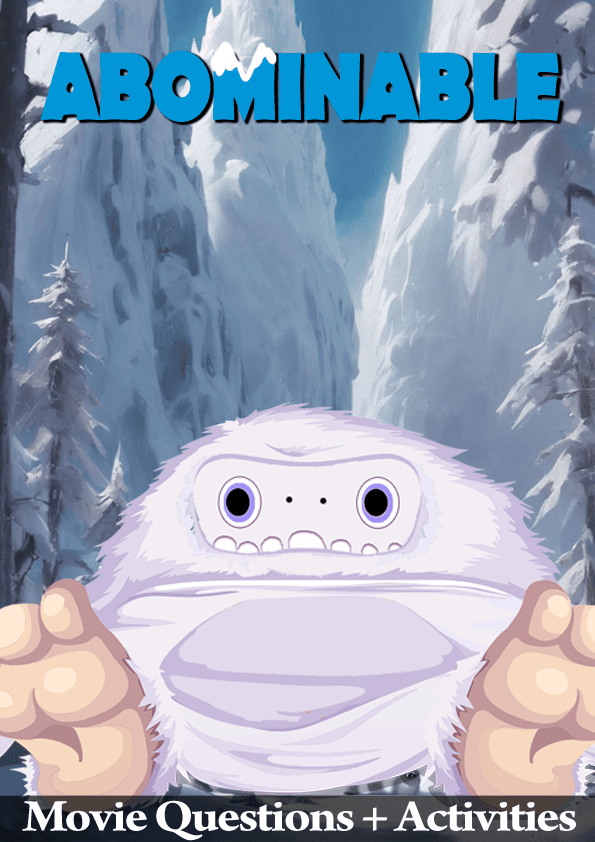
What's Inside the Guide
This is a 16-page classroom-ready resource.
Three sets for differentiation. Answer keys are included for all three sets.
- 40 question set requiring full sentence answers.
- 25 question set requiring full sentence answers, a reduced version of the first.
- 25 multiple choice question set with 3 possible answers each.
This part covers two activities.
- Drawing what they imagine a yeti might look like and writing a short description of it.
- Writing sentences using each letter from the word "Abominable" before writing about moments in the movie where they felt sad, happy, and excited.
This part covers two activities.
- A 15 word bank tied to the movie used across an unscrambling activity, a letter tracing activity, and a set of clue based questions.
- A separate word search with 15 words to find.
“This was great to use as a before winter break activity. It kept the kids engaged and from getting too squirrely while they watched the film! They enjoyed anticipating when the next answer to a question would come.”
— Laura A.
“We used this as an alternative activity for a "Christmas Themed" activity since I have students this year that don't celebrate Christmas. It was fun and the students enjoyed it!”
— Susan Y.
Why Watch This Movie With Your Students
Here's what your students naturally take away from the movie, whether through themes, values, ideas, or perspectives.
🏔️ Explores Grief Through a Character's Actions Rather Than Words. Yi has withdrawn from her mother, grandmother, and friends since her father's death, and her journey with Everest becomes a way of working through that loss without the movie stating it outright. Students get a portrait of grief shown through behavior and choices rather than direct explanation.
🌏 Shows Real Chinese Landmarks and Culture. The journey takes Yi and her friends across genuine locations in China on the way to the Himalayas, giving students a visual geography lesson layered into an adventure story. The movie also offers a grounded, positive picture of Chinese family life and culture.
🤝 Builds Trust and Loyalty Between Unlikely Friends. Jin and Peng stay with Yi through real danger even though the quest is not their responsibility, and their loyalty deepens over the course of the journey. Students see friendship demonstrated through sustained commitment rather than a single gesture.
🎻 Uses Music as a Form of Emotional Connection. Yi's violin playing, once tied to memories of her father, becomes a way she connects with Everest and eventually opens back up emotionally. It gives students a concrete example of how a skill or hobby can carry meaning beyond its surface purpose.
🧗 Follows a Dangerous Journey With Real Stakes. Yi and her friends face pursuit, capture attempts, and genuinely risky terrain as they try to get Everest home safely. The peril in the story gives it consistent tension without losing its warmth.
👨👩👧 Centers the Importance of Family and Honoring Loved Ones. Yi's quest is tied to a trip she and her father had once planned together, and completing parts of that journey becomes a way of honoring his memory. Students see how a character's actions can be shaped by the people who are no longer there.
Age Suitability and Content
This movie is rated PG.
⚠️ Things to be aware of:
- Peril and chase sequences throughout, including tranquilizer guns, drones, and a yeti being chained and caged.
- It briefly appears that a character has fallen to their death, and two people are swept off a mountain, though no one is seriously harmed.
- Characters discuss the death of a parent and the loneliness of a family that feels incomplete.
- Mild rude humor, including burp jokes and comments about smelling bad.
- No profanity, and no romantic content beyond brief flirting and lingering looks between two teenage characters.
📋 A free editable parent permission slip is available for this movie. It explains the educational benefits of watching movies in class and includes a space for parental consent. → Download Free Permission Slip on TpT (Free resource)
Note for educators: Movie details and age ratings in this post are sourced from IMDb, Common Sense Media, and Wikipedia to help ensure accuracy.
How My Movie Guide Helps You Teach It
Click your subject below to see how this guide supports it:
📚 English Language Arts Teachers
🗣️ ESL and ELL Teachers
🎬 Substitute Teachers and Cover Lessons
🏠 Homeschool Parents
💙 SEL Teachers
🌍 Geography Teachers
🌟 Supporting All Learners A movie gives students a story to follow, and the guide gives them questions to work through as they watch. For students with autism, learning difficulties, and mild to severe disabilities, that combination provides a clear focus for the lesson and a concrete way to show understanding. The format can be useful in special education and learning support classrooms, where teachers need activities that give students a defined task during viewing. Find out more about why movies work for diverse learners.
How These Guides Work: From Movie to Lesson
Watching a movie is not a break from learning. It reaches students through sight, sound, and story at once, engaging the brain in ways text alone does not, and the structured work around it is what turns the viewing into a genuine lesson. You can read the research behind this on the Why Movies Work page.
- A Teacher Notes and General Directions page opens the guide with a brief overview of everything inside: what the movie is about, then each part of the guide in order with a short description of what it entails. You know what to expect from the whole resource before you hand out a single page, so you can pick up the guide cold and teach it the same day.
- Answer keys are included for the comprehension question sets, so grading is quick and you are not rewatching the movie to check answers. Some guides also include example answers for the creative and written activities.
- Print and go: classroom ready, with no additional preparation needed. Print one the morning you need it and the lesson is ready.
- Substitute and first-timer friendly. A guide can be handed to a substitute or picked up by a teacher covering the topic for the first time. Nobody running the session needs to have seen the movie.
- Differentiated comprehension sets. Most guides include two or three question sets at different difficulty levels, and most include a multiple-choice option that works well for ESL and ELL students. One class set covers your strongest readers, your strugglers, and your language learners without separate prep.
- Activities that go beyond recall. Each guide includes structured activities that ask students to engage with the movie, not just watch it, ranging from creative and written tasks to discussion and critical thinking questions depending on the guide. That variety matters in a mixed classroom: a student who freezes on a written question set may show real understanding through a drawing or a creative task, and a confident writer gets room to go beyond recall. For the teacher, it turns a movie session into work you can grade: comprehension questions show whether students followed the plot, and the activities beyond them show whether they understood it.