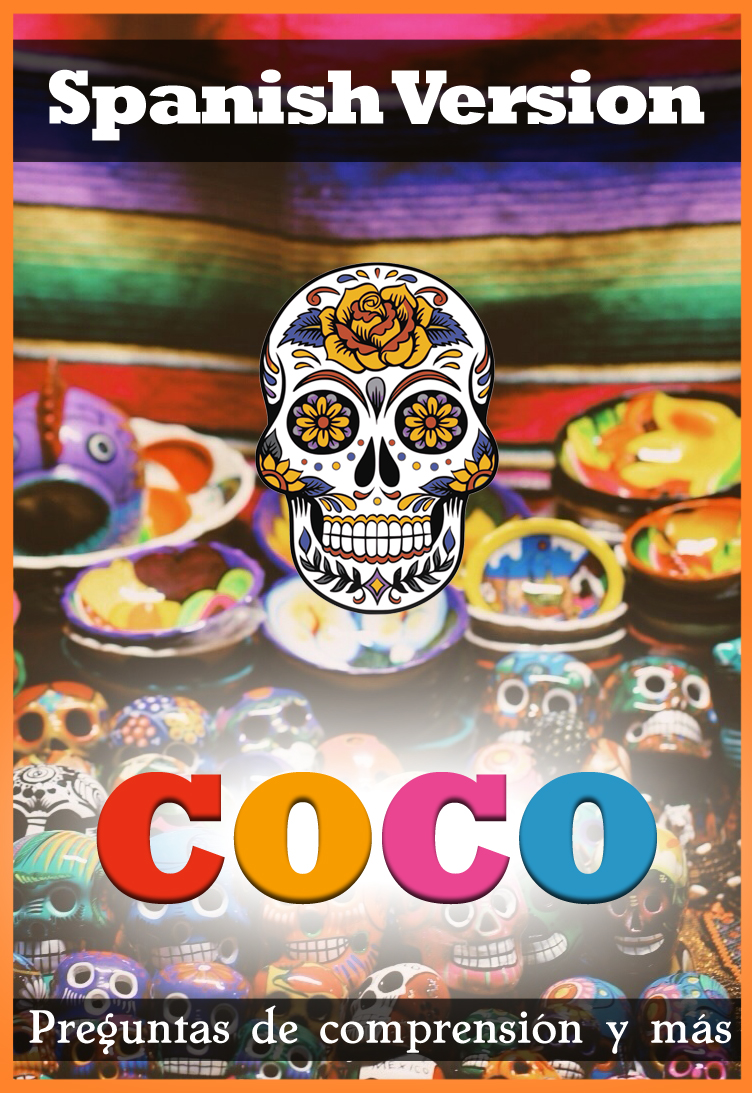
By Mr Hull's Movie Guides
Watch the Trailer
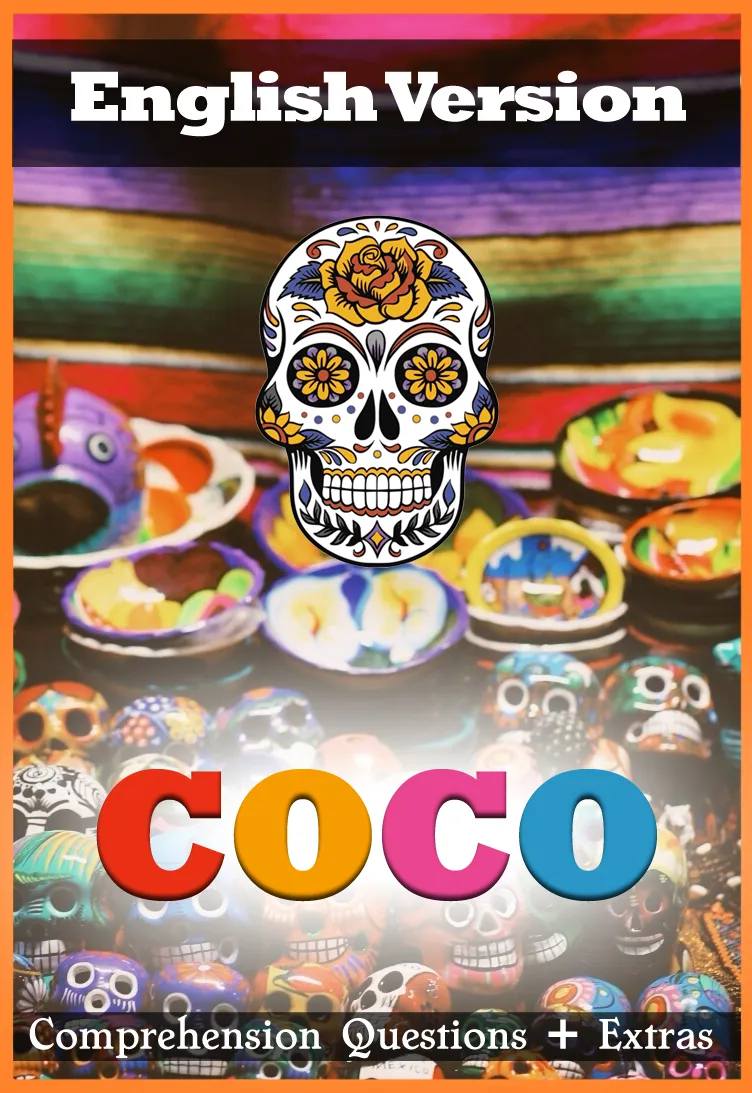
What's Inside the Guide
This is a 16-page classroom-ready resource.
Two sets of comprehension questions for differentiation. Answer keys are included for both sets. The multiple choice questions may also work well with ESL and ELL students.
- 30 question set requiring full sentence answers.
- 30 multiple choice question set with 3 possible answers.
This part covers two activities.
- Designing and drawing an imaginary spirit guide (alebrijes), with a description of their creation.
- Decorating a calavera.
There are four character profiles to complete, covering Miguel, Hector, Abuelita, and Dante. Students draw a profile picture, describe their features and personality, then write what they like and dislike about that character. Works well for a group of four if too much for one child.
A word search with 15 words to find, 5 of which need clues answered beforehand.
Students first write sentences using each of the letters from the words "Coco Movie" then write about places in the movie where they felt sad, happy, and excited.
“OUTSTANDING! It's always fun to show Coco for the students to learn about Dia de los Muertos. The movie guide is above and beyond great, and the activities allow for the students to go deeper than just filling out the movie guide. 100% happy!”
— Jesenia K.
“great resource for sub plans! it was easy for both my sub and students to follow along and complete with little to no help. will use again and recommend for others to use too!”
— Ashley S.
Why Watch This Movie With Your Students
Here's what your students naturally take away from the movie, whether through themes, values, ideas, or perspectives.
🌺 A genuine window into Mexican culture. Día de los Muertos, alebrijes, calaveras, the role of music in Mexican identity. These are not decorative details in Coco. They are the story. Students who watch it come away with real curiosity about traditions most of them have never encountered before.
🎸 The tension between family and personal dreams. Miguel's conflict is one students connect with immediately: what do you do when what you love is forbidden by the people you love most? The movie handles that tension with genuine honesty rather than easy resolution.
💀 A unique way into discussions about memory and loss. The concept of the final death, ceasing to exist entirely when the last person who remembers you is gone, generates genuinely thoughtful classroom discussion.
🎨 A visually extraordinary world with real cultural roots. The Land of the Dead is a visually extraordinary setting, and every detail of it, the alebrijes, the marigold bridge, the calavera aesthetic, comes directly from Mexican folk art tradition. Students who pay attention come away genuinely informed, not just entertained.
📅 A natural fit for Cinco de Mayo and cultural awareness units. Coco is one of the most-used movies for Día de los Muertos and Cinco de Mayo classroom activities. It works beautifully as a cultural studies anchor and doubles as a reliable substitute teacher plan.
❤️ Pixar at its most emotionally honest. The final act of Coco is genuinely moving. Students who think animated movies are just for younger children are consistently surprised by how much this one affects them. That emotional response is itself worth discussing.
Age Suitability and Content
This movie is rated PG.
⚠️ Things to be aware of:
- Skeletal characters and Land of the Dead imagery throughout the movie. Most students adjust to this quickly but younger or more sensitive viewers may find early scenes unsettling
- A character is shown being poisoned in a flashback sequence
- A character is crushed by a large bell, depicted partly for comic effect
- Characters fall from heights and face moments of genuine peril
- A character's memory fades and they begin to dissolve, which can be distressing for younger students
- Adult characters drink in a couple of scenes
- Mild language: stupid, dumb, jerks
- Themes of family conflict, abandonment, and grief handled with emotional honesty
Note for educators: Movie details and age ratings in this post are sourced from IMDb, Common Sense Media, and Wikipedia to help ensure accuracy.
How My Movie Guide Helps You Teach It
Click your subject below to see how this guide supports it:
📚 English Language Arts Teachers
🗣️ ESL and ELL Teachers
🌐 Social Studies Teachers
🎬 Substitute Teachers and Cover Lessons
🏠 Homeschool Parents
🌟 Supporting All Learners A movie gives students a story to follow, and the guide gives them questions to work through as they watch. For students with autism, learning difficulties, and mild to severe disabilities, that combination provides a clear focus for the lesson and a concrete way to show understanding. The format can be useful in special education and learning support classrooms, where teachers need activities that give students a defined task during viewing. Find out more about why movies work for diverse learners.
This guide is built around the movie's story, characters, and cultural content. The social studies connections are genuine but the guide is not tied to specific subject-area curriculum standards. For those teachers it works best alongside your own subject materials as an accountability and engagement tool during viewing.
How These Guides Work: From Movie to Lesson
Watching a movie is not a break from learning. It reaches students through sight, sound, and story at once, engaging the brain in ways text alone does not, and the structured work around it is what turns the viewing into a genuine lesson. You can read the research behind this on the Why Movies Work page.
- A Teacher Notes and General Directions page opens the guide with a brief overview of everything inside: what the movie is about, then each part of the guide in order with a short description of what it entails. You know what to expect from the whole resource before you hand out a single page, so you can pick up the guide cold and teach it the same day.
- Answer keys are included for the comprehension question sets, so grading is quick and you are not rewatching the movie to check answers. Some guides also include example answers for the creative and written activities.
- Print and go: classroom ready, with no additional preparation needed. Print one the morning you need it and the lesson is ready.
- Substitute and first-timer friendly. A guide can be handed to a substitute or picked up by a teacher covering the topic for the first time. Nobody running the session needs to have seen the movie.
- Differentiated comprehension sets. Most guides include two or three question sets at different difficulty levels, and most include a multiple-choice option that works well for ESL and ELL students. One class set covers your strongest readers, your strugglers, and your language learners without separate prep.
- Activities that go beyond recall. Each guide includes structured activities that ask students to engage with the movie, not just watch it, ranging from creative and written tasks to discussion and critical thinking questions depending on the guide. That variety matters in a mixed classroom: a student who freezes on a written question set may show real understanding through a drawing or a creative task, and a confident writer gets room to go beyond recall. For the teacher, it turns a movie session into work you can grade: comprehension questions show whether students followed the plot, and the activities beyond them show whether they understood it.