By Mr Hull's Movie Guides
Watch the Trailer

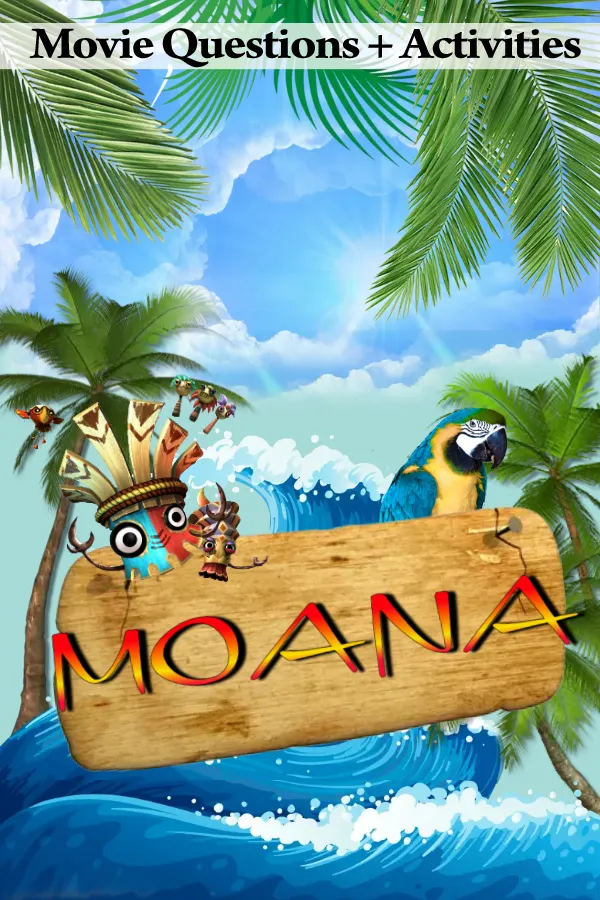
What's Inside the Guide
This is a 21-page classroom-ready resource.
This part covers two pre-viewing activities.
- Thinking and writing about what they already know about legends and myths, then discussing as a class.
- A reading comprehension based on the Polynesian legend How Maui Snared the Sun, with 10 questions to answer.
Two complete sets of 25 questions covering the movie in chronological order. Answer keys are included for both sets.
- Full written answer question set.
- Multiple-choice question set with three options per question, suited to ESL students or those who benefit from a more structured format.
Students draw and write about four main characters: Maui, Moana, Te Fiti, and Tamatoa. For each character they choose personality traits from a word bank, with definitions provided, and answer three additional questions about the character. Works well as an individual task or divided across a group of four.
Students write a story similar to Moana's, using question prompts to help develop their narrative. Once their stories are written, students work in pairs to create a role-play based on their stories and perform it.
This part covers three fun extension activities for students who finish early or as a class wind-down.
- A Moana word search.
- A cryptic puzzle.
- A design task where students create and colour their own Kakamora.
“I used this in our Hawaiian themed summer school class and it was a great resource to get the students engaged!”
— Joanna R.
“This resource was super useful for my Year 5 Moral Studies class, giving me activities to help our discussion of themes. Great materials!”
— Kate S.
Why Watch This Movie With Your Students
Here's what your students naturally take away from the movie, whether through themes, values, ideas, or perspectives.
🌊 A female lead who is defined by courage, not romance. Moana is entirely focused on saving her people. There is no love interest, no prince, and no suggestion that her worth depends on anything other than her own choices. That is worth noting to students, and worth discussing.
🏝️ Genuine Polynesian cultural content. The movie draws on Polynesian mythology, wayfinding traditions, and cultural values in a way that was developed in consultation with an Oceanic Story Trust of cultural advisors. Students come away with real curiosity about the cultures that inspired it.
⚡ A demigod who has to learn humility. Maui starts the movie as self-centred and boastful. His arc toward genuine mentorship and selflessness runs alongside Moana's, giving students two distinct character journeys to track rather than one.
📖 Mythology as living storytelling. The movie is rooted in Polynesian legends about how the world was shaped by gods and demigods. Students who engage with the pre-viewing myths section arrive at the movie with a framework for understanding what they are watching in a deeper way.
🎵 Music that carries real emotional weight. The soundtrack was created collaboratively by Lin-Manuel Miranda and Samoan musician Opetaia Foa'i. The songs move the story forward and reflect the themes of identity and belonging in a way that students notice and respond to.
🥥 Funny, fast-moving, and genuinely scary in places. The coconut pirates, the giant crab Tamatoa, and the lava monster Te Ka keep younger students on the edge of their seats. The comedy and the peril are well balanced, which is why the movie works across a wide age range.
Age Suitability and Content
This movie is rated PG.
⚠️ Things to be aware of:
- A large fiery lava monster is a recurring threat and may frighten younger or more sensitive students
- A giant glowing crab attacks the main characters in a visually intense sequence
- Coconut pirates shoot arrows and poisoned darts at characters
- An elderly character dies, shown gently, and later returns as a spirit. This scene can be upsetting for students who have recently lost someone
- Moana's father yells at her on several occasions
- An elder recounts the story of why Maui was exiled, told in a dark, stylised shadow puppet sequence
- Ocean storms and characters being tossed about by waves
- Mild language: butt, dumb, heiney, and a cut-off insult
- Maui is shirtless throughout. No romantic content
- No substance use
📋 A free editable parent permission slip is available for this movie. It explains the educational benefits of watching movies in class and includes a space for parental consent. → Download Free Permission Slip on TpT (Free resource)
Note for educators: Movie details and age ratings in this post are sourced from IMDb, Common Sense Media, and Wikipedia to help ensure accuracy.
How My Movie Guide Helps You Teach It
Click your subject below to see how this guide supports it:
📚 English Language Arts Teachers
🗣️ ESL and ELL Teachers
🌐 Social Studies Teachers
🎬 Substitute Teachers and Cover Lessons
🏠 Homeschool Parents
🌟 Supporting All Learners A movie gives students a story to follow, and the guide gives them questions to work through as they watch. For students with autism, learning difficulties, and mild to severe disabilities, that combination provides a clear focus for the lesson and a concrete way to show understanding. The format can be useful in special education and learning support classrooms, where teachers need activities that give students a defined task during viewing. Find out more about why movies work for diverse learners.
The social studies connection is based on the Polynesian cultural content woven through the movie and the pre-viewing myths reading. The movie is an imaginative interpretation of those traditions rather than a factual document. It works best as a springboard for cultural curiosity rather than as curriculum-specific content.
How These Guides Work: From Movie to Lesson
Watching a movie is not a break from learning. It reaches students through sight, sound, and story at once, engaging the brain in ways text alone does not, and the structured work around it is what turns the viewing into a genuine lesson. You can read the research behind this on the Why Movies Work page.
- A Teacher Notes and General Directions page opens the guide with a brief overview of everything inside: what the movie is about, then each part of the guide in order with a short description of what it entails. You know what to expect from the whole resource before you hand out a single page, so you can pick up the guide cold and teach it the same day.
- Answer keys are included for the comprehension question sets, so grading is quick and you are not rewatching the movie to check answers. Some guides also include example answers for the creative and written activities.
- Print and go: classroom ready, with no additional preparation needed. Print one the morning you need it and the lesson is ready.
- Substitute and first-timer friendly. A guide can be handed to a substitute or picked up by a teacher covering the topic for the first time. Nobody running the session needs to have seen the movie.
- Differentiated comprehension sets. Most guides include two or three question sets at different difficulty levels, and most include a multiple-choice option that works well for ESL and ELL students. One class set covers your strongest readers, your strugglers, and your language learners without separate prep.
- Activities that go beyond recall. Each guide includes structured activities that ask students to engage with the movie, not just watch it, ranging from creative and written tasks to discussion and critical thinking questions depending on the guide. That variety matters in a mixed classroom: a student who freezes on a written question set may show real understanding through a drawing or a creative task, and a confident writer gets room to go beyond recall. For the teacher, it turns a movie session into work you can grade: comprehension questions show whether students followed the plot, and the activities beyond them show whether they understood it.