By Mr Hull's Movie Guides
Watch the Trailer

What's Inside the Guide
This is a 14-page classroom-ready resource.
Three sets of chronological comprehension questions for differentiation. Answer keys are included for all three sets.
- 35 question set requiring full sentence answers.
- 25 question set (10 removed from the 35-question set).
- 24 multiple choice question set with three possible answers each, with the final question requiring a full sentence response.
- A 6-scene storyboard of what they consider the most important parts of the movie, with a brief description for each scene.
- A synopsis of the movie, written using their storyboard as a guide.
This part covers three activities.
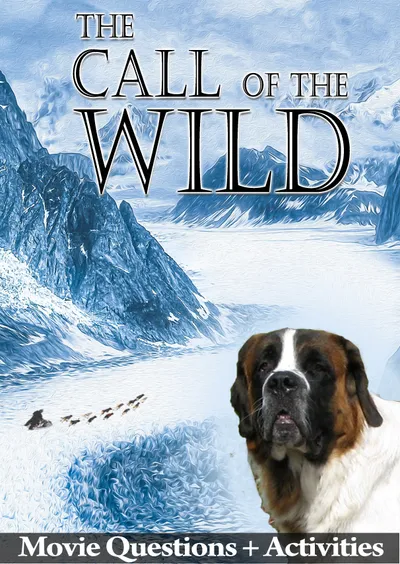
- A profile picture of Buck, with students describing his features and personality, and writing what they like and dislike about him.
- An imaginary map of the area where Buck finds the cabin, labeling features such as the stream, cabin, and wolf den.
- An imagined letter from John Thornton to his estranged wife describing his experiences on the journey.
Why Watch This Movie With Your Students
Here's what your students naturally take away from the movie, whether through themes, values, ideas, or perspectives.
🐕 A dog forced to relearn how to live. Buck goes from a pampered life in California to hard labor in the Yukon, and the movie tracks what that does to him physically and psychologically. Students watch an animal character adapt to conditions that strip away everything comfortable about his old life.
💪 Perseverance and resilience under real hardship. Buck survives abuse, exhaustion, and a rival pack leader by adapting rather than giving up. The movie ties his survival directly to persistence, not luck.
⚖️ Two very different models of how to treat an animal. Hal works his dogs past exhaustion and threatens violence, while John Thornton rescues Buck and nurses him back to health. Students see the practical and moral consequences of both approaches play out.
⛏️ The Klondike Gold Rush as a backdrop, not just scenery. The mail routes, sled dog teams, and desperate prospectors all reflect the real economic pressure of the 1890s gold rush. Students get a sense of what that period demanded from people and animals alike.
🐺 The pull between two lives. Buck spends much of the movie caught between loyalty to Thornton and the growing call of a wild wolf pack. It gives students a concrete way to talk about instinct, belonging, and what home means.
📖 A direct line to a classic novel. Because the movie is adapted from Jack London's 1903 book, it works as a visual companion for comparing the two, showing students how a story changes and what stays the same when it moves from page to screen.
Age Suitability and Content
This movie is rated PG.
⚠️ Things to be aware of:
- The movie contains frequent peril and physical violence, including a dog fight, men fighting, gunfire, and a character's death.
- A dog is struck with a club and other dogs are shown pushed to exhaustion and whipped.
- A man's ongoing drinking is shown negatively and he eventually gives it up.
- There is no sexual content in the movie.
📋 A free editable parent permission slip is available for this movie. It explains the educational benefits of watching movies in class and includes a space for parental consent. → Download Free Permission Slip on TpT (Free resource)
Note for educators: Movie details and age ratings in this post are sourced from IMDb, Common Sense Media, and Wikipedia to help ensure accuracy.
How My Movie Guide Helps You Teach It
Click your subject below to see how this guide supports it:
📚 English Language Arts Teachers
🗣️ ESL and ELL Teachers
🌐 Social Studies Teachers
🎬 Substitute Teachers and Cover Lessons
🏠 Homeschool Parents
💙 SEL Teachers
📜 History Teachers
🌟 Supporting All Learners A movie gives students a story to follow, and the guide gives them questions to work through as they watch. For students with autism, learning difficulties, and mild to severe disabilities, that combination provides a clear focus for the lesson and a concrete way to show understanding. The format can be useful in special education and learning support classrooms, where teachers need activities that give students a defined task during viewing. Find out more about why movies work for diverse learners.
This guide's dedicated activities focus on comprehension, creative writing, and narrative tasks. The social studies, history, and SEL callouts above rely on the comprehension questions for structure and accountability rather than subject specific worksheets.
How These Guides Work: From Movie to Lesson
Watching a movie is not a break from learning. It reaches students through sight, sound, and story at once, engaging the brain in ways text alone does not, and the structured work around it is what turns the viewing into a genuine lesson. You can read the research behind this on the Why Movies Work page.
- A Teacher Notes and General Directions page opens the guide with a brief overview of everything inside: what the movie is about, then each part of the guide in order with a short description of what it entails. You know what to expect from the whole resource before you hand out a single page, so you can pick up the guide cold and teach it the same day.
- Answer keys are included for the comprehension question sets, so grading is quick and you are not rewatching the movie to check answers. Some guides also include example answers for the creative and written activities.
- Print and go: classroom ready, with no additional preparation needed. Print one the morning you need it and the lesson is ready.
- Substitute and first-timer friendly. A guide can be handed to a substitute or picked up by a teacher covering the topic for the first time. Nobody running the session needs to have seen the movie.
- Differentiated comprehension sets. Most guides include two or three question sets at different difficulty levels, and most include a multiple-choice option that works well for ESL and ELL students. One class set covers your strongest readers, your strugglers, and your language learners without separate prep.
- Activities that go beyond recall. Each guide includes structured activities that ask students to engage with the movie, not just watch it, ranging from creative and written tasks to discussion and critical thinking questions depending on the guide. That variety matters in a mixed classroom: a student who freezes on a written question set may show real understanding through a drawing or a creative task, and a confident writer gets room to go beyond recall. For the teacher, it turns a movie session into work you can grade: comprehension questions show whether students followed the plot, and the activities beyond them show whether they understood it.