By Mr Hull's Movie Guides
Watch the Trailer

What's Inside the Guide
This is a 12-page classroom-ready resource.
Three sets of comprehension questions for differentiation. Answers are included. The 20 and 30 question sheets are labeled to make it easy to match questions to grade level or challenge.
- 20 multiple choice question set with three answer options, in chronological order.
- 20 question set requiring full sentence answers.
- 30 question set for higher grades, also requiring full sentence responses.
This part covers several activities.
- Drawing a picture of Ted and George doing something together, then answering four questions about their drawing.
- A word search.
- Three questions asking students to write about times they felt happy, sad, and excited during the movie.
“Great activity to supplement movie”
— Marla F.
Why Watch This Movie With Your Students
Here's what your students naturally take away from the movie, whether through themes, values, ideas, or perspectives.
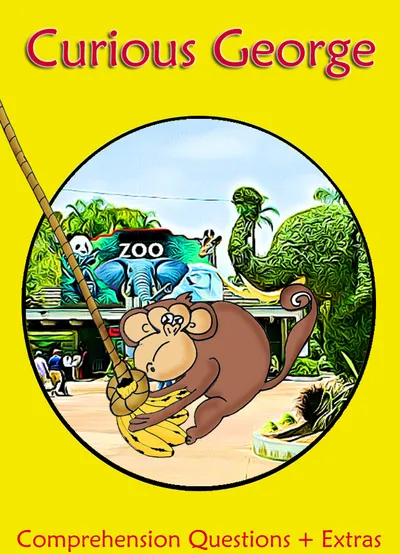
📚 Based on a Classic Children's Book Series. The movie is an origin story built around the classic Curious George books by H. A. Rey and Margret Rey, imagining how the mischievous monkey and his yellow-hatted friend first met. Students who know the books get to see familiar moments, like George floating away on balloons, brought to life on screen.
🐒 Curiosity Drives Every Scene. George's endless curiosity gets him into trouble again and again, from painting an apartment wall to setting off a rocket, but it also leads him to real discoveries. Students see curiosity treated as a genuine strength rather than something to be shut down, even when it causes a mess.
🤝 An Unlikely Friendship. A lonely museum tour guide and an even lonelier monkey slowly build a friendship neither of them expected, despite having almost nothing in common at the start. Watching that relationship grow gives students a concrete example of how patience and care turn strangers into family.
🏛️ A Case for Why Museums Matter. Much of the plot turns on saving a struggling museum from being replaced with a parking lot, giving the movie a clear stance on the value of places built for curiosity and learning. It is a light way to get students thinking about why museums, libraries, and other community spaces are worth protecting.
🎵 A Soundtrack That Tells the Story. Musician Jack Johnson wrote and performed original songs for the movie, using them almost as narration since George never speaks. The music carries much of George's personality and emotion, giving students an example of how a soundtrack can do storytelling work that dialogue cannot.
🌟 Low Stakes, High Warmth. The movie's conflicts stay light and comedic even at their most tense moments, keeping the tone gentle and reassuring for young viewers. That makes it an easy, low-pressure watch for a classroom, with nothing in the story that lingers as frightening once the credits roll.
Age Suitability and Content
This movie is rated G.
⚠️ Things to be aware of:
- Two adult characters flirt over the course of the movie, with a brief kiss near the end.
- A tense stretch involves the monkey being taken away by animal control, which resolves by the movie's end.
- Comic slapstick, including a tranquilizer dart and a few chaotic city chases, is played for laughs rather than real danger.
- The movie contains no strong language or drug and alcohol content beyond a passing glimpse of a cigarette holder.
Note for educators: Movie details and age ratings in this post are sourced from IMDb, Common Sense Media, and Wikipedia to help ensure accuracy.
How My Movie Guide Helps You Teach It
Click your subject below to see how this guide supports it:
📚 English Language Arts Teachers
🗣️ ESL and ELL Teachers
🎬 Substitute Teachers and Cover Lessons
🏠 Homeschool Parents
💙 SEL Teachers
🌟 Supporting All Learners A movie gives students a story to follow, and the guide gives them questions to work through as they watch. For students with autism, learning difficulties, and mild to severe disabilities, that combination provides a clear focus for the lesson and a concrete way to show understanding. The format can be useful in special education and learning support classrooms, where teachers need activities that give students a defined task during viewing. Find out more about why movies work for diverse learners.
How These Guides Work: From Movie to Lesson
Watching a movie is not a break from learning. It reaches students through sight, sound, and story at once, engaging the brain in ways text alone does not, and the structured work around it is what turns the viewing into a genuine lesson. You can read the research behind this on the Why Movies Work page.
- A Teacher Notes and General Directions page opens the guide with a brief overview of everything inside: what the movie is about, then each part of the guide in order with a short description of what it entails. You know what to expect from the whole resource before you hand out a single page, so you can pick up the guide cold and teach it the same day.
- Answer keys are included for the comprehension question sets, so grading is quick and you are not rewatching the movie to check answers. Some guides also include example answers for the creative and written activities.
- Print and go: classroom ready, with no additional preparation needed. Print one the morning you need it and the lesson is ready.
- Substitute and first-timer friendly. A guide can be handed to a substitute or picked up by a teacher covering the topic for the first time. Nobody running the session needs to have seen the movie.
- Differentiated comprehension sets. Most guides include two or three question sets at different difficulty levels, and most include a multiple-choice option that works well for ESL and ELL students. One class set covers your strongest readers, your strugglers, and your language learners without separate prep.
- Activities that go beyond recall. Each guide includes structured activities that ask students to engage with the movie, not just watch it, ranging from creative and written tasks to discussion and critical thinking questions depending on the guide. That variety matters in a mixed classroom: a student who freezes on a written question set may show real understanding through a drawing or a creative task, and a confident writer gets room to go beyond recall. For the teacher, it turns a movie session into work you can grade: comprehension questions show whether students followed the plot, and the activities beyond them show whether they understood it.