By Mr Hull's Movie Guides
Watch the Trailer

What's Inside the Guide
This is a 14-page classroom-ready resource.
Three differentiated sets of chronological comprehension questions. Answer keys are included for all three sets.
- 47 question set requiring full sentence answers.
- 30 question set (17 removed for a shorter option).
- 30 multiple choice question set with 3 possible answers each. The multiple choice set works well for ESL and ELL students.
This part covers three activities.
- A 9 scene storyboard depicting what they judge to be the most important parts of the movie, with a brief description for each scene.
- A synopsis of the movie, written using that storyboard.
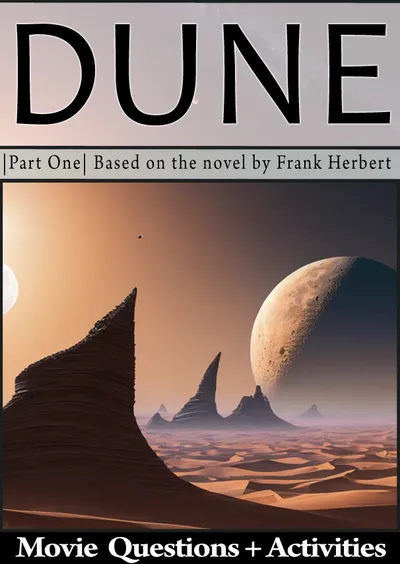
- An imaginary map of the city of Arrakis as depicted by the Harkonnens for their attack, including key points and vulnerabilities, along with a strategic plan of attack as similar as possible to what was seen in the movie.
Why Watch This Movie With Your Students
Here's what your students naturally take away from the movie, whether through themes, values, ideas, or perspectives.
🏜️ A war built on control of a single resource. House Harkonnen and House Atreides are both drawn into conflict over spice, the substance that makes interstellar travel possible and the only resource the planet Arrakis produces. The movie treats control of that resource as the root of nearly every decision made by every faction, giving students a clear entry point into discussing resource-driven conflict.
👑 A family caught between exploitation and partnership. House Harkonnen ruled Arrakis through open oppression of the native Fremen, while House Atreides arrives intending to work alongside them instead. The contrast gives students a concrete way to discuss colonization and the difference between occupying a place and genuinely partnering with the people who live there.
🔮 A young heir wrestling with prophecy and identity. Paul begins to suspect that visions he has been having point to him being the fulfillment of a Fremen prophecy, though the movie leaves open whether that belief is destiny or manipulation. His uncertainty about his own role gives students a way into discussing how power and belief can shape a person's sense of identity.
🐛 Giant sandworms and a fully realized alien ecosystem. Arrakis is shown as a harsh, worm-patrolled desert environment with its own rules for survival, from protective suits that recycle moisture to the extreme danger of moving in rhythm across open sand. The movie's attention to environmental detail offers a concrete example of how a fictional ecosystem can be built with internal logic.
⚔️ A father's death and a son's response to loss. Duke Leto is betrayed and killed during the Harkonnen invasion, and Paul's response to that loss, choosing to commit to the Fremen and his father's unfinished goals, drives the rest of the story. It gives students a clear example of how grief can shape a character's choices without the movie stating the connection outright.
🎬 A large-scale adaptation of an influential novel. The movie adapts the first half of Frank Herbert's 1965 novel, a book widely regarded as having shaped later science fiction. Its scale and pacing choices offer a starting point for discussing how filmmakers adapt long, complex source material for the screen.
Age Suitability and Content
This movie is rated PG-13.
⚠️ Things to be aware of:
- The movie includes frequent sci-fi combat with guns, knives, and other weapons, along with battle sequences, explosions, and a few beheadings.
- Characters are shot, stabbed, and one is swallowed by a giant sandworm, though blood shown on screen is minimal.
- Mild language includes words like 'hell,' 'crap,' 'ass,' and 'damn.'
- There is brief kissing between two characters, and one scene shows a man appearing naked with nothing explicit shown.
- A fictional drug called spice plays a central role in the plot, but it is not shown being abused, and there is no alcohol or tobacco use of note.
📋 A free editable parent permission slip is available for this movie. It explains the educational benefits of watching movies in class and includes a space for parental consent. → Download Free Permission Slip on TpT (Free resource)
Note for educators: Movie details and age ratings in this post are sourced from IMDb, Common Sense Media, and Wikipedia to help ensure accuracy.
How My Movie Guide Helps You Teach It
Click your subject below to see how this guide supports it:
📚 English Language Arts Teachers
🗣️ ESL and ELL Teachers
🌐 Social Studies Teachers
🎬 Substitute Teachers and Cover Lessons
🏠 Homeschool Parents
🌟 Supporting All Learners A movie gives students a story to follow, and the guide gives them questions to work through as they watch. For students with autism, learning difficulties, and mild to severe disabilities, that combination provides a clear focus for the lesson and a concrete way to show understanding. The format can be useful in special education and learning support classrooms, where teachers need activities that give students a defined task during viewing. Find out more about why movies work for diverse learners.
The Social Studies connection here comes from the movie's content, not from a dedicated activity in the guide.
How These Guides Work: From Movie to Lesson
Watching a movie is not a break from learning. It reaches students through sight, sound, and story at once, engaging the brain in ways text alone does not, and the structured work around it is what turns the viewing into a genuine lesson. You can read the research behind this on the Why Movies Work page.
- A Teacher Notes and General Directions page opens the guide with a brief overview of everything inside: what the movie is about, then each part of the guide in order with a short description of what it entails. You know what to expect from the whole resource before you hand out a single page, so you can pick up the guide cold and teach it the same day.
- Answer keys are included for the comprehension question sets, so grading is quick and you are not rewatching the movie to check answers. Some guides also include example answers for the creative and written activities.
- Print and go: classroom ready, with no additional preparation needed. Print one the morning you need it and the lesson is ready.
- Substitute and first-timer friendly. A guide can be handed to a substitute or picked up by a teacher covering the topic for the first time. Nobody running the session needs to have seen the movie.
- Differentiated comprehension sets. Most guides include two or three question sets at different difficulty levels, and most include a multiple-choice option that works well for ESL and ELL students. One class set covers your strongest readers, your strugglers, and your language learners without separate prep.
- Activities that go beyond recall. Each guide includes structured activities that ask students to engage with the movie, not just watch it, ranging from creative and written tasks to discussion and critical thinking questions depending on the guide. That variety matters in a mixed classroom: a student who freezes on a written question set may show real understanding through a drawing or a creative task, and a confident writer gets room to go beyond recall. For the teacher, it turns a movie session into work you can grade: comprehension questions show whether students followed the plot, and the activities beyond them show whether they understood it.