By Mr Hull's Movie Guides
Watch the Trailer
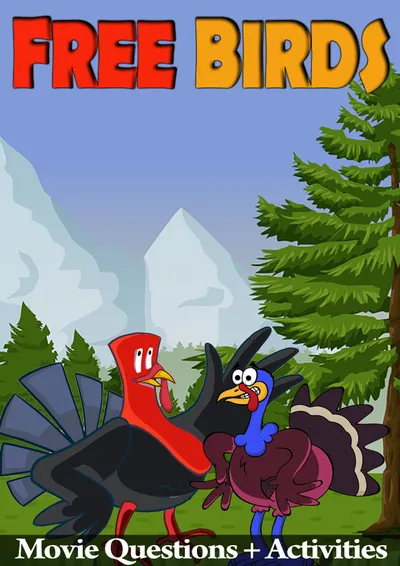
What's Inside the Guide
This is a 18-page classroom-ready resource.
All of the comprehension questions are made while I watch the movie, with the additional activities created to connect directly with its themes and story.
Three differentiated sets of questions in chronological order. Answer keys are included for all three sets.
- 40 question set.
- 30 question set drawn from the first set with 10 removed.
- 30 multiple-choice question set.
Common Core Anchor Standards: R.1 · SL.2
Read closely to determine what the text says explicitly and to make logical inferences from it; cite specific textual evidence when writing or speaking to support conclusions drawn from the text.
Students answer 40 chronological questions (a 30 question set and a multiple choice set are also included) on details the movie shows outright, such as who saved Reggie, what happened when Reggie hit the garden shears and who they met in the trees.
Integrate and evaluate information presented in diverse media and formats, including visually, quantitatively, and orally.
The questions can only be answered from what students saw and heard in the movie, such as what Reggie accidentally set off, what the Great Turkey gave to Jake and why Jenny said she and Reggie had to go back.
- A 9-scene storyboard illustrating pivotal events from the movie, with a short description explaining the main idea of each scene.
- A synopsis of the movie, written using the storyboard as a guide.
Common Core Anchor Standards: R.2 · W.4
Determine central ideas or themes of a text and analyze their development; summarize the key supporting details and ideas.
Students draw nine scenes in order with a brief description of each, so they must decide which events matter most across the whole movie, then use the storyboard to write a synopsis of it.
Produce clear and coherent writing in which the development, organization, and style are appropriate to task, purpose, and audience.
The synopsis is a clear, organized piece of writing built from the storyboard, so students must put the events in order from the beginning to the ending and keep the writing focused on the main story.
This part covers two activities.
- Character profiles for Reggie, Jake, and Jenny, drawing a profile picture and describing each character's features, personality, and likes and dislikes.
- An acrostic activity, writing a sentence for each letter in the words 'Free Birds', followed by sentences about moments in the movie where they felt happy, sad, and excited.
A just-for-fun word search featuring 15 words connected to the movie. Students answer clues to identify 5 of the words before locating all 15 in the grid. An answer key is included.
Common Core Anchor Standards throughout the guide: L.1 · L.2
Demonstrate command of the conventions of standard English grammar and usage when writing or speaking.
Students are expected to follow standard English grammar and usage in everything they write in this guide.
Demonstrate command of the conventions of standard English capitalization, punctuation, and spelling when writing.
Students are expected to use correct capitalization, punctuation and spelling in everything they write in this guide.
“My students enjoyed this fun activity that allowed them to review in a differentiated way. I will use it again. :)”
— Brittany T.
“This is my favorite thanksgiving movie. I was so excited to find a resource that went with it and was so well developed. Thank you. ”
— Tabler's Teaching Tidbits (TPT Seller)
Why Watch This Movie With Your Students
Here's what your students naturally take away from the movie, whether through themes, values, ideas, or perspectives.
🦃 A familiar holiday seen from an unfamiliar angle. By telling the Thanksgiving story from the turkeys' perspective, the movie takes a subject students already know and reframes it, which can prompt thinking about whose viewpoint stories are usually told from.
⏰ A time-travel plot that links two time periods. The journey from the present day back to 1621 Plymouth gives the story a clear structure, moving between a modern setting and a historical one and inviting comparison between the two.
🤝 An unlikely partnership at the center of the story. Reggie and Jake have very different personalities and approaches, and their mismatched partnership drives much of the movie's comedy and conflict.
😂 Broad, accessible comedy. The movie leans on slapstick and physical humor throughout, keeping the pace light even as the plot gets more complicated.
🏛️ A setting tied to the first Thanksgiving. The 1621 Plymouth setting connects the movie to the historical event most associated with the holiday, giving it a clear seasonal tie-in for classrooms.
Age Suitability and Content
This movie is rated PG.
⚠️ Things to be aware of:
- Several scenes involve guns and hunting, including turkeys being chased and caged, without graphic injury shown.
- Mild insults such as 'dumb' and 'coward' appear in dialogue.
- One brief scene shows a character watching a romance-themed show on television.
- No strong language or substance use is present.
📋 A free editable parent permission slip is available for this movie. It explains the educational benefits of watching movies in class and includes a space for parental consent. → Download Free Permission Slip on TpT (Free resource)
Note for educators: Movie details and age ratings in this post are sourced from IMDb, Common Sense Media, and Wikipedia to help ensure accuracy.
How My Movie Guide Helps You Teach It
Click your subject below to see how this guide supports it:
📚 English Language Arts Teachers
🗣️ ESL and ELL Teachers
🌐 Social Studies Teachers
🎬 Substitute Teachers and Cover Lessons
🏠 Homeschool Parents
📜 History Teachers
🌟 Supporting All Learners A movie gives students a story to follow, and the guide gives them questions to work through as they watch. For students with autism, learning difficulties, and mild to severe disabilities, that combination provides a clear focus for the lesson and a concrete way to show understanding. The format can be useful in special education and learning support classrooms, where teachers need activities that give students a defined task during viewing. Find out more about why movies work for diverse learners.
How These Guides Work: From Movie to Lesson
Watching a movie is not a break from learning. It reaches students through sight, sound, and story at once, engaging the brain in ways text alone does not, and the structured work around it is what turns the viewing into a genuine lesson. You can read the research behind this on the Why Movies Work page.
- A Teacher Notes and General Directions page opens the guide with a brief overview of everything inside: what the movie is about, then each part of the guide in order with a short description of what it entails. You know what to expect from the whole resource before you hand out a single page, so you can pick up the guide cold and teach it the same day.
- Answer keys are included for the comprehension question sets, so grading is quick and you are not rewatching the movie to check answers. Some guides also include example answers for the creative and written activities.
- Print and go: classroom ready, with no additional preparation needed. Print one the morning you need it and the lesson is ready.
- Substitute and first-timer friendly. A guide can be handed to a substitute or picked up by a teacher covering the topic for the first time. Nobody running the session needs to have seen the movie.
- Differentiated comprehension sets. Most guides include two or three question sets at different difficulty levels, and most include a multiple-choice option that works well for ESL and ELL students. One class set covers your strongest readers, your strugglers, and your language learners without separate prep.
- Activities that go beyond recall. Each guide includes structured activities that ask students to engage with the movie, not just watch it, ranging from creative and written tasks to discussion and critical thinking questions depending on the guide. That variety matters in a mixed classroom: a student who freezes on a written question set may show real understanding through a drawing or a creative task, and a confident writer gets room to go beyond recall. For the teacher, it turns a movie session into work you can grade: comprehension questions show whether students followed the plot, and the activities beyond them show whether they understood it.