By Mr Hull's Movie Guides
Watch the Trailer

What's Inside the Guide
This is a 7-page classroom-ready resource.
Two sets of chronological comprehension questions for differentiation. Answer keys are included for both sets.
- 20 question set requiring full sentence answers.
- 20 multiple choice question set with 3 possible answers per question. The multiple choice set also works well for ESL and ELL students.
Students use the comprehension questions to help with sequencing.
- A 9 scene storyboard of what they believe are the most important parts of the short film, with a brief description for each scene.
- A synopsis of the film, written using their completed storyboard as a guide.
Students imagine two other different ways Henry could have used his skill to raise money for hospitals and orphanages, then explain what a typical day in that version of his life would look like.
Why Watch This Movie With Your Students
Here's what your students naturally take away from the movie, whether through themes, values, ideas, or perspectives.
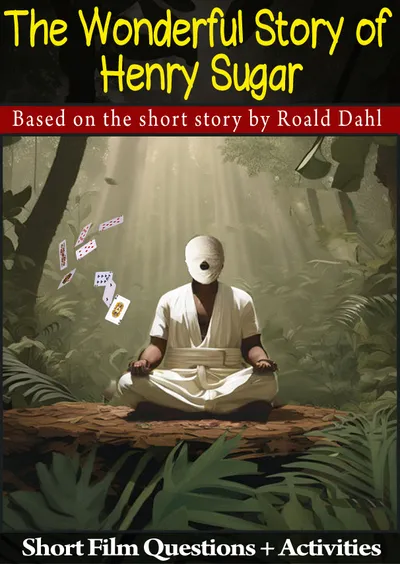
🃏 A story about what wealth is for. Henry starts out as a man with no reason to work for anything and no interest in anyone else, and the story tracks what happens once he gains a skill he originally only wanted for personal gain. Students see a clear turning point where usefulness to other people becomes more compelling to him than winning for its own sake.
🧘 Self-control shown as something built through years of effort, not willpower alone. Henry only gains his ability to see without his eyes after years of disciplined practice, mirroring the training the yogi and the circus performer went through before him. It gives students a concrete example of mastery as a slow, repeated process rather than a single moment of insight.
📖 A story told through layers of narration. The movie is structured as a story within a story within a story, a narrator recounting a doctor's account of a circus performer's account of a yogi's teaching, all building toward Henry's own choices. It's a clear, visual way to show students how narrative distance and multiple narrators can shape how a single story gets told.
🎲 A turning point sparked by a single unplanned reaction. Henry only redirects his fortune toward hospitals and orphanages after his attempt to give money away carelessly nearly causes a riot in the street. Students get to see how one moment of consequence, not a grand plan, can permanently change the direction of someone's life.
🌍 A found purpose that plays out over decades, not a single act. Rather than treating Henry's change of heart as an ending, the story follows him travelling the world under disguises for the rest of his life, using his skill again and again to fund the same cause. It shows students that a genuine change in someone's values tends to look like a sustained pattern, not a one-time decision.
🕯️ A quiet ending that ties Henry's foresight back to his choices. Henry's trained sight lets him see the blood clot that will eventually kill him, and he meets his death having spent decades using his ability for other people instead of himself. It gives students a clear, understated point of closure to a story about what someone chooses to do with an unusual gift.
Age Suitability and Content
This movie is rated PG.
⚠️ Things to be aware of:
- A character smokes on screen several times.
- A man is said to die by natural causes.
- A scar from being struck with a stone is mentioned.
- Mild language is limited to the word 'idiot.'
- There is no sexual content or nudity in the movie.
📋 A free editable parent permission slip is available for this movie. It explains the educational benefits of watching movies in class and includes a space for parental consent. → Download Free Permission Slip on TpT (Free resource)
Note for educators: Movie details and age ratings in this post are sourced from IMDb, Common Sense Media, and Wikipedia to help ensure accuracy.
How My Movie Guide Helps You Teach It
Click your subject below to see how this guide supports it:
📚 English Language Arts Teachers
🗣️ ESL and ELL Teachers
🎬 Substitute Teachers and Cover Lessons
🏠 Homeschool Parents
💙 SEL Teachers
🌟 Supporting All Learners A movie gives students a story to follow, and the guide gives them questions to work through as they watch. For students with autism, learning difficulties, and mild to severe disabilities, that combination provides a clear focus for the lesson and a concrete way to show understanding. The format can be useful in special education and learning support classrooms, where teachers need activities that give students a defined task during viewing. Find out more about why movies work for diverse learners.
How These Guides Work: From Movie to Lesson
Watching a movie is not a break from learning. It reaches students through sight, sound, and story at once, engaging the brain in ways text alone does not, and the structured work around it is what turns the viewing into a genuine lesson. You can read the research behind this on the Why Movies Work page.
- A Teacher Notes and General Directions page opens the guide with a brief overview of everything inside: what the movie is about, then each part of the guide in order with a short description of what it entails. You know what to expect from the whole resource before you hand out a single page, so you can pick up the guide cold and teach it the same day.
- Answer keys are included for the comprehension question sets, so grading is quick and you are not rewatching the movie to check answers. Some guides also include example answers for the creative and written activities.
- Print and go: classroom ready, with no additional preparation needed. Print one the morning you need it and the lesson is ready.
- Substitute and first-timer friendly. A guide can be handed to a substitute or picked up by a teacher covering the topic for the first time. Nobody running the session needs to have seen the movie.
- Differentiated comprehension sets. Most guides include two or three question sets at different difficulty levels, and most include a multiple-choice option that works well for ESL and ELL students. One class set covers your strongest readers, your strugglers, and your language learners without separate prep.
- Activities that go beyond recall. Each guide includes structured activities that ask students to engage with the movie, not just watch it, ranging from creative and written tasks to discussion and critical thinking questions depending on the guide. That variety matters in a mixed classroom: a student who freezes on a written question set may show real understanding through a drawing or a creative task, and a confident writer gets room to go beyond recall. For the teacher, it turns a movie session into work you can grade: comprehension questions show whether students followed the plot, and the activities beyond them show whether they understood it.