By Mr Hull's Movie Guides
Watch the Trailer

What's Inside the Guide
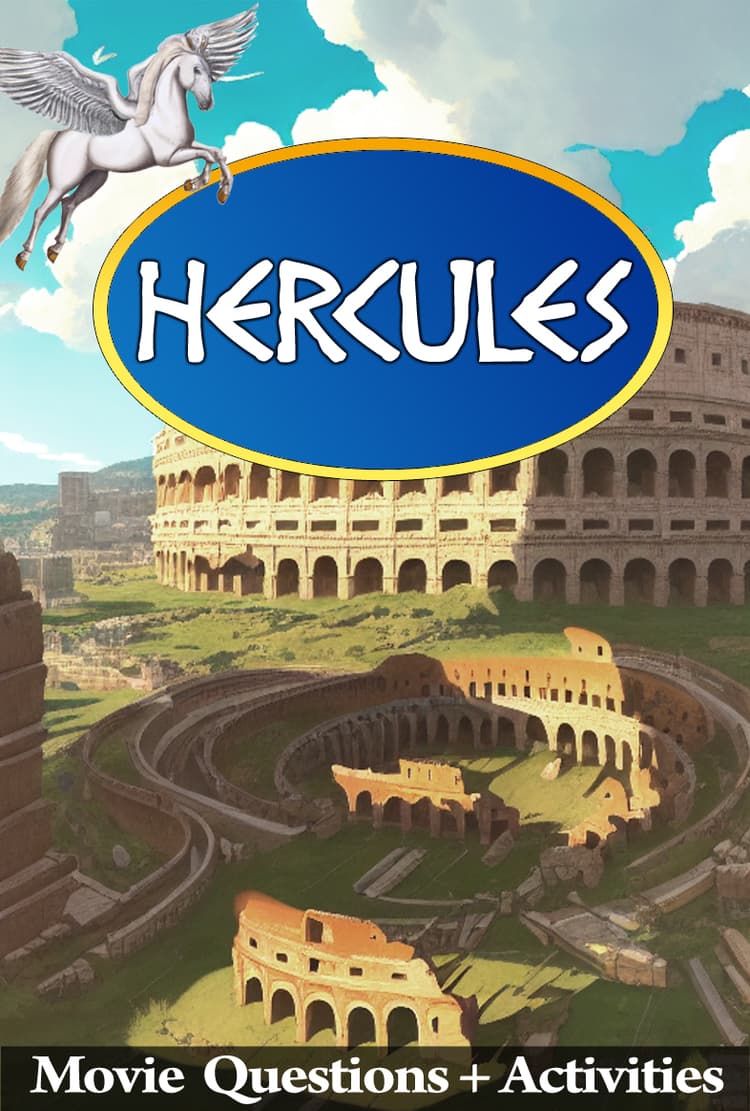
This is a 11-page classroom-ready resource.
Two full sets of comprehension questions in chronological order, built for differentiation. Answer keys are included for both sets.
- 35 question set requiring full sentence answers.
- 34 multiple choice question set with three possible answers each, with one question (Q14) still requiring a full sentence response. This multiple choice set also works well for ESL and ELL students.
The comprehension questions are available to help them sequence events.
- A nine scene storyboard covering what they consider the most important parts of the movie, including a brief description for each scene.
- A synopsis of the movie, written using their completed storyboard as a guide.
This part covers two activities.
- Character writing, where students choose one of the movie's characters and write about them following guided question prompts, along with drawing a picture of their chosen character.
- Imagining themselves as junior reporters in Thebes interviewing Hercules and Phil about the final battle with Hades and the Titans, writing a short newspaper article that includes quotes from the imagined interview and a drawing.
“I love these guides! They come with a multiple choice version that is easier for students to answer as they watch. The questions truly are about student understanding, and are not thought provoking so students can easily watch the movie still.”
— Sara P.
“Super fun to help close out lessons on Greek mythology!”
— Savanna W.
Why Watch This Movie With Your Students
Here's what your students naturally take away from the movie, whether through themes, values, ideas, or perspectives.
🏛️ Introduces the major figures of Greek mythology. Zeus, Hera, Hades, Hermes, and the three Fates all appear as characters, giving students an entry point into figures they will meet again in literature and history classes. For students who don't already know Greek mythology, the movie works as a first introduction to several of these gods and goddesses.
🌟 Explores celebrity versus genuine heroism. After Hercules defeats the Hydra, he becomes an instant celebrity with his name on sandals, dolls, and a drink, and the movie treats that fame as hollow next to real heroism. It gives students a concrete example to compare with how society treats celebrities and athletes today.
🐍 Delivers a genuinely tense monster battle. The fight with the multi-headed Hydra is one of the movie's centerpieces, built through a mix of hand-drawn and computer animation. It's a strong example of how animated storytelling can build real tension without relying on realism.
💔 Builds its ending around sacrifice, not strength. Hercules only becomes a true hero when he gives up his own life to save Megara, not when he wins a fight. That twist gives students a clear, discussable example of a story defining heroism through what a character is willing to give up rather than what they can defeat.
🎭 Plays with the gap between myth and adaptation. The movie borrows names and figures from Greek mythology, Zeus, Hades, Pegasus, the River Styx, while changing or simplifying much of the actual mythology. That gap gives students a natural way to compare a popular adaptation against original source material.
🎵 Uses a gospel influenced musical score to narrate the story. The five Muses act as a Greek chorus, singing much of the movie's exposition. It's an accessible entry point for students into how music and narration work together in storytelling.
Age Suitability and Content
This movie is rated G.
⚠️ Things to be aware of:
- The Hydra battle includes the monster's heads being sliced off, shown with green slime rather than blood.
- The underworld includes images of dead souls in a river.
- Hercules and Meg share a few brief kisses, and one scene shows Meg attempting to seduce him.
- Hades smokes a cigar and drinks in one scene; gods are shown drinking wine at a celebration.
- Language is limited to mild insults such as 'freak' and 'sweetcheeks.' There is no strong language, drug use, or explicit sexual content.
Note for educators: Movie details and age ratings in this post are sourced from IMDb, Common Sense Media, and Wikipedia to help ensure accuracy.
How My Movie Guide Helps You Teach It
Click your subject below to see how this guide supports it:
📚 English Language Arts Teachers
🗣️ ESL and ELL Teachers
🌐 Social Studies Teachers
🎬 Substitute Teachers and Cover Lessons
🏠 Homeschool Parents
💙 SEL Teachers
🎵 Music Teachers
🌟 Supporting All Learners A movie gives students a story to follow, and the guide gives them questions to work through as they watch. For students with autism, learning difficulties, and mild to severe disabilities, that combination provides a clear focus for the lesson and a concrete way to show understanding. The format can be useful in special education and learning support classrooms, where teachers need activities that give students a defined task during viewing. Find out more about why movies work for diverse learners.
How These Guides Work: From Movie to Lesson
Watching a movie is not a break from learning. It reaches students through sight, sound, and story at once, engaging the brain in ways text alone does not, and the structured work around it is what turns the viewing into a genuine lesson. You can read the research behind this on the Why Movies Work page.
- A Teacher Notes and General Directions page opens the guide with a brief overview of everything inside: what the movie is about, then each part of the guide in order with a short description of what it entails. You know what to expect from the whole resource before you hand out a single page, so you can pick up the guide cold and teach it the same day.
- Answer keys are included for the comprehension question sets, so grading is quick and you are not rewatching the movie to check answers. Some guides also include example answers for the creative and written activities.
- Print and go: classroom ready, with no additional preparation needed. Print one the morning you need it and the lesson is ready.
- Substitute and first-timer friendly. A guide can be handed to a substitute or picked up by a teacher covering the topic for the first time. Nobody running the session needs to have seen the movie.
- Differentiated comprehension sets. Most guides include two or three question sets at different difficulty levels, and most include a multiple-choice option that works well for ESL and ELL students. One class set covers your strongest readers, your strugglers, and your language learners without separate prep.
- Activities that go beyond recall. Each guide includes structured activities that ask students to engage with the movie, not just watch it, ranging from creative and written tasks to discussion and critical thinking questions depending on the guide. That variety matters in a mixed classroom: a student who freezes on a written question set may show real understanding through a drawing or a creative task, and a confident writer gets room to go beyond recall. For the teacher, it turns a movie session into work you can grade: comprehension questions show whether students followed the plot, and the activities beyond them show whether they understood it.