By Mr Hull's Movie Guides
Watch the Trailer

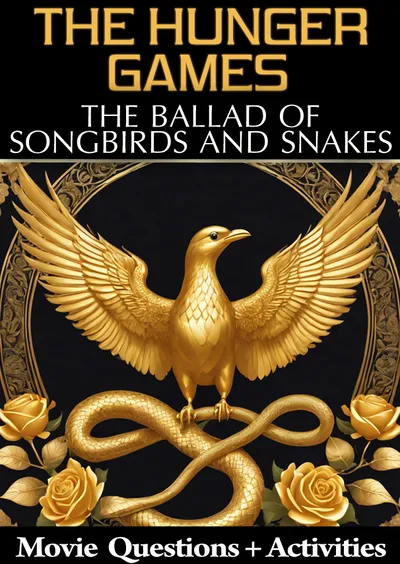
What's Inside the Guide
This is a 14-page classroom-ready resource.
Two sets of chronological comprehension questions for differentiation, each covering three parts of the movie: The Mentor, The Prize, and The Peacekeeper. Answer keys are included for both sets.
- 52 question set requiring full sentence answers.
- 52 multiple choice question set with 3 possible answers each. The multiple choice set may also work well with ESL and ELL students.
- A nine scene storyboard depicting what they believe are the most important parts of the movie, with a brief description for each scene.
- A synopsis of the movie, written using that storyboard.
This part covers two activities.
- Choosing any character from the movie to write about, including a drawing.
- A short scene depicting an action that happened off-screen for three specific characters: Lucy Gray's journey from the reaping ceremony to the Capitol, Sejanus bribing the Peacekeeper so he could sneak into the arena, and Spruce taking the guns to the log cabin in the woods by the lake.
“This The Hunger Games: The Ballad of Songbirds & Snakes Movie Guide & Activities is a ready-to-go win in my classroom. The differentiated questions, storyboard activity, and character work kept my students actively participating and thinking beyond just "what happened." A fantastic resource for a full movie day or to tie into a novel/dystopian unit. Highly recommend!”
— Miss Hooks and Books (TPT Seller)
“LOVE using this with my Dystopian film & lit elective!”
— Amy M.
Why Watch This Movie With Your Students
Here's what your students naturally take away from the movie, whether through themes, values, ideas, or perspectives.
🐍 Traces the making of a villain in real time. Rather than presenting Coriolanus Snow as an already-formed tyrant, the movie follows the specific choices, betrayals, and justifications that shape him into the man seen in the original Hunger Games. Students can identify the exact moments where he chooses ambition over loyalty or decency.
⚖️ Explores staying true to a moral compass under extreme pressure. Characters around Coriolanus respond differently to the same corrupt system, some holding onto empathy and principle even as others learn they will do whatever it takes to survive or get ahead. The contrast gives students a concrete way to examine how people justify their choices under pressure.
🏛️ Examines how authoritarian systems justify themselves. The Capitol's Gamemakers and academy figures argue for the necessity of the Hunger Games using reasoning that reveals how power structures rationalize cruelty. Students get direct access to the logic characters use to defend a brutal system rather than simply being told it is wrong.
🎤 Builds empathy through music and performance. Lucy Gray's singing becomes her most powerful tool for survival, winning over Capitol audiences and shaping how Coriolanus and others see her throughout the story. The movie ties her musical talent directly to questions of manipulation, audience, and public image.
🤝 Shows friendship tested by ambition. Coriolanus's relationship with his classmate Sejanus, who is critical of the Capitol and genuinely selfless, is steadily eroded by Coriolanus's willingness to prioritize his own advancement. Their friendship becomes a measure of how far Coriolanus is willing to go against someone who trusted him.
🌾 Offers a prequel lens on a familiar dystopian world. Set 64 years before the original Hunger Games, the movie expands students' understanding of Panem's history and the origins of its traditions and cruelties. Watching the system take shape gives students a deeper foundation for understanding the world of the original trilogy.
Age Suitability and Content
This movie is rated PG-13.
⚠️ Things to be aware of:
- Frequent graphic violence throughout, including on-screen killings during the Hunger Games arena sequences, executions, and hand-to-hand combat with weapons.
- A scene shows several tributes bitten and killed by snakes released into the arena.
- A public execution by hanging is shown on screen.
- A supporting character struggles with drug addiction and is shown acting impaired.
- Brief romantic content includes hand-holding, embracing, and a small number of kisses.
- Language includes a single use each of two mild profanities.
📋 A free editable parent permission slip is available for this movie. It explains the educational benefits of watching movies in class and includes a space for parental consent. → Download Free Permission Slip on TpT (Free resource)
Note for educators: Movie details and age ratings in this post are sourced from IMDb, Common Sense Media, and Wikipedia to help ensure accuracy.
How My Movie Guide Helps You Teach It
Click your subject below to see how this guide supports it:
📚 English Language Arts Teachers
🗣️ ESL and ELL Teachers
🌐 Social Studies Teachers
🎬 Substitute Teachers and Cover Lessons
🏠 Homeschool Parents
💙 SEL Teachers
🌟 Supporting All Learners A movie gives students a story to follow, and the guide gives them questions to work through as they watch. For students with autism, learning difficulties, and mild to severe disabilities, that combination provides a clear focus for the lesson and a concrete way to show understanding. The format can be useful in special education and learning support classrooms, where teachers need activities that give students a defined task during viewing. Find out more about why movies work for diverse learners.
Social Studies use here draws on the movie's fictional depiction of authoritarian power and propaganda; the guide itself is not written as a dedicated Social Studies resource.
How These Guides Work: From Movie to Lesson
Watching a movie is not a break from learning. It reaches students through sight, sound, and story at once, engaging the brain in ways text alone does not, and the structured work around it is what turns the viewing into a genuine lesson. You can read the research behind this on the Why Movies Work page.
- A Teacher Notes and General Directions page opens the guide with a brief overview of everything inside: what the movie is about, then each part of the guide in order with a short description of what it entails. You know what to expect from the whole resource before you hand out a single page, so you can pick up the guide cold and teach it the same day.
- Answer keys are included for the comprehension question sets, so grading is quick and you are not rewatching the movie to check answers. Some guides also include example answers for the creative and written activities.
- Print and go: classroom ready, with no additional preparation needed. Print one the morning you need it and the lesson is ready.
- Substitute and first-timer friendly. A guide can be handed to a substitute or picked up by a teacher covering the topic for the first time. Nobody running the session needs to have seen the movie.
- Differentiated comprehension sets. Most guides include two or three question sets at different difficulty levels, and most include a multiple-choice option that works well for ESL and ELL students. One class set covers your strongest readers, your strugglers, and your language learners without separate prep.
- Activities that go beyond recall. Each guide includes structured activities that ask students to engage with the movie, not just watch it, ranging from creative and written tasks to discussion and critical thinking questions depending on the guide. That variety matters in a mixed classroom: a student who freezes on a written question set may show real understanding through a drawing or a creative task, and a confident writer gets room to go beyond recall. For the teacher, it turns a movie session into work you can grade: comprehension questions show whether students followed the plot, and the activities beyond them show whether they understood it.