By Mr Hull's Movie Guides
Watch the Trailer

Why Watch This Movie With Your Students
Here's what your students naturally take away from the movie, whether through themes, values, ideas, or perspectives.
🧩 Explores identity under pressure. Tris spends the movie grappling with who she is and what she's capable of once her old certainties collapse. Her struggle with guilt, selflessness, and courage gives students a concrete character study in how identity is tested rather than fixed.
🏛️ Questions authority and control. Jeanine's rule depends on fear, surveillance, and controlling information, and the movie shows what happens when that control starts to break down. It's a clear way into conversations about propaganda and how those in power justify their actions.
⚖️ Examines a society built on rigid categories. The faction system divides an entire city by personality trait, and the movie shows the cost of forcing people into fixed identities. Students can use this as a way to think about conformity, individuality, and what gets lost when a system refuses to allow for complexity.
💔 Shows the weight of loss and guilt. Tris carries real guilt over decisions made in the previous installment, and that guilt shapes how she acts throughout the movie. It gives students a grounded look at how grief and responsibility can drive a character's choices without resolving neatly.
🤝 Depicts an equal, supportive relationship. Tris and Four's relationship is built on mutual respect, with each defending and relying on the other rather than one simply rescuing the other. It offers a positive counterexample to relationships where one partner is defined only by protecting the other.
🎬 Builds on a bestselling book series. This movie adapts the second book in Veronica Roth's bestselling Divergent trilogy, giving students who've read the novel a chance to compare page to screen. It makes its own choices about pacing and character focus, which opens up direct discussion of adaptation decisions.
Age Suitability and Content
This movie is rated PG-13.
📋 A free editable parent permission slip is available for this movie. It explains the educational benefits of watching movies in class and includes a space for parental consent. → Download Free Permission Slip on TpT (Free resource)
⚠️ Things to be aware of:
- Contains frequent intense violence, including executions, shootings, and combat throughout.
- One scene implies a sexual encounter between the two lead characters, shown only through kissing and characters waking up together, with no nudity.
- Language includes one use of a strong profanity along with milder swearing scattered through the movie.
- There is no drinking, drug use, or smoking depicted.
How My Movie Guide Helps You Teach It
📚 English Language Arts Teachers. This story gives an ELA class a strong book to movie comparison, since the movie adapts the second novel in Veronica Roth's bestselling trilogy and makes its own choices about pacing, character focus, and which scenes to keep or cut. The guide's three differentiated comprehension question sets move students through the plot at different levels of independence, and the storyboard and synopsis tasks push students to identify and sequence the story's key turning points in their own words. The character based creative writing activity asks students to write in role as one of the characters, building perspective taking and characterization skills alongside the comprehension work.
🗣️ ESL and ELL Teachers. The dialogue in this movie moves at a steady pace with clear stakes in each scene, which helps ESL and ELL students follow along even during the action sequences. The guide's 30 question multiple choice set is built with this in mind, giving ESL students a more accessible way to demonstrate understanding alongside the full sentence answer sets used by the rest of the class.
🌐 Social Studies Teachers. The faction system at the center of this movie divides an entire society by personality trait, and that structure gives a Social Studies class a concrete way to examine how societies categorize people and use fear to maintain control. The guide does not include dedicated Social Studies activities, but the comprehension questions keep students accountable to the plot and its social structure throughout the viewing.
🎬 Substitute Teachers and Cover Lessons. Hand this guide to a substitute and walk away. The comprehension questions, storyboard, synopsis, and creative writing tasks are all organized and self-contained, with answer keys included for the comprehension question sets. A substitute can run the entire session without having seen the movie.
🏠 Homeschool Parents. This movie's questions about authority, identity, and loyalty under pressure make it a strong pick for a parent and teen to watch and discuss together, especially for older students who've read the book series. The guide's differentiated comprehension questions, storyboard and synopsis tasks, and character writing activity give structure for a single student working independently. The creative writing activity is written as pair work, so a home learner would need to write both sides of the character exchange rather than swapping sheets with a partner.
💙 SEL Teachers. Tris spends this movie carrying real guilt over Will's death while trying to rebuild trust with people around her, including Christina, giving an SEL class a genuine emotional arc to discuss around grief, guilt, and rebuilding relationships after betrayal. The guide does not include dedicated SEL activities, but the comprehension questions give students a structured task that keeps them engaged with these moments as they watch.
🌟 Supporting All Learners Movie guides can be a wonderfully calm fit for students with autism, learning difficulties, and mild to severe disabilities. The structured format gives every student a clear purpose during viewing, easing uncertainty and allowing them to engage at their own pace. If you teach in a special education or learning support setting, you may find this guide a gentle and practical resource. Find out more about why movies work for diverse learners.
What's Inside the Guide
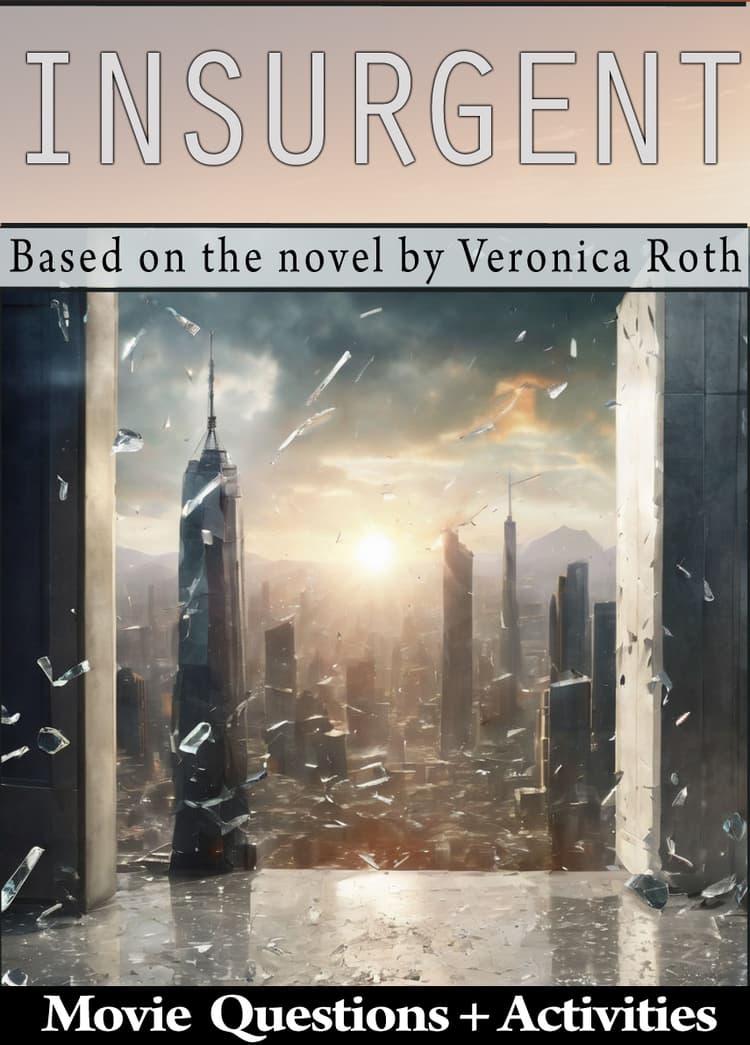
This is a 14-page classroom-ready resource.
Part 1: Comprehension Questions
Three sets of differentiated chronological comprehension questions covering the movie. 40 questions requiring full sentence answers, a shorter 30 question set with 10 removed from the 40 question set, and a 30 question multiple choice set with three possible answers each, which also works well for ESL and ELL students. Answer keys are included for all three sets.
Part 2: Storyboard and Synopsis
Students draw a nine scene storyboard covering what they consider the most important parts of the movie, with a brief written description for each scene, then use their completed storyboard to write a synopsis of the movie.
Part 3: Creative Writing and Characters
A pair work activity in which students write questions they believe need answering for each character, then swap sheets with a partner and answer in role as that character before returning the sheets, with the option to read answers aloud and discuss as a class. A second activity asks students to write about one character of their choosing following guided question prompts and include a drawing of that character.
How These Guides Work: From Movie to Lesson
A movie is not a break from learning. It reaches students through sight, sound, and story at once, engaging the brain in ways text alone does not, and the structured work around it is what turns the viewing into a genuine lesson. You can read the research behind this on the Why Movies Work page.
- A Teacher Notes and General Directions page opens the guide with a brief overview of everything inside: what the movie is about, then each part of the guide in order with a short description of what it entails. You know what to expect from the whole resource before you hand out a single page, so you can pick up the guide cold and teach it the same day.
- Answer keys are included for the comprehension question sets, so grading is quick and you are not rewatching the movie to check answers. Some guides also include example answers for the creative and written activities.
- Print and go: classroom ready, with no additional preparation needed. Print one the morning you need it and the lesson is ready.
- Substitute and first-timer friendly. A guide can be handed to a substitute or picked up by a teacher covering the topic for the first time. Nobody running the session needs to have seen the movie.
- Differentiated comprehension sets. Most guides include two or three question sets at different difficulty levels, and most include a multiple-choice option that works well for ESL and ELL students. One class set covers your strongest readers, your strugglers, and your language learners without separate prep.
- Activities that go beyond recall. Each guide includes structured activities that ask students to engage with the movie, not just watch it, ranging from creative and written tasks to discussion and critical thinking questions depending on the guide. That variety matters in a mixed classroom: a student who freezes on a written question set may show real understanding through a drawing or a creative task, and a confident writer gets room to go beyond recall. For the teacher, it turns a movie session into work that can actually be assessed: comprehension questions show whether students followed the plot, and the activities beyond them show whether they understood it.