By Mr Hull's Movie Guides
Watch the Trailer

What's Inside the Guide
This is a 16-page classroom-ready resource.
Three sets of differentiated comprehension questions in chronological order, covering the movie's events. Answer keys are included for all three sets.
- 60 question set requiring full sentence answers.
- 40 question set requiring full sentence answers.
- 40 multiple choice question set with 3 possible answers each.
- A 9 scene storyboard of what they consider the most important parts of the movie, including a brief description for each scene.
- A synopsis of the movie, written using their storyboard as a guide.
This part covers two activities. Example answers are included for the discussion questions.
- 5 critical thinking questions about the movie, answered in pairs, which can then be discussed as a class.
- A day in the life of three characters from the alternate reality where George was never born, focusing on how their lives differ and what that reflects about George's impact.
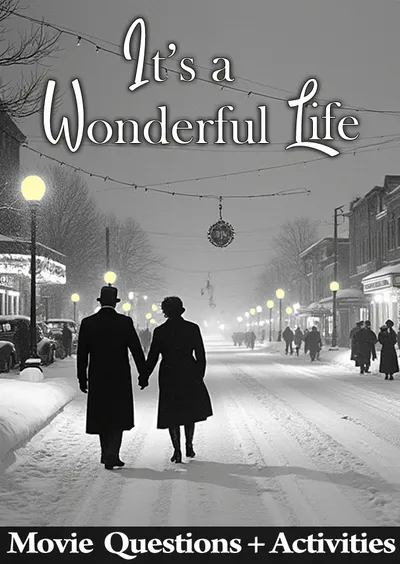
“Great resource. I used this while watching It's A Wonderful Life. My class watches the movie after reading the short story "The Greatest Gift". ”
— Stacia B.
Why Watch This Movie With Your Students
Here's what your students naturally take away from the movie, whether through themes, values, ideas, or perspectives.
🌉 A Man Learns the Value of His Own Life Through Its Absence. George Bailey reaches a point of complete despair and wishes he had never been born, and the movie takes that wish seriously by showing him exactly what happens to the people he loves without him. Students get a concrete, dramatized answer to a question that is normally left abstract, whether one person's ordinary choices matter.
🏦 A Small Town Business Becomes a Stand Against Greed. George spends years running his family's building and loan specifically to keep the wealthy, controlling Henry Potter from taking over Bedford Falls, giving families an alternative to Potter's slum housing. Students see a clear example of how a single institution can shape who gets a fair shot in a community.
👨👩👧👦 Sacrifice and Delayed Dreams Shape George's Whole Life. George repeatedly gives up his own plans, from traveling the world to going to college, in order to take care of his family and his town. The movie treats these choices honestly, showing George's frustration and resentment alongside his commitment, rather than presenting sacrifice as effortless.
👼 A Guardian Angel Turns an Abstract Idea Into a Real Demonstration. Clarence does not simply tell George that his life matters, he shows him an alternate version of Bedford Falls where George was never born and everyone he loves is worse off. This gives students a clear example of a story making an argument through a hypothetical rather than through explanation alone.
🤝 A Community Rallies Around One Person in Crisis. When George faces financial ruin and the threat of arrest, the people he has helped throughout the movie come together to support him in return. Students see reciprocity play out directly, the same kindness George showed others coming back to him when he needs it most.
🎄 A Christmas Setting Frames a Story About What Matters. Although the movie takes place during the holidays, its questions about purpose, community, and self-worth extend well beyond any single season. Students can examine how a specific setting is used to frame ideas that apply throughout the year.
Age Suitability and Content
This movie is rated PG.
⚠️ Things to be aware of:
- George experiences a suicidal crisis and stands on a bridge on the verge of jumping before he is stopped by his guardian angel.
- A man is shown getting drunk at a bar and is punched in a brief fistfight.
- There is a passing mention of a naked woman hiding in shrubbery, though nothing is shown on screen.
- There is no strong language or sexual content shown in this movie.
📋 A free editable parent permission slip is available for this movie. It explains the educational benefits of watching movies in class and includes a space for parental consent. → Download Free Permission Slip on TpT (Free resource)
Note for educators: Movie details and age ratings in this post are sourced from IMDb, Common Sense Media, and Wikipedia to help ensure accuracy.
How My Movie Guide Helps You Teach It
Click your subject below to see how this guide supports it:
📚 English Language Arts Teachers
🗣️ ESL and ELL Teachers
🌐 Social Studies Teachers
🎬 Substitute Teachers and Cover Lessons
🏠 Homeschool Parents
💙 SEL Teachers
🌟 Supporting All Learners A movie gives students a story to follow, and the guide gives them questions to work through as they watch. For students with autism, learning difficulties, and mild to severe disabilities, that combination provides a clear focus for the lesson and a concrete way to show understanding. The format can be useful in special education and learning support classrooms, where teachers need activities that give students a defined task during viewing. Find out more about why movies work for diverse learners.
The Social Studies angle here is about the economic backdrop of the story rather than a specific historical event, so it pairs well with a broader unit on the Great Depression or community economics.
How These Guides Work: From Movie to Lesson
Watching a movie is not a break from learning. It reaches students through sight, sound, and story at once, engaging the brain in ways text alone does not, and the structured work around it is what turns the viewing into a genuine lesson. You can read the research behind this on the Why Movies Work page.
- A Teacher Notes and General Directions page opens the guide with a brief overview of everything inside: what the movie is about, then each part of the guide in order with a short description of what it entails. You know what to expect from the whole resource before you hand out a single page, so you can pick up the guide cold and teach it the same day.
- Answer keys are included for the comprehension question sets, so grading is quick and you are not rewatching the movie to check answers. Some guides also include example answers for the creative and written activities.
- Print and go: classroom ready, with no additional preparation needed. Print one the morning you need it and the lesson is ready.
- Substitute and first-timer friendly. A guide can be handed to a substitute or picked up by a teacher covering the topic for the first time. Nobody running the session needs to have seen the movie.
- Differentiated comprehension sets. Most guides include two or three question sets at different difficulty levels, and most include a multiple-choice option that works well for ESL and ELL students. One class set covers your strongest readers, your strugglers, and your language learners without separate prep.
- Activities that go beyond recall. Each guide includes structured activities that ask students to engage with the movie, not just watch it, ranging from creative and written tasks to discussion and critical thinking questions depending on the guide. That variety matters in a mixed classroom: a student who freezes on a written question set may show real understanding through a drawing or a creative task, and a confident writer gets room to go beyond recall. For the teacher, it turns a movie session into work you can grade: comprehension questions show whether students followed the plot, and the activities beyond them show whether they understood it.