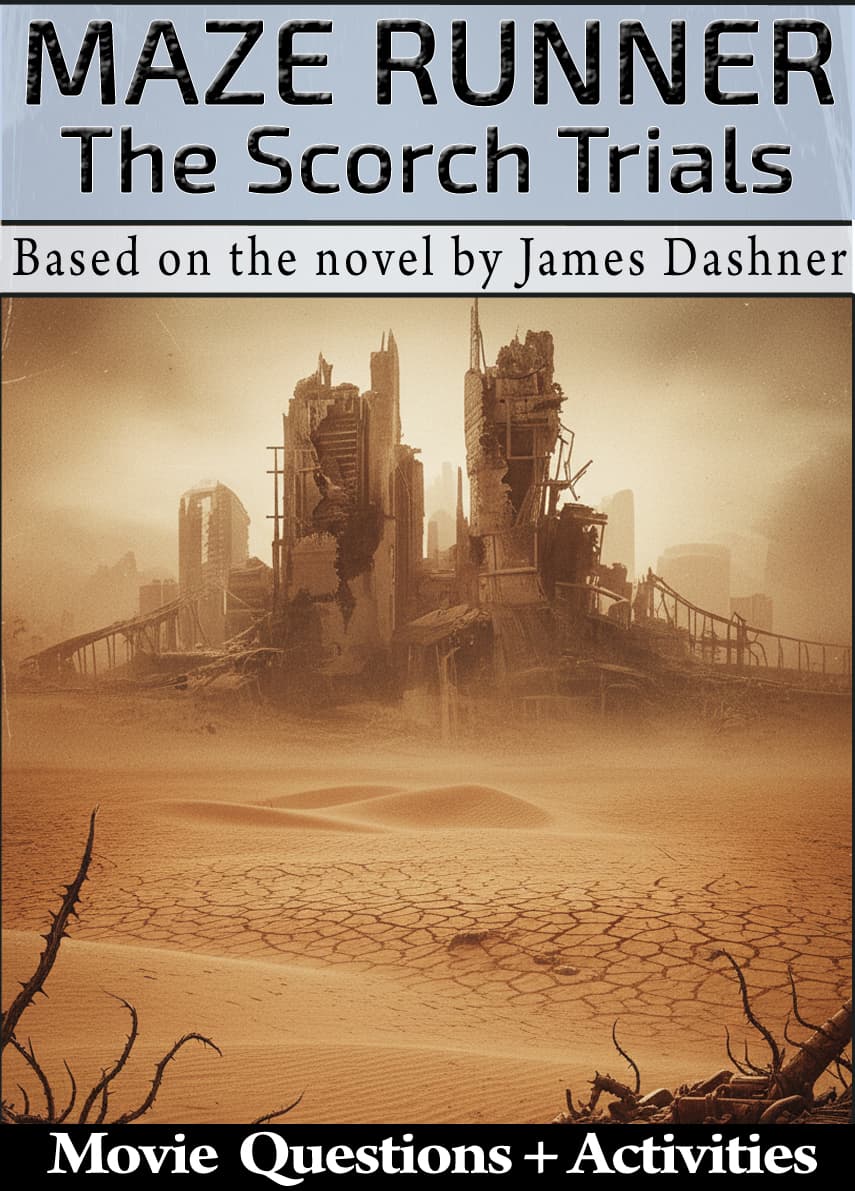
By Mr Hull's Movie Guides

Watch the Trailer

Why Watch This Movie With Your Students
Here's what your students naturally take away from the movie, whether through themes, values, ideas, or perspectives.
⚖️ Puts a "cure" under ethical scrutiny. WCKD frames its search for a cure to the Flare virus as a mission to save humanity, but the movie shows exactly what that mission costs the young people caught inside it. Students see how a stated good intention can still justify harm when the people making the decisions never have to bear the cost themselves.
💔 Doesn't shy away from loss. The story follows through on real consequences for its characters, including the death of a longtime friend within the group. It gives students an example of a story that treats loss as permanent and meaningful rather than something a script quietly reverses.
🤝 Loyalty is tested under the worst conditions. Thomas and the remaining Gladers risk their own safety repeatedly to rescue Minho and protect each other, even when leaders like Vince advise against it. The movie shows commitment to other people as an active choice made again and again, not a one-time decision.
🏙️ A fortified, hostile setting raises the stakes. The Last City is heavily walled and guarded, and getting inside it means navigating protests, gunfire, and infected Cranks before the real mission even begins. The setting itself becomes an obstacle course that forces the characters to adapt their plan at every stage.
🔄 Redemption plays out on screen. Both Teresa and Gally get chances to make different choices than the ones that defined them earlier in the story, and the movie follows through on what that costs them. Students see change presented as something demonstrated through action, not simply stated.
📖 Closes out a story students may already know from the books. As the final installment based on James Dashner's novel series, the movie gives students who followed the books or the earlier movies a chance to see how the overall story resolves. It also works as a way to compare how a long narrative arc concludes across different formats.
Age Suitability and Content
This movie is rated PG-13.
⚠️ Things to be aware of:
- Frequent violence includes shootouts, explosions, and large-scale fighting.
- Characters are attacked by zombie-like Cranks, including one on-screen infection and self-inflicted death.
- Two major character deaths occur in the movie's final act.
- Strong language includes frequent mild to strong swear words.
- There is brief kissing, with no other sexual content or substance use.
📋 A free editable parent permission slip is available for this movie. It explains the educational benefits of watching movies in class and includes a space for parental consent. → Download Free Permission Slip on TpT (Free resource)
Note for educators: Movie details and age ratings in this post are sourced from IMDb, Common Sense Media, and Wikipedia to help ensure accuracy.
How My Movie Guide Helps You Teach It
📚 English Language Arts Teachers. This movie gives an ELA class a tense, high-stakes plot to study, as the rescue mission's shifting obstacles and the group's escalating losses build toward a resolution that pays off threads from the earlier movies. The guide's discussion questions and creative writing tasks, including a redesigned comic strip scene and a full movie synopsis, move students from basic comprehension into structured written analysis and response. Differentiated comprehension questions support mixed-ability classes throughout.
🗣️ ESL and ELL Teachers. The movie's consistent cast of characters and clear rescue-mission structure make it easier for ESL and ELL students to follow the plot even as the story reaches its most complex point in the trilogy. The guide's multiple choice question set is built with this in mind, giving students a lower-barrier way to demonstrate understanding while still engaging with the full story.
🌐 Social Studies Teachers. WCKD's willingness to experiment on and sacrifice young people while framing its mission as saving humanity gives a Social Studies class a fictional case study in how institutions justify harm in the name of a stated collective good. The guide does not include dedicated Social Studies activities, but the comprehension questions keep students accountable to the plot details that carry this theme throughout the movie.
🎬 Substitute Teachers and Cover Lessons. Everything a substitute needs is included and organized, with three sets of differentiated comprehension questions and answer keys ready to hand over. A substitute can run the full session without having seen the movie, since the materials guide students through the plot in chronological order.
🏠 Homeschool Parents. This is the kind of movie that opens up conversation about sacrifice, loyalty, and loss between a parent and a teenage student, especially as the concluding chapter of a story they may already know. The guide's mix of comprehension questions, discussion prompts, and creative tasks like the character mind map and storyboard gives a single student plenty to work through independently, with the discussion questions offering a natural way to extend the conversation beyond the screen.
💙 SEL Teachers. The group's loss of a close friend, along with Teresa and Gally's attempts to make amends for past choices, gives an SEL class real material for discussing grief, forgiveness, and what people carry forward after loss. The guide does not include a dedicated SEL activity, but the comprehension questions require students to follow these relationships closely enough to keep the emotional throughline in view.
🌟 Supporting All Learners Movie guides can be a wonderfully calm fit for students with autism, learning difficulties, and mild to severe disabilities. The structured format gives every student a clear purpose during viewing, easing uncertainty and allowing them to engage at their own pace. If you teach in a special education or learning support setting, you may find this guide a gentle and practical resource. Find out more about why movies work for diverse learners.
What's Inside the Guide
This is a 18-page classroom-ready resource.
Part 1: Comprehension Questions
Three sets of differentiated comprehension questions in chronological order. The first set has 58 questions requiring full sentence answers, the second has 40 questions requiring full sentence answers (18 removed from the 58 question set), and the third has 40 multiple choice questions with 3 possible answers each. The multiple choice set works well for ESL and ELL students. Answer keys are included for all three sets.
Part 2: Discussion Questions
Students answer five critical thinking questions for class discussion. Example answers are included.
Part 3: Character Mind Map and Comic Strip
Students choose any character and fill in a mind map covering personality, motivation, relationships, and a personal "movie to self" connection built around a growth mindset. They also choose one movie scene and draw a 4 panel comic strip, writing a new quote for their character, changing what happens in the scene, and ending the final panel with the word "YET" to represent learning from failure.
Part 4: Storyboard and Synopsis
Students create a 9 scene storyboard illustrating pivotal events from the movie, with a short description explaining the main idea each scene represents, using the movie questions to guide sequencing. Using their storyboards as a guide, students then write a full synopsis of the movie.
How These Guides Work: From Movie to Lesson
Watching a movie is not a break from learning. It reaches students through sight, sound, and story at once, engaging the brain in ways text alone does not, and the structured work around it is what turns the viewing into a genuine lesson. You can read the research behind this on the Why Movies Work page.
- A Teacher Notes and General Directions page opens the guide with a brief overview of everything inside: what the movie is about, then each part of the guide in order with a short description of what it entails. You know what to expect from the whole resource before you hand out a single page, so you can pick up the guide cold and teach it the same day.
- Answer keys are included for the comprehension question sets, so grading is quick and you are not rewatching the movie to check answers. Some guides also include example answers for the creative and written activities.
- Print and go: classroom ready, with no additional preparation needed. Print one the morning you need it and the lesson is ready.
- Substitute and first-timer friendly. A guide can be handed to a substitute or picked up by a teacher covering the topic for the first time. Nobody running the session needs to have seen the movie.
- Differentiated comprehension sets. Most guides include two or three question sets at different difficulty levels, and most include a multiple-choice option that works well for ESL and ELL students. One class set covers your strongest readers, your strugglers, and your language learners without separate prep.
- Activities that go beyond recall. Each guide includes structured activities that ask students to engage with the movie, not just watch it, ranging from creative and written tasks to discussion and critical thinking questions depending on the guide. That variety matters in a mixed classroom: a student who freezes on a written question set may show real understanding through a drawing or a creative task, and a confident writer gets room to go beyond recall. For the teacher, it turns a movie session into work you can grade: comprehension questions show whether students followed the plot, and the activities beyond them show whether they understood it.