By Mr Hull's Movie Guides
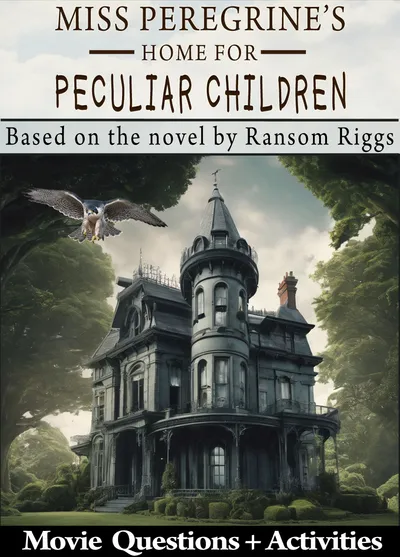
Watch the Trailer

What's Inside the Guide
This is a 18-page classroom-ready resource.
Three differentiated sets of chronological comprehension questions. Answer keys are included for all three sets.
- 60 question set requiring full sentence answers.
- 45 question set (15 removed for a shorter option).
- 45 multiple choice question set with 3 possible answers each. The multiple choice set works well for ESL and ELL students.
- A 9 scene storyboard depicting what they judge to be the most important parts of the movie, with a brief description for each scene.
- A synopsis of the movie, written using that storyboard.
This part covers two activities.
- A record for a new child arriving at Miss Peregrine's home, including name, original home, age, peculiarity and description, personality, and a short biography.
- A junior reporter article about the events at Blackpool pier, including a drawing and quotes from imaginary interviews with local witnesses.
Why Watch This Movie With Your Students
Here's what your students naturally take away from the movie, whether through themes, values, ideas, or perspectives.
🦅 A grandfather's stories turn out to be true. Jake spent his childhood hearing Abe's stories about monsters and children with strange gifts, dismissing them as tall tales as he got older. The movie rewards his eventual willingness to believe an elderly relative, giving students a concrete example of intergenerational trust paying off.
🕰️ A hidden world protected by a repeating day. Miss Peregrine and the other Ymbrynes shelter their children inside time loops that reset every day, keeping them safe from the outside world and the creatures hunting them. The concept gives students an accessible way into ideas about time, safety, and isolation without requiring prior fantasy genre knowledge.
🦋 Being different is treated as a gift, not a flaw. Each Peculiar child has an unusual ability that would make them an outcast in the ordinary world, yet Miss Peregrine's home treats those differences as valuable rather than something to hide. It gives students a clear, sustained message about identity and belonging built into the plot itself, not just stated once and dropped.
👹 Shapeshifting monsters raise real stakes. The Hollowgasts and their leader, Mr. Barron, hunt Peculiar children specifically for their abilities, and Barron's use of disguise means the children, and the audience, can never be sure who to trust. This tension drives the movie's plot and gives students a clear antagonist built on deception.
🎬 A visually distinct director's style. Tim Burton's direction gives the movie a specific gothic, atmospheric look that stands apart from typical teen fantasy adaptations. It offers a concrete example for discussing how a director's visual choices shape the tone of a story.
🤝 A teenager chooses to stay loyal to people he just met. By the end, Jake gives up a normal life to remain connected to Emma and the other Peculiar children rather than walk away from what he has learned. His choice models loyalty and commitment to newly formed relationships over the comfort of returning to his old life.
Age Suitability and Content
This movie is rated PG-13.
⚠️ Things to be aware of:
- The movie has a consistently creepy, tense tone with menacing shapeshifting monsters and several intense battle sequences involving explosives and weapons.
- Villainous creatures called Hollows are shown eating eyeballs taken from their victims, and a dead character's eyes are shown removed.
- Mild language includes words like 'crap,' 'hell,' 'goddamn,' and 'bollocks.'
- There is light romance between two teenage characters, including flirting and hand-holding, and adults are shown drinking in a pub.
- The plot involves a grandparent's death and a child processing that loss throughout the story.
📋 A free editable parent permission slip is available for this movie. It explains the educational benefits of watching movies in class and includes a space for parental consent. → Download Free Permission Slip on TpT (Free resource)
Note for educators: Movie details and age ratings in this post are sourced from IMDb, Common Sense Media, and Wikipedia to help ensure accuracy.
How My Movie Guide Helps You Teach It
Click your subject below to see how this guide supports it:
📚 English Language Arts Teachers
🗣️ ESL and ELL Teachers
🎬 Substitute Teachers and Cover Lessons
🏠 Homeschool Parents
💙 SEL Teachers
🌟 Supporting All Learners A movie gives students a story to follow, and the guide gives them questions to work through as they watch. For students with autism, learning difficulties, and mild to severe disabilities, that combination provides a clear focus for the lesson and a concrete way to show understanding. The format can be useful in special education and learning support classrooms, where teachers need activities that give students a defined task during viewing. Find out more about why movies work for diverse learners.
How These Guides Work: From Movie to Lesson
Watching a movie is not a break from learning. It reaches students through sight, sound, and story at once, engaging the brain in ways text alone does not, and the structured work around it is what turns the viewing into a genuine lesson. You can read the research behind this on the Why Movies Work page.
- A Teacher Notes and General Directions page opens the guide with a brief overview of everything inside: what the movie is about, then each part of the guide in order with a short description of what it entails. You know what to expect from the whole resource before you hand out a single page, so you can pick up the guide cold and teach it the same day.
- Answer keys are included for the comprehension question sets, so grading is quick and you are not rewatching the movie to check answers. Some guides also include example answers for the creative and written activities.
- Print and go: classroom ready, with no additional preparation needed. Print one the morning you need it and the lesson is ready.
- Substitute and first-timer friendly. A guide can be handed to a substitute or picked up by a teacher covering the topic for the first time. Nobody running the session needs to have seen the movie.
- Differentiated comprehension sets. Most guides include two or three question sets at different difficulty levels, and most include a multiple-choice option that works well for ESL and ELL students. One class set covers your strongest readers, your strugglers, and your language learners without separate prep.
- Activities that go beyond recall. Each guide includes structured activities that ask students to engage with the movie, not just watch it, ranging from creative and written tasks to discussion and critical thinking questions depending on the guide. That variety matters in a mixed classroom: a student who freezes on a written question set may show real understanding through a drawing or a creative task, and a confident writer gets room to go beyond recall. For the teacher, it turns a movie session into work you can grade: comprehension questions show whether students followed the plot, and the activities beyond them show whether they understood it.