By Mr Hull's Movie Guides
Watch the Trailer
What's Inside the Guide
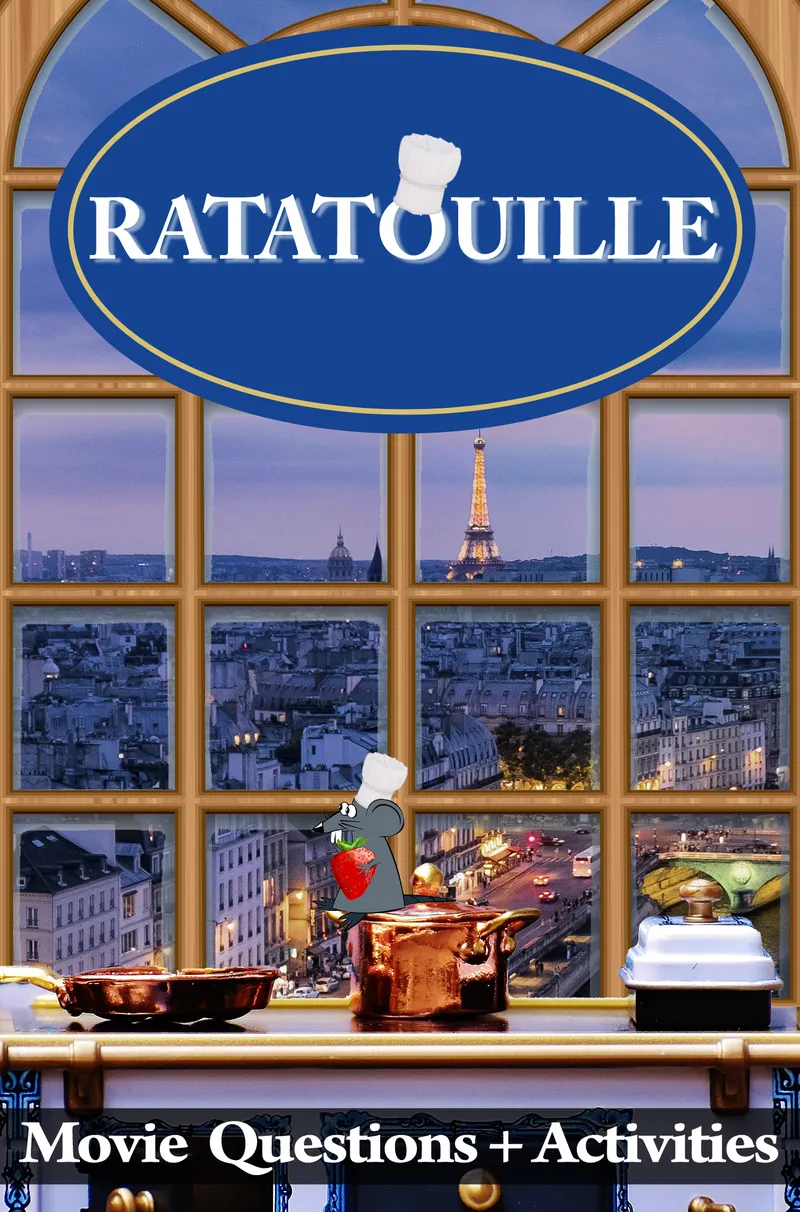
This is a 12-page classroom-ready resource.
Two differentiated sets of questions in chronological order. Answer keys included for both sets.
- 30 question set requiring full sentence answers.
- 30 multiple choice question set with 3 possible answers, suited to differentiation and ESL students.
- 9 key scenes illustrated and summarised in chronological order, with a brief description for each.
- A synopsis of the movie, written using their completed storyboard as a guide, in their own words.
This part covers three linked creative tasks based on Linguini's new restaurant.
- Designing and labeling a floor plan for the restaurant, including kitchen, seating, doors, windows, and facilities.
- Creating a special recipe for the menu, listing ingredients and directions.
- A newspaper or magazine article about their experience dining at the restaurant, including a short interview with Linguini and an image.
“Great resource! Even my students that were hard to reach without comic book topics and superhero’s said they were “inspired” by the extended writing tasks AFTER completing the questions that go with the movie. I had a group of students who wanted to take extra copies home and cook with their moms after school that day. Cutest thing ever! ”
— The Sparkly Apple
“A fantastic resource, lots of detail and worked well for a variety of learning levels and interest. Great for developing French skills by associating with a movie. Thanks”
— Rebecca H.
Why Watch This Movie With Your Students
Here's what your students naturally take away from the movie, whether through themes, values, ideas, or perspectives.
🐀 A story about ambition that students take seriously. Remy wants something the world tells him he cannot have. The movie follows that desire honestly, without pretending the obstacles are easy to overcome. Students who have ever felt out of place in a space they belong in will recognise something in it.
🍽️ Paris and the world of haute cuisine as a genuinely engaging setting. The animation of the kitchen sequences is extraordinary in its detail. Students who have never thought about cooking as a craft or Paris as a place find themselves drawn into both. The setting does real work in the story.
🤝 A friendship built on mutual need, not convenience. Remy and Linguini need each other to survive, but the movie takes its time turning that arrangement into something genuine. The development of their friendship is one of the more honest portrayals of how trust is built gradually rather than all at once.
🎨 Creativity presented as something that can come from anywhere. The movie's central argument, stated outright by Gusteau and tested throughout the story, is that great cooking, and by extension great work of any kind, is not limited to those with the right background or credentials. That idea lands differently with different students, and it tends to prompt real conversation.
😂 Genuinely funny across a wide age range. The comedy works on multiple levels. Younger students laugh at the physical gags; older students pick up on the sharper satire aimed at food critics, culinary culture, and French stereotypes. Both groups stay engaged throughout.
✍️ Rich material for writing tasks. The movie gives students a detailed world to work from. The restaurant, the kitchen, the characters, and the food are all specific enough that writing tasks feel grounded rather than abstract. Students have something concrete to describe, argue about, and imagine extending.
Age Suitability and Content
This movie is rated G.
⚠️ Things to be aware of:
- Some peril involving rats being chased by humans, including a grandma with a shotgun in the opening scene. Unlikely to trouble most students but may startle sensitive younger viewers.
- A sewer escape sequence that is tense and visually dark.
- One use of 'hell' and a few mild insults including 'stupid' and 'loser'.
- Two characters share a brief kiss. Nothing beyond this.
- No violence, sexual content, or substance use.
Note for educators: Movie details and age ratings in this post are sourced from IMDb, Common Sense Media, and Wikipedia to help ensure accuracy.
How My Movie Guide Helps You Teach It
Click your subject below to see how this guide supports it:
📚 English Language Arts Teachers
🗣️ ESL and ELL Teachers
🎬 Substitute Teachers and Cover Lessons
🏠 Homeschool Parents
🌟 Supporting All Learners A movie gives students a story to follow, and the guide gives them questions to work through as they watch. For students with autism, learning difficulties, and mild to severe disabilities, that combination provides a clear focus for the lesson and a concrete way to show understanding. The format can be useful in special education and learning support classrooms, where teachers need activities that give students a defined task during viewing. Find out more about why movies work for diverse learners.
How These Guides Work: From Movie to Lesson
Watching a movie is not a break from learning. It reaches students through sight, sound, and story at once, engaging the brain in ways text alone does not, and the structured work around it is what turns the viewing into a genuine lesson. You can read the research behind this on the Why Movies Work page.
- A Teacher Notes and General Directions page opens the guide with a brief overview of everything inside: what the movie is about, then each part of the guide in order with a short description of what it entails. You know what to expect from the whole resource before you hand out a single page, so you can pick up the guide cold and teach it the same day.
- Answer keys are included for the comprehension question sets, so grading is quick and you are not rewatching the movie to check answers. Some guides also include example answers for the creative and written activities.
- Print and go: classroom ready, with no additional preparation needed. Print one the morning you need it and the lesson is ready.
- Substitute and first-timer friendly. A guide can be handed to a substitute or picked up by a teacher covering the topic for the first time. Nobody running the session needs to have seen the movie.
- Differentiated comprehension sets. Most guides include two or three question sets at different difficulty levels, and most include a multiple-choice option that works well for ESL and ELL students. One class set covers your strongest readers, your strugglers, and your language learners without separate prep.
- Activities that go beyond recall. Each guide includes structured activities that ask students to engage with the movie, not just watch it, ranging from creative and written tasks to discussion and critical thinking questions depending on the guide. That variety matters in a mixed classroom: a student who freezes on a written question set may show real understanding through a drawing or a creative task, and a confident writer gets room to go beyond recall. For the teacher, it turns a movie session into work you can grade: comprehension questions show whether students followed the plot, and the activities beyond them show whether they understood it.