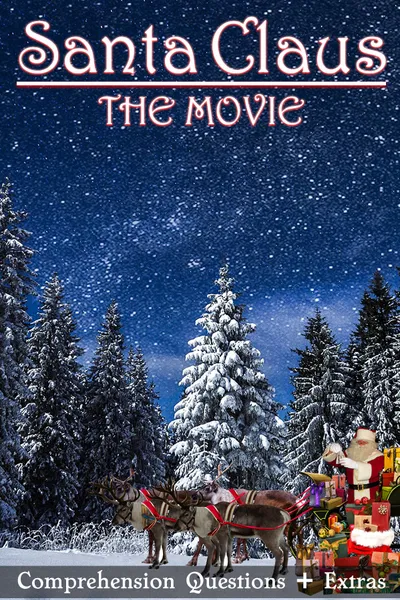
By Mr Hull's Movie Guides
Watch the Trailer

What's Inside the Guide
This is a 7-page classroom-ready resource.
30 questions in chronological order covering the full movie. Answer key is included.
This part covers two creative writing activities.
- Imagining they are an elf working for Santa and designing a new outdoor toy, then drawing and labeling the design and writing instructions for how it works.
- Imagining they have spent a year in the North Pole and recounting the interesting activities and things they did while spending time with the elves and Santa.
Students complete a 10 clue crossword, then use those answers to find them in a word search. Answer key is included.
“Engaging yet straightforward questions. Lovely resource.”
— Shauna D.
“These are great....why spend hours searching for something like this when it has already been made for you? Thank you!!!!”
— Daniel B.
Why Watch This Movie With Your Students
Here's what your students naturally take away from the movie, whether through themes, values, ideas, or perspectives.
🎁 Contrasts selfless giving with corporate greed. The story sets up Santa's mission of giving against a rival toy manufacturer's plan to profit off of Christmas itself. Students can trace how each side's motivations shape their choices throughout the story.
🔧 Shows how good intentions can go wrong. Patch's drive to modernize toymaking through mass production leads directly to broken toys and his own dismissal from the North Pole. The story treats that mistake seriously rather than brushing past it, following Patch through the consequences of his choice.
🏙️ Contrasts two very different worlds. The movie moves from the fantasy of Santa's North Pole workshop to the gritty realism of 1980s New York City, including a homeless boy struggling to survive on the streets. That shift gives students a concrete way to compare settings, tone, and circumstance within a single story.
🤝 Explores found family and belonging. A homeless boy named Joe and a wealthy but neglected girl named Cornelia both find a place with Santa's family by the end of the story. Their inclusion widens what the movie has to say about who gets to belong somewhere and how that happens.
🎅 Offers an origin story for a familiar figure. Rather than starting with an established Santa Claus, the movie builds an explanation for how an ordinary toy maker becomes the character children know from tradition. Students get to see mythology constructed piece by piece rather than simply presented as fact.
⚠️ Depicts the fallout of unchecked ambition. B.Z.'s scheme to seize control of Christmas ultimately traps him, and his own greed is what leaves him stranded with no way out. The story ties his downfall directly to the choices he made rather than treating it as incidental.
Age Suitability and Content
This movie is rated PG.
⚠️ Things to be aware of:
- The antagonist is shown smoking a cigar and drinking alcohol in most of his scenes.
- A boy is tied up and left alone in a dark basement before being rescued by another character.
- Mild language includes occasional use of "crap," "sucks," and "hell."
- No sexual content.
📋 A free editable parent permission slip is available for this movie. It explains the educational benefits of watching movies in class and includes a space for parental consent. → Download Free Permission Slip on TpT (Free resource)
Note for educators: Movie details and age ratings in this post are sourced from IMDb, Common Sense Media, and Wikipedia to help ensure accuracy.
How My Movie Guide Helps You Teach It
Click your subject below to see how this guide supports it:
📚 English Language Arts Teachers
🗣️ ESL and ELL Teachers
🎬 Substitute Teachers and Cover Lessons
🏠 Homeschool Parents
💙 SEL Teachers
🌟 Supporting All Learners A movie gives students a story to follow, and the guide gives them questions to work through as they watch. For students with autism, learning difficulties, and mild to severe disabilities, that combination provides a clear focus for the lesson and a concrete way to show understanding. The format can be useful in special education and learning support classrooms, where teachers need activities that give students a defined task during viewing. Find out more about why movies work for diverse learners.
How These Guides Work: From Movie to Lesson
Watching a movie is not a break from learning. It reaches students through sight, sound, and story at once, engaging the brain in ways text alone does not, and the structured work around it is what turns the viewing into a genuine lesson. You can read the research behind this on the Why Movies Work page.
- A Teacher Notes and General Directions page opens the guide with a brief overview of everything inside: what the movie is about, then each part of the guide in order with a short description of what it entails. You know what to expect from the whole resource before you hand out a single page, so you can pick up the guide cold and teach it the same day.
- Answer keys are included for the comprehension question sets, so grading is quick and you are not rewatching the movie to check answers. Some guides also include example answers for the creative and written activities.
- Print and go: classroom ready, with no additional preparation needed. Print one the morning you need it and the lesson is ready.
- Substitute and first-timer friendly. A guide can be handed to a substitute or picked up by a teacher covering the topic for the first time. Nobody running the session needs to have seen the movie.
- Differentiated comprehension sets. Most guides include two or three question sets at different difficulty levels, and most include a multiple-choice option that works well for ESL and ELL students. One class set covers your strongest readers, your strugglers, and your language learners without separate prep.
- Activities that go beyond recall. Each guide includes structured activities that ask students to engage with the movie, not just watch it, ranging from creative and written tasks to discussion and critical thinking questions depending on the guide. That variety matters in a mixed classroom: a student who freezes on a written question set may show real understanding through a drawing or a creative task, and a confident writer gets room to go beyond recall. For the teacher, it turns a movie session into work you can grade: comprehension questions show whether students followed the plot, and the activities beyond them show whether they understood it.