By Mr Hull's Movie Guides
Watch the Trailer

What's Inside the Guide
This is a 17-page classroom-ready resource.
Three sets of chronological comprehension questions for differentiation. Answer keys are included for all three sets.
- 50 question set requiring full sentence answers.
- 35 question version (15 removed from the full set).
- 35 multiple choice question set with 3 possible answers each. The multiple choice set works well for ESL and ELL students.
This part covers two activities.
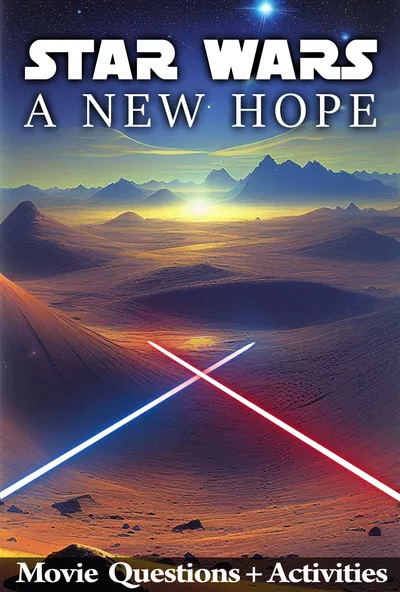
- A table on Joseph Campbell's 12 stages, identifying how Luke's story follows the Hero's Journey, with space for notes and drawings, guiding questions, and reflection.
- Identifying key archetypes, including the Hero, Mentor, Shadow, Ally, and Shapeshifter.
- A nine scene storyboard depicting what they believe are the most important parts of the movie, with a brief description for each scene.
- A synopsis of the movie, written using that storyboard.
This part covers two activities.
- Character writing, where students choose a character to write about following guided question prompts and include a drawing of that character.
- A short story imagining what one or more characters did after the destruction of the Death Star.
“We finished The Hero's Journey using Star Wars and this was a really good supplemental activity.”
— Shawn N.
“This was a great resource to use for Star Wars Day! My students really enjoyed it and I appreciated how easy it was to incorporate into my plans.”
— Erin D.
Why Watch This Movie With Your Students
Here's what your students naturally take away from the movie, whether through themes, values, ideas, or perspectives.
🌌 Introduces the hero's journey. Luke Skywalker's arc from farm boy to rebel pilot follows the stages Joseph Campbell identified across myths and stories worldwide. Students can trace the call to adventure, the mentor figure, and the final test as they happen on screen.
🤝 Explores teamwork across different backgrounds. Luke, Han Solo, Princess Leia, Chewbacca, and the droids come from entirely different worlds and start out with conflicting goals. Their success depends on learning to trust each other and work as a team.
👑 Gives students a strong female lead. Princess Leia commands a rescue mission, gives orders under pressure, and remains composed while the men around her argue. She is decisive and assertive throughout the story rather than a passive character waiting to be saved.
🖤 Presents a clearly drawn conflict between good and evil. Darth Vader and the Empire represent an oppressive, destructive power, while the Rebellion fights for the survival of entire worlds. That clarity gives younger and older students alike an accessible way into discussing morality and stakes in storytelling.
🛰️ Introduces students to foundational science fiction world-building. The movie constructs an entire galaxy of alien species, technology, and politics largely through visual storytelling rather than exposition. Its influence on the genre gives students a reference point for science fiction conventions they will encounter again.
💔 Shows personal sacrifice as a driving force in the story. Obi-Wan Kenobi willingly gives up his life so that Luke and the others can escape, an act that shapes Luke's resolve for the rest of the story. Han Solo's late decision to return and help Luke in the final battle echoes that same theme of choosing others over self-interest.
Age Suitability and Content
This movie is rated PG.
⚠️ Things to be aware of:
- Darth Vader chokes a character to death using the Force, and a character's arm is severed by a lightsaber with a small amount of blood shown.
- A main character's home is found burned, with the charred remains of two guardians briefly shown.
- Mild language includes a couple of uses of "damn" and "hell."
- No sexual content beyond mild flirting between characters.
📋 A free editable parent permission slip is available for this movie. It explains the educational benefits of watching movies in class and includes a space for parental consent. → Download Free Permission Slip on TpT (Free resource)
Note for educators: Movie details and age ratings in this post are sourced from IMDb, Common Sense Media, and Wikipedia to help ensure accuracy.
How My Movie Guide Helps You Teach It
Click your subject below to see how this guide supports it:
📚 English Language Arts Teachers
🗣️ ESL and ELL Teachers
🎬 Substitute Teachers and Cover Lessons
🏠 Homeschool Parents
💙 SEL Teachers
🌟 Supporting All Learners A movie gives students a story to follow, and the guide gives them questions to work through as they watch. For students with autism, learning difficulties, and mild to severe disabilities, that combination provides a clear focus for the lesson and a concrete way to show understanding. The format can be useful in special education and learning support classrooms, where teachers need activities that give students a defined task during viewing. Find out more about why movies work for diverse learners.
How These Guides Work: From Movie to Lesson
Watching a movie is not a break from learning. It reaches students through sight, sound, and story at once, engaging the brain in ways text alone does not, and the structured work around it is what turns the viewing into a genuine lesson. You can read the research behind this on the Why Movies Work page.
- A Teacher Notes and General Directions page opens the guide with a brief overview of everything inside: what the movie is about, then each part of the guide in order with a short description of what it entails. You know what to expect from the whole resource before you hand out a single page, so you can pick up the guide cold and teach it the same day.
- Answer keys are included for the comprehension question sets, so grading is quick and you are not rewatching the movie to check answers. Some guides also include example answers for the creative and written activities.
- Print and go: classroom ready, with no additional preparation needed. Print one the morning you need it and the lesson is ready.
- Substitute and first-timer friendly. A guide can be handed to a substitute or picked up by a teacher covering the topic for the first time. Nobody running the session needs to have seen the movie.
- Differentiated comprehension sets. Most guides include two or three question sets at different difficulty levels, and most include a multiple-choice option that works well for ESL and ELL students. One class set covers your strongest readers, your strugglers, and your language learners without separate prep.
- Activities that go beyond recall. Each guide includes structured activities that ask students to engage with the movie, not just watch it, ranging from creative and written tasks to discussion and critical thinking questions depending on the guide. That variety matters in a mixed classroom: a student who freezes on a written question set may show real understanding through a drawing or a creative task, and a confident writer gets room to go beyond recall. For the teacher, it turns a movie session into work you can grade: comprehension questions show whether students followed the plot, and the activities beyond them show whether they understood it.