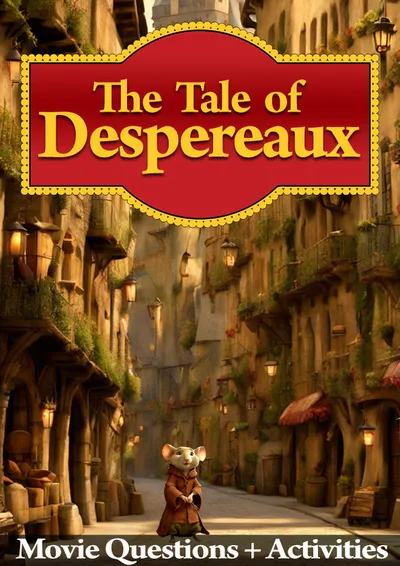
By Mr Hull's Movie Guides
Watch the Trailer

What's Inside the Guide
This is a 16-page classroom-ready resource.
Two full sets of differentiated comprehension questions. Answer keys are included for both sets.
- 35 question set requiring full sentence answers.
- 35 multiple choice question set with three possible answers each.
This part covers several activities. Example answers are included.
- Writing sentences using each letter from the word Mouseland, then writing about places in the movie where they felt sad, happy, and excited.
- Five high level extension questions pushing critical thinking further, which can be completed individually or discussed as a class.
- Recounting four memorable scenes from the movie, each given a starting sentence to help them remember and provide a base to build from.
Four character profiles for students to complete, covering Despereaux, Roscuro, Princess Pea, and Miggery Sow. For each character, students draw a profile picture, describe their features and personality, then write what they like and dislike about that character. The activity is designed for a group of four if it's too much for one student to complete alone.
“I highly recommend this seller! This is perfect to help keep my chatty kiddos engaged on the movie and not their friends :)”
— Literally LeBlanc (TPT Seller)
“This was the perfect resource to wrap up our novel study.”
— Amanda Crunk (TPT Seller)
Why Watch This Movie With Your Students
Here's what your students naturally take away from the movie, whether through themes, values, ideas, or perspectives.
🐭 Follows a hero defined by curiosity and courage, not size. Despereaux is a mouse who reads books instead of eating them and refuses to live by the fear that governs every other mouse around him. His bravery isn't about physical strength, it's about choosing to act when everyone else chooses to hide.
🐀 Gives a redemption arc to a character who starts by causing harm. Roscuro's accidental role in the queen's death sets off the kingdom's decline, and the movie follows his genuine remorse and eventual attempt to make things right. Students see a character reckon with the consequences of a mistake rather than simply being punished for it.
👑 Shows grief reshaping an entire community, not just one person. The king's mourning leads him to outlaw soup and banish rats, decisions that spread poverty and sadness through the whole kingdom. The movie is direct about how one person's unprocessed loss can end up affecting everyone around them.
🗝️ Centers a character shaped by neglect and unmet longing. Miggery Sow grew up believing she could become a princess if she just wanted it badly enough, and her storyline gives weight to how that hope was exploited by someone she trusted. Her arc adds real complexity to a story that could have settled for simple heroes and villains.
🍲 Ties the kingdom's happiness to a specific, symbolic object. Soup becomes the marker of whether Dor is thriving or suffering, giving students a concrete symbol to track as the story moves between despair and recovery. It's a simple thread that ties together three otherwise very different character arcs.
⚖️ Asks what forgiveness requires. Characters who have wronged each other, intentionally or not, are given the chance to make amends by the movie's end, and the story doesn't treat forgiveness as automatic or easy. Students can examine what each character does, not just says, to earn it.
Age Suitability and Content
This movie is rated G.
⚠️ Things to be aware of:
- A supporting character dies suddenly of a heart attack, shown briefly without graphic detail.
- A rat is killed by a cat off-screen, and a mob of rats threatens to kill and eat other characters.
- Despereaux duels with rats using a sewing needle sword, and two characters are tied up and held captive for part of the story.
- No sexual content, language, or substance use of any kind.
Note for educators: Movie details and age ratings in this post are sourced from IMDb, Common Sense Media, and Wikipedia to help ensure accuracy.
How My Movie Guide Helps You Teach It
Click your subject below to see how this guide supports it:
📚 English Language Arts Teachers
🗣️ ESL and ELL Teachers
🎬 Substitute Teachers and Cover Lessons
🏠 Homeschool Parents
💙 SEL Teachers
🌟 Supporting All Learners A movie gives students a story to follow, and the guide gives them questions to work through as they watch. For students with autism, learning difficulties, and mild to severe disabilities, that combination provides a clear focus for the lesson and a concrete way to show understanding. The format can be useful in special education and learning support classrooms, where teachers need activities that give students a defined task during viewing. Find out more about why movies work for diverse learners.
How These Guides Work: From Movie to Lesson
Watching a movie is not a break from learning. It reaches students through sight, sound, and story at once, engaging the brain in ways text alone does not, and the structured work around it is what turns the viewing into a genuine lesson. You can read the research behind this on the Why Movies Work page.
- A Teacher Notes and General Directions page opens the guide with a brief overview of everything inside: what the movie is about, then each part of the guide in order with a short description of what it entails. You know what to expect from the whole resource before you hand out a single page, so you can pick up the guide cold and teach it the same day.
- Answer keys are included for the comprehension question sets, so grading is quick and you are not rewatching the movie to check answers. Some guides also include example answers for the creative and written activities.
- Print and go: classroom ready, with no additional preparation needed. Print one the morning you need it and the lesson is ready.
- Substitute and first-timer friendly. A guide can be handed to a substitute or picked up by a teacher covering the topic for the first time. Nobody running the session needs to have seen the movie.
- Differentiated comprehension sets. Most guides include two or three question sets at different difficulty levels, and most include a multiple-choice option that works well for ESL and ELL students. One class set covers your strongest readers, your strugglers, and your language learners without separate prep.
- Activities that go beyond recall. Each guide includes structured activities that ask students to engage with the movie, not just watch it, ranging from creative and written tasks to discussion and critical thinking questions depending on the guide. That variety matters in a mixed classroom: a student who freezes on a written question set may show real understanding through a drawing or a creative task, and a confident writer gets room to go beyond recall. For the teacher, it turns a movie session into work you can grade: comprehension questions show whether students followed the plot, and the activities beyond them show whether they understood it.