By Mr Hull's Movie Guides
Watch the Trailer

What's Inside the Guide
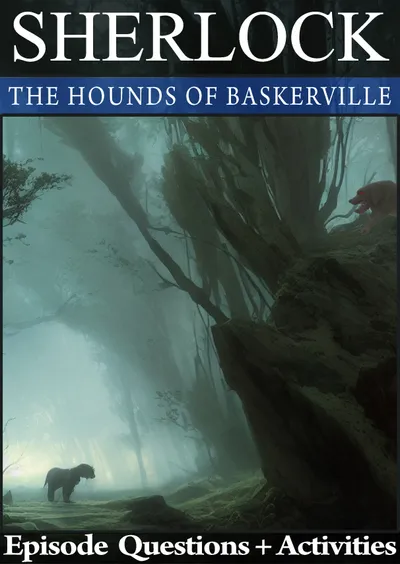
This is a 11-page classroom-ready resource.
Two differentiated sets in chronological order. Answer keys are included for both sets.
- 35 question set requiring full sentence answers.
- 35 multiple choice question set with three answer options each. The multiple choice set works well for ESL and ELL students.
Students use the episode questions to help with sequencing.
- A nine scene storyboard of what they believe to be the most important parts of the episode, with a brief description for each scene.
- A synopsis of the episode, written using their storyboards as a guide.
Students first imagine themselves as local reporters investigating the case of the gigantic hound, 'interviewing' locals who interacted with Sherlock and John and taking notes on the investigation. Using those notes, students then write a full news article about the investigation, including a drawing and quotes drawn from the interviews.
Why Watch This TV Episode With Your Students
Here's what your students naturally take away from the TV episode, whether through themes, values, ideas, or perspectives.
🐺 A legend that turns out to have a rational, man-made explanation. The hound appears throughout the episode as something genuinely supernatural, but the resolution reveals it to be the result of a chemical weapon designed to trigger hallucinations. Students get a clear example of a mystery that builds real dread before resolving through logic rather than the supernatural.
🧠 Sherlock's deduction process shown in unusual detail. The episode gives an extended look at how Sherlock organizes information and reaches conclusions, including a sequence where he mentally works through what he knows to arrive at the truth. Students can study this as a model of structured reasoning, working from small details to a complete explanation.
😨 A rare look at Sherlock experiencing genuine fear. Sherlock is usually presented as coolly rational, but this episode shows him rattled and frightened after seeing the hound himself, unable to explain it. Students can examine what it means for a character built around logic to confront something that briefly seems to defy it.
🕵️ A case built entirely on careful attention to small, easily missed details. Clues throughout the episode, an odd meat order, two unusual words repeated in a dream, come together only once Sherlock and John connect them properly. Students get a genuine puzzle where the answer depends on noticing details rather than a dramatic reveal that comes from nowhere.
🧬 A mystery grounded in real scientific and military concerns. The investigation leads to a secret research base connected to genetic experiments and a hallucinogenic chemical weapon, giving the episode a modern, grounded threat in place of the original story's ghost story trappings. Students can examine how a classic mystery gets updated with contemporary anxieties about secrecy and experimentation.
📖 A modern take on one of the most famous detective stories ever written. The episode adapts Arthur Conan Doyle's The Hound of the Baskervilles, one of the most widely adapted stories in the entire Sherlock Holmes canon, while updating its setting and central threat for a contemporary audience. Students familiar with the original story have a built in way to compare how a classic mystery gets reinterpreted.
Age Suitability and Content
This TV episode is rated 12.
⚠️ Things to be aware of:
- A character is deliberately drugged multiple times without his knowledge as part of the mystery's plot.
- Characters experience frightening hallucinations throughout the episode, including a growling creature and a threatening figure.
- A character dies after fleeing into a minefield and being killed in an explosion.
- A character is shown holding a gun to himself before being talked down.
- There is mild language and brief references to past drug use, but no graphic violence or sexual content.
📋 A free editable parent permission slip is available for this TV episode. It explains the educational benefits of watching TV episodes in class and includes a space for parental consent. → Download Free Permission Slip on TpT (Free resource)
Note for educators: TV episode details and age ratings in this post are sourced from IMDb, Common Sense Media, and Wikipedia to help ensure accuracy.
How My Guide Helps You Teach It
Click your subject below to see how this guide supports it:
📚 English Language Arts Teachers
🗣️ ESL and ELL Teachers
🔬 Science Teachers
🎬 Substitute Teachers and Cover Lessons
🏠 Homeschool Parents
🔭 STEM Teachers
🌟 Supporting All Learners A movie gives students a story to follow, and the guide gives them questions to work through as they watch. For students with autism, learning difficulties, and mild to severe disabilities, that combination provides a clear focus for the lesson and a concrete way to show understanding. The format can be useful in special education and learning support classrooms, where teachers need activities that give students a defined task during viewing. Find out more about why movies work for diverse learners.
How These Guides Work: From TV Episode to Lesson
Watching a TV episode is not a break from learning. It reaches students through sight, sound, and story at once, engaging the brain in ways text alone does not, and the structured work around it is what turns the viewing into a genuine lesson. You can read the research behind this on the Why Movies Work page.
- A Teacher Notes and General Directions page opens the guide with a brief overview of everything inside: what the TV episode is about, then each part of the guide in order with a short description of what it entails. You know what to expect from the whole resource before you hand out a single page, so you can pick up the guide cold and teach it the same day.
- Answer keys are included for the comprehension question sets, so grading is quick and you are not rewatching the TV episode to check answers. Some guides also include example answers for the creative and written activities.
- Print and go: classroom ready, with no additional preparation needed. Print one the morning you need it and the lesson is ready.
- Substitute and first-timer friendly. A guide can be handed to a substitute or picked up by a teacher covering the topic for the first time. Nobody running the session needs to have seen the TV episode.
- Differentiated comprehension sets. Most guides include two or three question sets at different difficulty levels, and most include a multiple-choice option that works well for ESL and ELL students. One class set covers your strongest readers, your strugglers, and your language learners without separate prep.
- Activities that go beyond recall. Each guide includes structured activities that ask students to engage with the TV episode, not just watch it, ranging from creative and written tasks to discussion and critical thinking questions depending on the guide. That variety matters in a mixed classroom: a student who freezes on a written question set may show real understanding through a drawing or a creative task, and a confident writer gets room to go beyond recall. For the teacher, it turns a TV episode session into work you can grade: comprehension questions show whether students followed the plot, and the activities beyond them show whether they understood it.