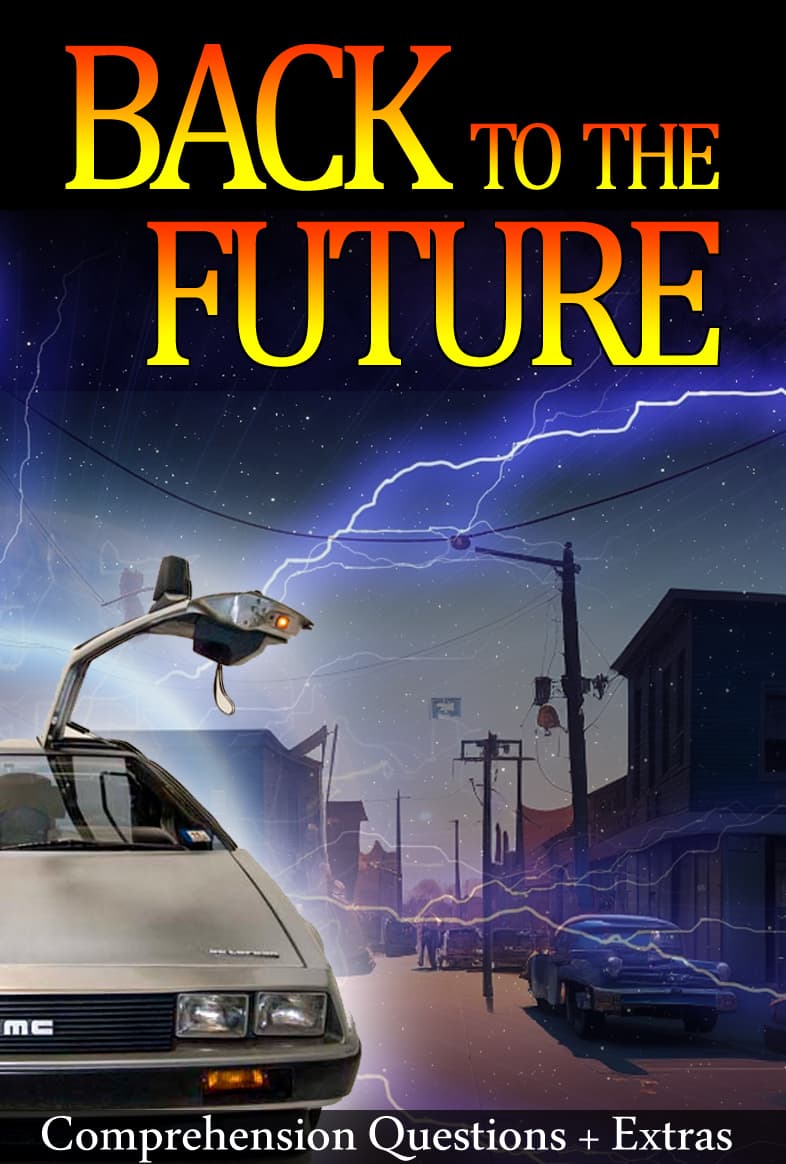
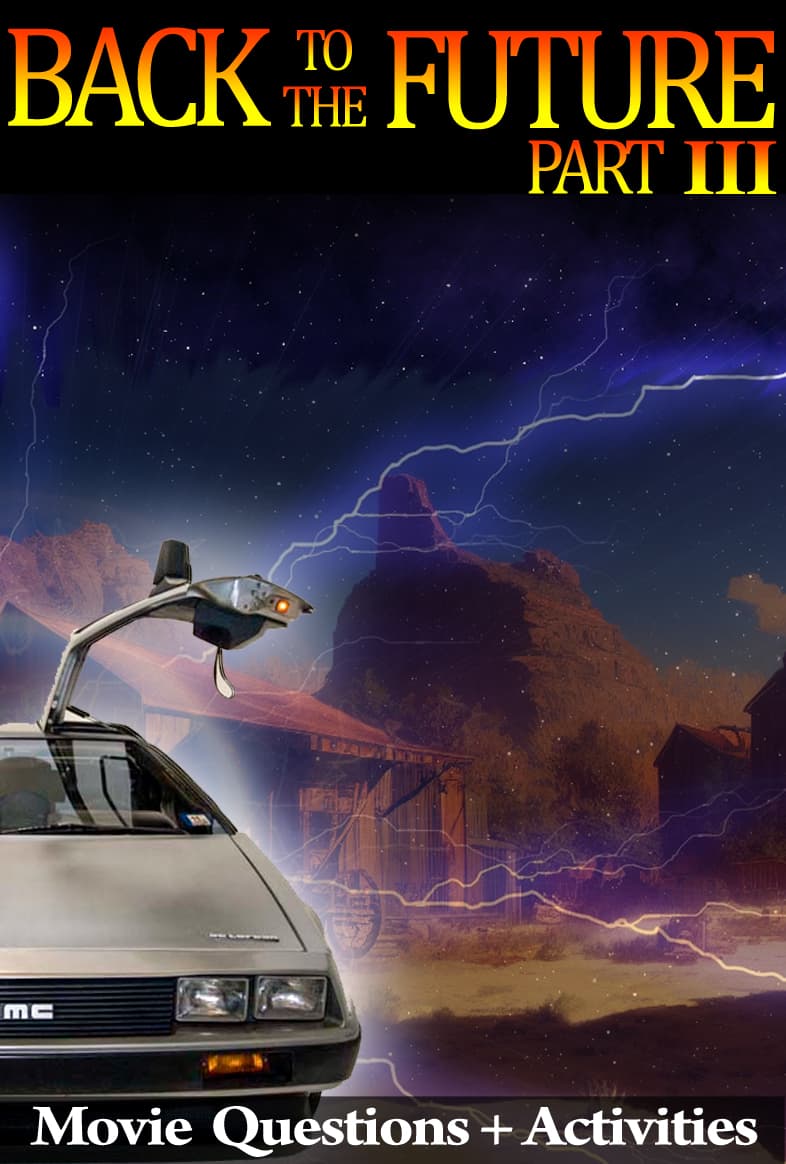
By Mr Hull's Movie Guides

Watch the Trailer

Why Watch This Movie With Your Students
Here's what your students naturally take away from the movie, whether through themes, values, ideas, or perspectives.
📅 The movie's '2015' is now the past, which makes the predictions discussable. The future sequences were made in 1989 and depict 2015 as a world of hoverboards, video calls, and self-drying jackets. Since 2015 has now come and gone, students can compare what arrived, what didn't, and what the gap between expectation and reality says about how people think about technology.
📖 One sports almanac reshapes an entire version of history. The movie's central problem, Biff giving his younger self a book of sporting results to bet on, is a clean illustration of how a single advantage, compounded over decades, produces dramatically different outcomes. The alternate 1985 makes those outcomes visible in a way that's easy to read and discuss.
🏙️ The alternate 1985 is a deliberately dark version of a familiar place. Hill Valley under Biff's control is rundown, corrupt, and dangerous. The movie uses the contrast between this version of 1985 and the one students already know from the first movie to make a point about what happens when money and power concentrate in the hands of one person. It's a stark image and students tend to find it striking.
⏱️ The story runs across three time periods simultaneously. Part II sends characters to 2015, back to 1985, and then back again to 1955, where the events of the first movie are still in progress. Tracking how the three periods connect and how changes in one affect the others requires genuine attention and makes the movie a strong text for analyzing narrative structure and cause and effect.
🤝 The Marty and Doc friendship is tested more seriously here. Doc spends part of the movie separated from Marty, and the situation is more genuinely dangerous than anything in the first movie. Their reunion and the decision Doc makes at the end of the movie, which triggers the cliffhanger, gives the relationship more weight than the original's lighter tone allowed.
💸 Greed is the engine of the plot. Biff's motivation is simple: he wants money and the power it brings. The movie traces exactly what that looks like when it succeeds, a corrupt town, a murdered father, a coerced marriage, which gives students a specific and concrete example of the consequences the movie is arguing against.
Age Suitability and Content
This movie is rated PG.
⚠️ Things to be aware of:
- Violence includes a character being shot and escaping unharmed, fistfights with small amounts of blood, a drive-by shooting, a woman shoved to the ground, and a character falling from a roof unharmed. Biff makes several threats and taunts characters with a bat.
- Language includes 'shit,' 'bitch,' 'asshole,' 'hell,' 'butthead,' and references to body parts.
- Lorraine is shown drinking frequently in the alternate 1985, with references to her possibly being an alcoholic. Biff is also shown drinking.
- Sexual content includes jokes about breast implants, references to infidelity and threesomes, a brief background ad showing cartoon breasts, and a scene where a man has his arms around two women in a hot tub.
- Common Sense Media rates this age 10+, consistent with the guide's grade range of 6-10.
📋 A free editable parent permission slip is available for this movie. It explains the educational benefits of watching movies in class and includes a space for parental consent. → Download Free Permission Slip on TpT (Free resource)
Note for educators: Movie details and age ratings in this post are sourced from IMDb, Common Sense Media, and Wikipedia to help ensure accuracy.
How My Movie Guide Helps You Teach It
📚 English Language Arts Teachers. Back to the Future Part II is a strong ELA text for classes working on cause and effect, narrative structure across multiple timelines, or speculative writing. The three-period structure gives students something complex to track and analyze, and the alternate 1985 is a clear illustration of consequence at scale. The guide covers a range of writing, from comprehension through to creative and analytical tasks, with differentiated question sets for mixed-ability classes.
🗣️ ESL and ELL Teachers. The guide is explicitly tagged for ESL and ELL students, and the multiple choice question set is noted as working well for English language learners. The movie's strong visual storytelling across all three time periods also helps non-native speakers follow the plot even when the dialogue moves quickly.
🎬 Substitute Teachers and Cover Lessons. Back to the Future Part II spans two class periods for the viewing alone, and the guide activities extend well beyond that. The guide is self-contained with no setup required from the class teacher, and the differentiated question sets cover a range of ability levels without additional preparation.
🏠 Homeschool Parents. The movie works well for home learners across the upper elementary to high school range. The differentiated question sets give families flexibility to match the activity to the learner's level, and the invention writing task in Part 3 makes a strong standalone project with a natural connection to the movie's themes.
🔭 STEM Teachers. The movie's vision of 2015 technology, from hoverboards to self-lacing shoes to video calling, gives STEM classes a concrete starting point for discussing how science and engineering shape predictions about the future and how accurate those predictions turned out to be. The guide's comprehension questions give students a structured way to engage with the movie.
🌟 Supporting All Learners Movie guides can be a wonderfully calm fit for students with autism, learning difficulties, and mild to severe disabilities. The structured format gives every student a clear purpose during viewing, easing uncertainty and allowing them to engage at their own pace. If you teach in a special education or learning support setting, you may find this guide a gentle and practical resource. Find out more about why movies work for diverse learners.
What's Inside the Guide
This is a 16-page classroom-ready resource.
Part 1: Comprehension Questions
Three differentiated question sets covering the movie in chronological order, all with answer keys included. Students can complete 50 full sentence answer questions, 30 full sentence answer questions, or 30 multiple choice questions with three possible answers each. The multiple choice set is noted as working well with ESL and ELL students.
Part 2: Storyboard and Synopsis
Students draw a 9-scene storyboard of what they consider the most important events in the movie, with a brief description for each scene. They then use their storyboard as a guide to write a synopsis of the movie.
Part 3: Invention Writing and Puzzles
Students imagine they have traveled 30 years into the future and design an invention they would like to see exist at that time. The task includes drawing and labeling the invention, explaining its purpose, and listing the pros and cons. A combined word search and crossword puzzle (10 clued words plus 5 additional hidden words) rounds out the section. Answer key included for the puzzles.
“We had been learning about “future” tense in the classroom! We used the packet, and when they created their plot diagram, they had to write their sentences in future tense! The students loved the movies, and it helped them distinguish between past, present and future tenses!?”
— Stephanie R. (TPT Seller)
How These Guides Work: From Movie to Lesson
Watching a movie is not a break from learning. It reaches students through sight, sound, and story at once, engaging the brain in ways text alone does not, and the structured work around it is what turns the viewing into a genuine lesson. You can read the research behind this on the Why Movies Work page.
- A Teacher Notes and General Directions page opens the guide with a brief overview of everything inside: what the movie is about, then each part of the guide in order with a short description of what it entails. You know what to expect from the whole resource before you hand out a single page, so you can pick up the guide cold and teach it the same day.
- Answer keys are included for the comprehension question sets, so grading is quick and you are not rewatching the movie to check answers. Some guides also include example answers for the creative and written activities.
- Print and go: classroom ready, with no additional preparation needed. Print one the morning you need it and the lesson is ready.
- Substitute and first-timer friendly. A guide can be handed to a substitute or picked up by a teacher covering the topic for the first time. Nobody running the session needs to have seen the movie.
- Differentiated comprehension sets. Most guides include two or three question sets at different difficulty levels, and most include a multiple-choice option that works well for ESL and ELL students. One class set covers your strongest readers, your strugglers, and your language learners without separate prep.
- Activities that go beyond recall. Each guide includes structured activities that ask students to engage with the movie, not just watch it, ranging from creative and written tasks to discussion and critical thinking questions depending on the guide. That variety matters in a mixed classroom: a student who freezes on a written question set may show real understanding through a drawing or a creative task, and a confident writer gets room to go beyond recall. For the teacher, it turns a movie session into work you can grade: comprehension questions show whether students followed the plot, and the activities beyond them show whether they understood it.