By Mr Hull's Movie Guides
Watch the Trailer

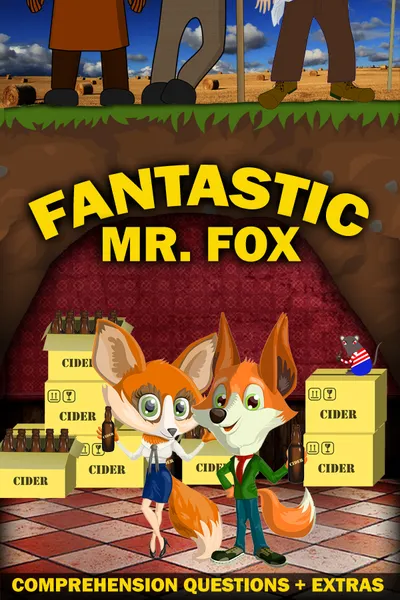
What's Inside the Guide
This is a 11-page classroom-ready resource.
All of the comprehension questions are made while I watch the movie, with the additional activities created to connect directly with its themes and story.
23 full sentence answer questions following the movie's plot, with a full answer key included. Students are encouraged to take notes while watching to support their answers.
Common Core Anchor Standards: R.1 · SL.2
Read closely to determine what the text says explicitly and to make logical inferences from it; cite specific textual evidence when writing or speaking to support conclusions drawn from the text.
Students answer 23 chronological questions on details the movie shows outright, such as what happened to Mr. and Mrs. Fox when they stole the squabs, what protected the fence around the farm and what Ash wanted to steal back from Bean.
Integrate and evaluate information presented in diverse media and formats, including visually, quantitatively, and orally.
The questions can only be answered from what students saw and heard in the movie, such as who they meet in the cider cellar, who is waiting for Mr. Fox outside his house and what the farmers use to flush the animals out of the tunnels.
Students draw and describe the three farmers, Boggis, Bunce, and Bean, including their appearance and habits, then choose one farm and write out the plan Mr. Fox would need to steal from it, including a hand drawn map of the route and a list of equipment needed.
Common Core Anchor Standards: W.2
Write informative/explanatory texts to examine and convey complex ideas and information clearly and accurately through the effective selection, organization, and analysis of content.
Students choose one of the three farms and write the plan Mr. Fox must follow to take something from it, explaining how to get past the farm's security, with a map of the route and a list of the equipment needed, so they explain how the plan works.
A group activity for three students, each taking on the role of one farmer, where they write and illustrate the new security measures their farmer would install to stop Mr. Fox from stealing again.
Common Core Anchor Standards: SL.1 · W.2
Prepare for and participate effectively in a range of conversations and collaborations with diverse partners, building on others' ideas and expressing their own clearly and persuasively.
In groups of three, students each take one of the farmers, Boggis, Bunce or Bean, and work together on how the farms will stop Mr. Fox stealing again, so they must share and combine ideas with their group.
Write informative/explanatory texts to examine and convey complex ideas and information clearly and accurately through the effective selection, organization, and analysis of content.
In a group of three, each student takes one of the farmers, Boggis, Bunce or Bean, and writes what they will do to protect the farm and stop Mr. Fox stealing again, with drawings of the new security they will install, so they explain how their security plan works.
A movie themed word search included as a quick extra activity for students who finish early.
Common Core Anchor Standards throughout the guide: L.1 · L.2
Demonstrate command of the conventions of standard English grammar and usage when writing or speaking.
Students are expected to follow standard English grammar and usage in everything they write in this guide.
Demonstrate command of the conventions of standard English capitalization, punctuation, and spelling when writing.
Students are expected to use correct capitalization, punctuation and spelling in everything they write in this guide.
“This resource was great for my Year 7 class. It allowed me to set them some more creative activities to get them more engaged in my overall film unit.”
— Rebecca D.
“My students voted for this movie. I had not seen it but wanted to align watching this movie to retain some educational purposes. This worked great. I ended up not having them answer all the questions, but it worked great.”
— Sara V.
Why Watch This Movie With Your Students
Here's what your students naturally take away from the movie, whether through themes, values, ideas, or perspectives.
🦊 A father who cannot resist one more score. Mr. Fox has already promised his family he is done stealing, yet he cannot let go of the thrill. Students see a character make a choice he knows is risky, which opens up real discussion about instinct versus responsibility.
👨👦 A father and son who do not understand each other yet. Ash wants to be like his father and constantly falls short in his own eyes. Their relationship gives students a grounded look at how parents and children can care about each other while still struggling to connect.
🎬 A distinct stop motion visual style. Wes Anderson's handmade animation gives every scene a textured, deliberate look that differs from typical computer animated movies students may be used to.
📚 A direct link to a Roald Dahl classic. Based on Dahl's novel, the movie invites comparison between the book's plot and Anderson's expanded, more character driven version of the story.
⚖️ Consequences that reach beyond one character. Mr. Fox's scheme puts every animal in the valley in danger, not just his own family. Students see how one person's choices can ripple outward and affect an entire community.
🤝 A resolution that requires humility, not victory. The animals do not simply beat the farmers, they have to accept a smaller, different life to survive. It gives students a less conventional ending to think through than a clean-cut win.
Age Suitability and Content
This movie is rated PG.
⚠️ Things to be aware of:
- Farmers use guns to try to shoot the animals, though no blood or injury is shown on screen.
- Mr. Fox is injured off screen and loses part of his tail, referenced but not shown in detail.
- Adult animals drink cider and other alcohol in a few scenes, though never to excess.
- Characters use a stand in word, cuss, in place of actual profanity throughout.
- No sexual content beyond a brief kiss between Mr. and Mrs. Fox.
📋 A free editable parent permission slip is available for this movie. It explains the educational benefits of watching movies in class and includes a space for parental consent. → Download Free Permission Slip on TpT (Free resource)
Note for educators: Movie details and age ratings in this post are sourced from IMDb, Common Sense Media, and Wikipedia to help ensure accuracy.
How My Movie Guide Helps You Teach It
Click your subject below to see how this guide supports it:
📚 English Language Arts Teachers
🗣️ ESL and ELL Teachers
🎬 Substitute Teachers and Cover Lessons
🏠 Homeschool Parents
💙 SEL Teachers
🌟 Supporting All Learners A movie gives students a story to follow, and the guide gives them questions to work through as they watch. For students with autism, learning difficulties, and mild to severe disabilities, that combination provides a clear focus for the lesson and a concrete way to show understanding. The format can be useful in special education and learning support classrooms, where teachers need activities that give students a defined task during viewing. Find out more about why movies work for diverse learners.
How These Guides Work: From Movie to Lesson
Watching a movie is not a break from learning. It reaches students through sight, sound, and story at once, engaging the brain in ways text alone does not, and the structured work around it is what turns the viewing into a genuine lesson. You can read the research behind this on the Why Movies Work page.
- A Teacher Notes and General Directions page opens the guide with a brief overview of everything inside: what the movie is about, then each part of the guide in order with a short description of what it entails. You know what to expect from the whole resource before you hand out a single page, so you can pick up the guide cold and teach it the same day.
- Answer keys are included for the comprehension question sets, so grading is quick and you are not rewatching the movie to check answers. Some guides also include example answers for the creative and written activities.
- Print and go: classroom ready, with no additional preparation needed. Print one the morning you need it and the lesson is ready.
- Substitute and first-timer friendly. A guide can be handed to a substitute or picked up by a teacher covering the topic for the first time. Nobody running the session needs to have seen the movie.
- Differentiated comprehension sets. Most guides include two or three question sets at different difficulty levels, and most include a multiple-choice option that works well for ESL and ELL students. One class set covers your strongest readers, your strugglers, and your language learners without separate prep.
- Activities that go beyond recall. Each guide includes structured activities that ask students to engage with the movie, not just watch it, ranging from creative and written tasks to discussion and critical thinking questions depending on the guide. That variety matters in a mixed classroom: a student who freezes on a written question set may show real understanding through a drawing or a creative task, and a confident writer gets room to go beyond recall. For the teacher, it turns a movie session into work you can grade: comprehension questions show whether students followed the plot, and the activities beyond them show whether they understood it.