By Mr Hull's Movie Guides
Watch the Trailer

Why Watch This Movie With Your Students
Here's what your students naturally take away from the movie, whether through themes, values, ideas, or perspectives.
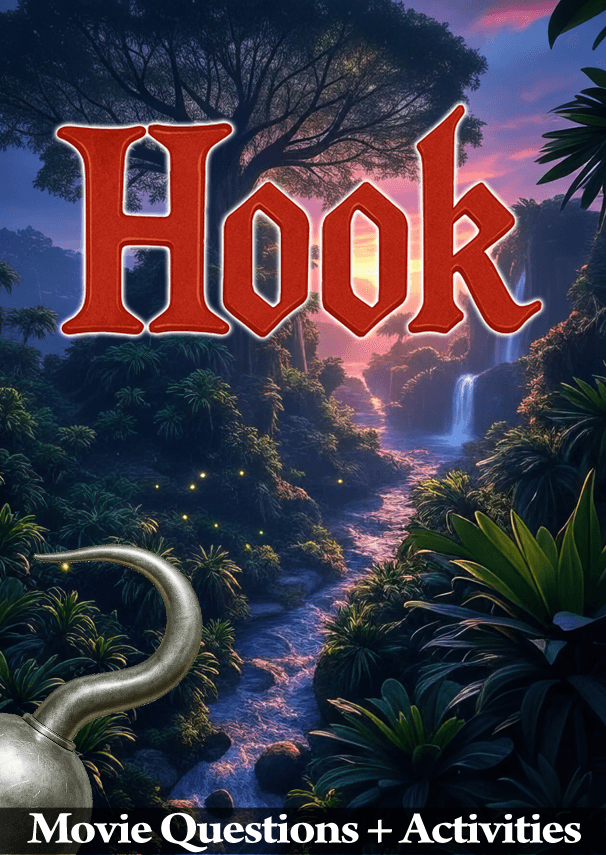
🗺️ A modern sequel to a classic story. Hook takes J.M. Barrie's Peter and Wendy and imagines what would happen if Peter Pan grew up and forgot who he was. Students who know the original story or the 1953 animated version have a ready comparison point, since this movie treats Neverland and its characters as a continuation rather than a retelling.
💼 An adult who has lost his sense of play. Peter Banning is introduced as a workaholic who misses his son's baseball game and snaps at his kids during a work call. His arc from distracted father back to someone who remembers how to imagine and how to be present gives students a clear character transformation to track across the movie.
⚔️ Old rivalries and a return to Neverland. Captain Hook has waited years for a rematch with Peter Pan, and his plan to win by turning Peter's own son against him raises the stakes beyond a simple good versus evil fight. Students can examine what Hook is actually after and why defeating an aged, forgetful Peter does not satisfy him.
🧑🤝🧑 The Lost Boys and what it means to belong. Peter has to be retrained and reaccepted by the Lost Boys, now led by Rufio, before he can be trusted to fight Hook. The group's initial mockery and eventual loyalty give students material to think about how belonging is earned rather than assumed.
👨👧👦 A father and son working through hurt. Peter's son Jack begins to side with Hook after feeling let down by his father's broken promises, and the movie spends real time on that rift before resolving it. It is a concrete example of how children respond to feeling unseen, and how trust gets rebuilt.
✨ A close to the story about choosing to grow up. By the end, Peter chooses to return to his real life and his family rather than remain in Neverland, having recovered both his memory and his sense of wonder. The movie's final message, that living itself can be an adventure, gives students something concrete to discuss about growing up without losing yourself.
Age Suitability and Content
This movie is rated PG.
📋 A free editable parent permission slip is available for this movie. It explains the educational benefits of watching movies in class and includes a space for parental consent. → Download Free Permission Slip on TpT (Free resource)
⚠️ Things to be aware of:
- Includes sword fighting and gunfire in which several pirates are killed on screen.
- Captain Hook threatens suicide with a gun, and the shot misses him.
- A main character is fatally stabbed and dies in Peter's arms.
- Mild language is used throughout, including 'ass', 'hell', and one use of 'bitch'.
- One adult character drinks a large glass of whiskey and stumbles.
- There is no sexual content beyond brief innuendo and a kiss between characters.
How My Movie Guide Helps You Teach It
📚 English Language Arts Teachers. The movie gives students a clear case study in adaptation, taking a well known children's book and extending its story into a new setting and timeline. Students can trace how Peter's character changes across the movie and compare this version of the Peter Pan mythology with Barrie's original. The guide includes multiple tiers of comprehension questions along with a discussion and storyboard sequence that builds toward a written synopsis.
🗣️ ESL and ELL Teachers. Hook moves through clearly staged scenes with strong visual storytelling, from Peter's ordinary London life to the fantastical world of Neverland, giving ESL and ELL students plenty of visual context to support their comprehension. The guide's multiple choice question set offers a lower pressure way for these students to demonstrate understanding without relying entirely on written recall.
🎬 Substitute Teachers and Cover Lessons. Everything a substitute needs is laid out and ready to go, with three tiers of comprehension questions and answer keys included for the question sets. A substitute can run the full session, from questions through the storyboard and synopsis task, without having seen the movie beforehand.
🏠 Homeschool Parents. Hook works well for a single learner, since its layered story rewards close attention and its comprehension questions come in multiple difficulty levels a parent can match to their child's level. The mind map and storyboard tasks give a homeschool student a hands on way to process the story visually before writing their synopsis. The discussion questions are designed with pairs in mind, so a homeschool parent may want to work through them alongside their child rather than leaving them for independent work.
💙 SEL Teachers. Peter's relationship with his son runs through the whole movie, from broken promises and a missed baseball game to Jack briefly turning toward Hook before the two reconcile. An SEL teacher can use this arc to open up conversations about trust, repair, and what kids need from the adults in their lives. The guide does not include a dedicated SEL activity, but the comprehension questions keep students engaged with these moments as they watch.
🌟 Supporting All Learners Movie guides can be a wonderfully calm fit for students with autism, learning difficulties, and mild to severe disabilities. The structured format gives every student a clear purpose during viewing, easing uncertainty and allowing them to engage at their own pace. If you teach in a special education or learning support setting, you may find this guide a gentle and practical resource. Find out more about why movies work for diverse learners.
What's Inside the Guide
This is a 16-page classroom-ready resource.
Part 1: Comprehension Questions
Three sets of differentiated comprehension questions in chronological order, for use with different ability levels. The first set has 50 questions requiring full sentence answers, the second has 35 questions requiring full sentence answers (15 removed from the 50-question set), and the third has 35 multiple choice questions with 3 possible answers each. Answer keys are included for all three sets.
Part 2: Discussion and Mind Map
Students answer five critical thinking questions for class discussion, which could also work well in pairs, with example answers included. Students then complete a character mind map, choosing a character, writing their name and drawing their face in the center bubble, and filling in surrounding bubbles with words or drawings based on the given prompts.
Part 3: Storyboard and Synopsis
Students create a nine scene storyboard illustrating pivotal events from the movie, with each scene including a short description of the main idea it represents, using the movie questions to guide sequencing. Using their completed storyboards as a guide, students then write a synopsis of the movie.
How These Guides Work: From Movie to Lesson
A movie is not a break from learning. It reaches students through sight, sound, and story at once, engaging the brain in ways text alone does not, and the structured work around it is what turns the viewing into a genuine lesson. You can read the research behind this on the Why Movies Work page.
- A Teacher Notes and General Directions page opens the guide with a brief overview of everything inside: what the movie is about, then each part of the guide in order with a short description of what it entails. You know what to expect from the whole resource before you hand out a single page, so you can pick up the guide cold and teach it the same day.
- Answer keys are included for the comprehension question sets, so grading is quick and you are not rewatching the movie to check answers. Some guides also include example answers for the creative and written activities.
- Print and go: classroom ready, with no additional preparation needed. Print one the morning you need it and the lesson is ready.
- Substitute and first-timer friendly. A guide can be handed to a substitute or picked up by a teacher covering the topic for the first time. Nobody running the session needs to have seen the movie.
- Differentiated comprehension sets. Most guides include two or three question sets at different difficulty levels, and most include a multiple-choice option that works well for ESL and ELL students. One class set covers your strongest readers, your strugglers, and your language learners without separate prep.
- Activities that go beyond recall. Each guide includes structured activities that ask students to engage with the movie, not just watch it, ranging from creative and written tasks to discussion and critical thinking questions depending on the guide. That variety matters in a mixed classroom: a student who freezes on a written question set may show real understanding through a drawing or a creative task, and a confident writer gets room to go beyond recall. For the teacher, it turns a movie session into work that can actually be assessed: comprehension questions show whether students followed the plot, and the activities beyond them show whether they understood it.