By Mr Hull's Movie Guides
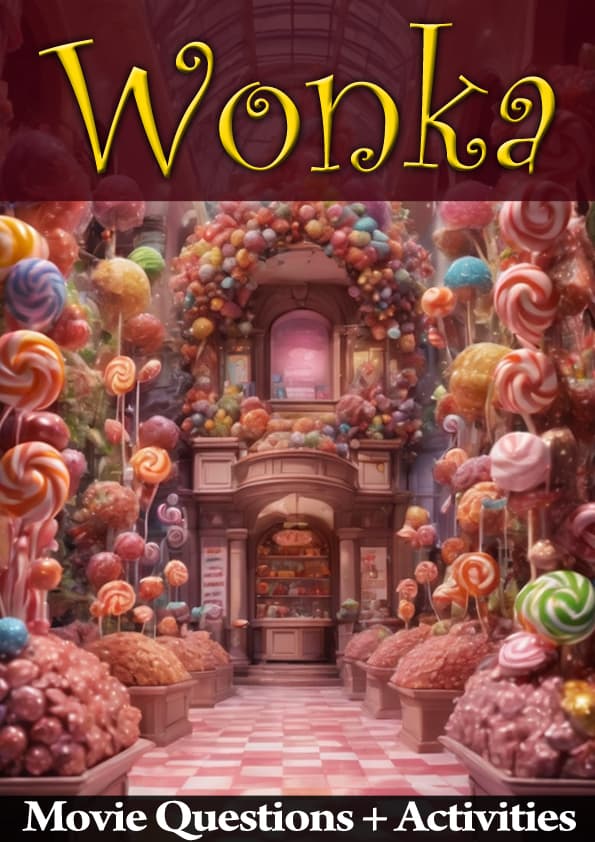
Watch the Trailer

Why Watch This Movie With Your Students
Here's what your students naturally take away from the movie, whether through themes, values, ideas, or perspectives.
📖 Uses Illiteracy as the Story's Catalyst. Willy Wonka cannot read, and that single vulnerability is what a predatory landlady exploits to trap him in a contract, sending the story in the direction it takes from there. Students see literacy treated as something with real, immediate consequences rather than an abstract school skill.
🍫 Builds Its Villains Out of Organized Greed. Three established chocolatiers form a cartel that bribes the police and a group of monks to keep Wonka and any other competition out of the market. The movie gives students a clear, concrete example of how greed can organize itself into something bigger than one person.
🤝 Turns a Laundry Room Into a Team. Wonka and his fellow captives, including Noodle, Abacus Crunch, and several others, work together to escape their debt and outsmart the people holding them captive. None of them could manage it alone, and the movie treats their collective effort as the actual engine of the plot.
💬 States Its Own Values Out Loud. Wonka tells the people around him that every good thing in the world started with a dream, and that what matters is not the chocolate itself but who you share it with. Students get direct, quotable statements of the movie's values rather than having to infer them from subtext alone.
💭 Roots Wonka's Ambition in Grief. Wonka's drive to make and share chocolate is tied to memories of his late mother, giving his ambition an emotional foundation rather than making it feel arbitrary. It gives students a way to talk about how loss can shape what someone chooses to build.
⚖️ Follows Through on Its Own Themes at the Ending. Wonka and Noodle expose the cartel's corruption publicly rather than simply escaping quietly, and the movie ties that public reckoning directly to the friendship and teamwork built earlier in the story. Students see a resolution that pays off the values the movie has been building the whole way through.
Age Suitability and Content
This movie is rated PG.
⚠️ Things to be aware of:
- A police officer holds Wonka's head underwater in a fountain and hits him with a baton in a scene that lasts about a minute.
- Wonka and Noodle are locked in a vault and nearly drown as it floods with liquid chocolate.
- Two characters are held at gunpoint, and a gun is fired once, though not at a person.
- A recurring joke involves a character rapidly gaining weight from eating chocolate.
- The laundry workers, including Wonka, are treated as indentured servants by their landlady, and there are references to a parent's death from illness.
- There is mild language, including one use of "damn," and one of Wonka's chocolates causes people who eat it to act as though drunk.
- There is a small amount of brief kissing and flirting between adult characters, but no sexual content beyond that.
📋 A free editable parent permission slip is available for this movie. It explains the educational benefits of watching movies in class and includes a space for parental consent. → Download Free Permission Slip on TpT (Free resource)
Note for educators: Movie details and age ratings in this post are sourced from IMDb, Common Sense Media, and Wikipedia to help ensure accuracy.
How My Movie Guide Helps You Teach It
📚 English Language Arts Teachers. Wonka's entire plot turns on reading, since Willy Wonka's illiteracy is what traps him in a predatory contract, and his growing ability to read becomes central to his escape and success. The guide is built around three sets of differentiated comprehension questions, giving teachers room to adjust for different reading levels, alongside storyboard and synopsis writing that pushes students beyond simple recall into sequencing and summarizing a complex, multi character plot.
🗣️ ESL and ELL Teachers. The movie's musical numbers and highly visual storytelling give language learners multiple ways into the story beyond dialogue alone, and its clear cause and effect plot structure is easy to track even when specific vocabulary is missed. The multiple choice comprehension question set in the guide is built with this kind of accessibility in mind, making it a strong fit for ESL and ELL students.
🎬 Substitute Teachers and Cover Lessons. Every activity in the guide is self-contained and clearly organized, with instructions a substitute can follow without any prior planning. Answer keys are included for all three sets of comprehension questions, and because the tasks do not depend on earlier classroom discussion, a substitute can run the full session without having seen the movie.
🏠 Homeschool Parents. Wonka's themes around perseverance, teamwork, and holding onto a dream despite real obstacles make it a natural movie to talk through with a single learner, especially alongside the more literal stakes the story places on being able to read. The guide's comprehension questions, storyboard and synopsis writing, and creative chocolate design and newspaper article activities all work well for one student working independently, without needing group adaptation.
💙 SEL Teachers. A group of strangers thrown together by exploitation, including Wonka, Noodle, and their fellow laundry workers, only escape their situation by working as a team, and the movie states its own values directly through lines like it not being the chocolate that matters but who you share it with. The guide does not include dedicated SEL activities, but the comprehension questions and creative writing tasks give students a structured way to engage with these themes as they watch.
🎵 Music Teachers. Wonka is built as a movie with original songs at its center, and musical numbers carry real plot and character weight rather than functioning as decoration, including Wonka's own statement of his values through song. The guide does not include dedicated music activities, but the comprehension questions give students a structured task that keeps them engaged with the movie as they watch.
🌟 Supporting All Learners Movie guides can be a wonderfully calm fit for students with autism, learning difficulties, and mild to severe disabilities. The structured format gives every student a clear purpose during viewing, easing uncertainty and allowing them to engage at their own pace. If you teach in a special education or learning support setting, you may find this guide a gentle and practical resource. Find out more about why movies work for diverse learners.
What's Inside the Guide
This is a 14-page classroom-ready resource.
Part 1: Comprehension Questions
Three sets of differentiated comprehension questions in chronological order: 40 questions requiring full sentence answers, a second set of 30 questions requiring full sentence answers (10 removed from the 40 question set), and 30 multiple choice questions with three possible answers each, which also work well with ESL and ELL students. Answer keys are included for all three sets.
Part 2: Storyboard and Synopsis
Students draw a nine scene storyboard of what they consider the most important parts of the movie, with a brief description for each scene, with a reminder that they can reference the comprehension questions to help with sequencing. Using their completed storyboard as a guide, students then write a synopsis of the movie.
Part 3: Creativity
Students design a new chocolate, including naming it, listing its ingredients, describing what it looks and tastes like, and what happens after someone eats it. Students then imagine themselves as junior newspaper reporters interviewing Lofty about the new chocolate and use those details to write an article about it.
“This was just what I was looking for. Thank you for the great resource!”
— Annell S.
How These Guides Work: From Movie to Lesson
Watching a movie is not a break from learning. It reaches students through sight, sound, and story at once, engaging the brain in ways text alone does not, and the structured work around it is what turns the viewing into a genuine lesson. You can read the research behind this on the Why Movies Work page.
- A Teacher Notes and General Directions page opens the guide with a brief overview of everything inside: what the movie is about, then each part of the guide in order with a short description of what it entails. You know what to expect from the whole resource before you hand out a single page, so you can pick up the guide cold and teach it the same day.
- Answer keys are included for the comprehension question sets, so grading is quick and you are not rewatching the movie to check answers. Some guides also include example answers for the creative and written activities.
- Print and go: classroom ready, with no additional preparation needed. Print one the morning you need it and the lesson is ready.
- Substitute and first-timer friendly. A guide can be handed to a substitute or picked up by a teacher covering the topic for the first time. Nobody running the session needs to have seen the movie.
- Differentiated comprehension sets. Most guides include two or three question sets at different difficulty levels, and most include a multiple-choice option that works well for ESL and ELL students. One class set covers your strongest readers, your strugglers, and your language learners without separate prep.
- Activities that go beyond recall. Each guide includes structured activities that ask students to engage with the movie, not just watch it, ranging from creative and written tasks to discussion and critical thinking questions depending on the guide. That variety matters in a mixed classroom: a student who freezes on a written question set may show real understanding through a drawing or a creative task, and a confident writer gets room to go beyond recall. For the teacher, it turns a movie session into work you can grade: comprehension questions show whether students followed the plot, and the activities beyond them show whether they understood it.