By Mr Hull's Movie Guides
Watch the Trailer

What's Inside the Guide
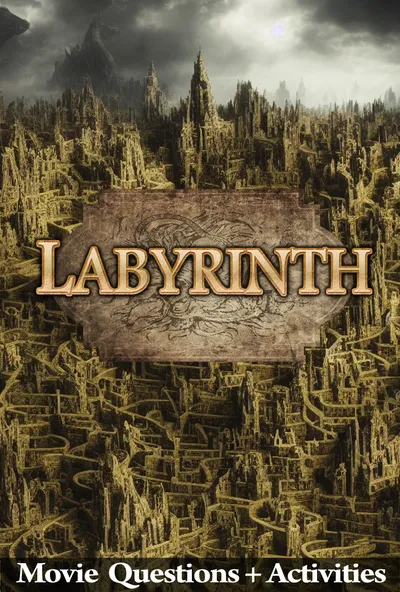
This is a 14-page classroom-ready resource.
Three sets of differentiated comprehension questions in chronological order. Answer keys are included for all three sets.
- 40 question set requiring full sentence answers.
- 30 question set requiring full sentence answers (a shortened version of the 40 question set).
- 30 multiple choice question set with three possible answers each.
- A nine scene storyboard where students illustrate and summarize key events in chronological order, building sequencing and summary writing skills.
- A structured synopsis of the story, written using their completed storyboard, reinforcing narrative organization and clear written expression.
This part covers two activities.
- Character writing, where students choose one character to write about using guided question prompts, then draw a picture of that character.
- A creative writing task where students imagine and write a short account of what Hoggle, Ludo, and Sir Didymus were doing before they met Sarah.
“Good resource to follow alongside the film. I loved the different versions available.”
— Anel F.
Why Watch This Movie With Your Students
Here's what your students naturally take away from the movie, whether through themes, values, ideas, or perspectives.
🧩 Puts problem solving front and center. Sarah has to think her way through the labyrinth using logic, timing, and trial and error rather than force. Every obstacle she meets has a solution built into it, which makes the movie a running example of working through a puzzle under pressure.
🎵 Built around original songs written and performed by David Bowie. Musical numbers like Magic Dance and As the World Falls Down are not background music, they carry key scenes and shape Jareth's character directly. The movie gives students a fantasy story told partly through songwriting rather than dialogue alone.
🕰️ Builds tension through a hard deadline. Sarah has thirteen hours to reach the Goblin King's castle before her brother is lost for good. That ticking clock gives the story a clear structure students can follow and discuss scene by scene.
🤝 Explores loyalty through unlikely friendships. Sarah teams up with Hoggle, Ludo, and Sir Didymus, each of whom has their own reasons for helping or hesitating. Their shifting loyalty, especially Hoggle's, gives students something concrete to track across the story.
💭 Centers a character taking responsibility for her own mistake. Sarah's wish is what puts Toby in danger in the first place, and the entire quest is her working to undo it. The movie ties her growth directly to owning the consequences of what she said in anger.
🏰 Offers a maze structure that rewards close attention. The labyrinth itself is full of misdirection, hidden paths, and rules that shift depending on how Sarah approaches them. Following her route through it gives students a reason to track sequence and cause and effect closely.
Age Suitability and Content
This movie is rated PG.
⚠️ Things to be aware of:
- Fantasy creatures fight with swords and there are tense chase sequences, but there is no blood or visible gore.
- Mild language includes words like 'hell,' 'damn,' and 'crap.'
- The villain, Jareth, is an adult character who shows romantic and possessive interest in Sarah, a sixteen-year-old.
- There is no sexual content in the movie, and no realistic drinking, drug use, or smoking depicted.
📋 A free editable parent permission slip is available for this movie. It explains the educational benefits of watching movies in class and includes a space for parental consent. → Download Free Permission Slip on TpT (Free resource)
Note for educators: Movie details and age ratings in this post are sourced from IMDb, Common Sense Media, and Wikipedia to help ensure accuracy.
How My Movie Guide Helps You Teach It
Click your subject below to see how this guide supports it:
📚 English Language Arts Teachers
🗣️ ESL and ELL Teachers
🎬 Substitute Teachers and Cover Lessons
🏠 Homeschool Parents
💙 SEL Teachers
🎵 Music Teachers
🌟 Supporting All Learners A movie gives students a story to follow, and the guide gives them questions to work through as they watch. For students with autism, learning difficulties, and mild to severe disabilities, that combination provides a clear focus for the lesson and a concrete way to show understanding. The format can be useful in special education and learning support classrooms, where teachers need activities that give students a defined task during viewing. Find out more about why movies work for diverse learners.
How These Guides Work: From Movie to Lesson
Watching a movie is not a break from learning. It reaches students through sight, sound, and story at once, engaging the brain in ways text alone does not, and the structured work around it is what turns the viewing into a genuine lesson. You can read the research behind this on the Why Movies Work page.
- A Teacher Notes and General Directions page opens the guide with a brief overview of everything inside: what the movie is about, then each part of the guide in order with a short description of what it entails. You know what to expect from the whole resource before you hand out a single page, so you can pick up the guide cold and teach it the same day.
- Answer keys are included for the comprehension question sets, so grading is quick and you are not rewatching the movie to check answers. Some guides also include example answers for the creative and written activities.
- Print and go: classroom ready, with no additional preparation needed. Print one the morning you need it and the lesson is ready.
- Substitute and first-timer friendly. A guide can be handed to a substitute or picked up by a teacher covering the topic for the first time. Nobody running the session needs to have seen the movie.
- Differentiated comprehension sets. Most guides include two or three question sets at different difficulty levels, and most include a multiple-choice option that works well for ESL and ELL students. One class set covers your strongest readers, your strugglers, and your language learners without separate prep.
- Activities that go beyond recall. Each guide includes structured activities that ask students to engage with the movie, not just watch it, ranging from creative and written tasks to discussion and critical thinking questions depending on the guide. That variety matters in a mixed classroom: a student who freezes on a written question set may show real understanding through a drawing or a creative task, and a confident writer gets room to go beyond recall. For the teacher, it turns a movie session into work you can grade: comprehension questions show whether students followed the plot, and the activities beyond them show whether they understood it.