By Mr Hull's Movie Guides
Watch the Trailer

What's Inside the Guide
This is a 14-page classroom-ready resource.
Two complete question sets covering the movie in chronological order. Answer keys are included for both sets.
- 35 full-sentence question set, tracking the story from beginning to end.
- 35-question multiple-choice set with three options per question, suited to younger students or language learners.
This part covers two activities.
- Nine key scenes illustrated and described from the movie, covering the beginning, middle, and end, each panel including a drawing and a short sentence explaining what is happening.
- A profile of an animal they would like to hop into, including a detailed drawing, a physical description, a justification for their choice, and a short narrative describing their first adventure in that body.
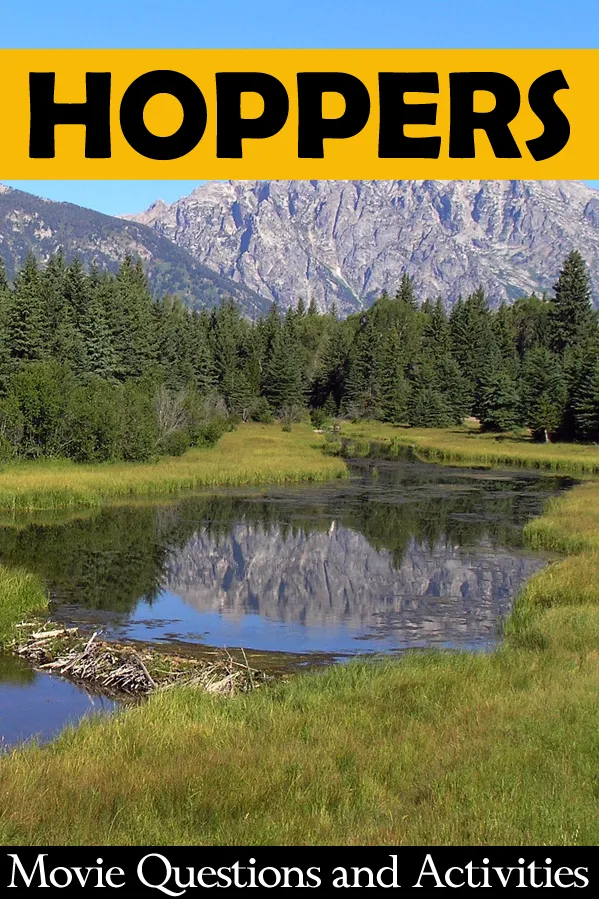
Using a provided Beaver Fact Sheet, students complete a side-view drawing of a beaver, match key vocabulary terms, write a written description of the animal, and compose a short creative diary entry from the perspective of a beaver. The activity reinforces real knowledge about beaver adaptations, behaviours, and ecological role.
A themed word search with 15 words connected to the movie. Students first unscramble 10 words and then use 5 clues to identify the remaining words before finding them all in the grid. Answers are included.
Why Watch This Movie With Your Students
Here's what your students naturally take away from the movie, whether through themes, values, ideas, or perspectives.
🌿 Real science woven into the story. Keystone species, apex predators, food chains, and ecosystem collapse are not background details in this movie. They are plot points. Students who watch closely will encounter genuine ecological concepts in a context that makes them memorable.
🦫 Beavers as a genuine teaching subject. The movie centres on beavers and their role as a keystone species, the animals whose activity shapes the entire ecosystem around them. The guide's beaver fact sheet activity reinforces this directly, giving science teachers a structured written task tied to real animal biology.
🌍 Environmental activism done right. Mabel is a young activist trying to save a habitat from a development project. The movie explores what activism looks like in practice, including the mistakes activists make and the importance of bringing others with you. It is a model of civic engagement that connects to Social Studies as naturally as it does to Science.
🤖 A science fiction premise grounded in real questions. The hopping technology raises genuine questions about consciousness, identity, and the ethics of science. These are not heavy discussions for this age group, but the movie plants the seeds in a way that more curious students will want to explore further.
😄 Pixar at its most entertaining. This is a genuinely funny movie. Students who are not especially interested in science will be drawn in by the characters and the humour, and will come away having absorbed more than they realise. That is exactly the kind of movie a classroom needs.
💛 A story about grief and purpose. Mabel's drive to protect the woodland is tied to the loss of her grandmother, who first took her there as a child. The movie handles grief with care, and the connection between loss and purpose gives the story real emotional depth beyond the adventure.
Age Suitability and Content
This movie is rated PG.
⚠️ Things to be aware of:
- Some genuinely scary scenes, particularly in the third act, with intensity increasing as the movie progresses
- A fast-spreading wildfire sequence where humans and animals must evacuate
- A humanoid robot whose face mask comes off, revealing unsettling internal components. Some parents have described this as a jump scare
- Animals in peril throughout, including predator-and-prey moments played partly for humour
- A speaking insect character is impulsively squashed
- A large shark pursues a human in an extended chase sequence
- References to a grandmother's death and a child's grief, handled with care
- Mild language including stupid, jerk, loser, and one euphemistic expression
- No sexual content, alcohol, or substance use
📋 A free editable parent permission slip is available for this movie. It explains the educational benefits of watching movies in class and includes a space for parental consent. → Download Free Permission Slip on TpT (Free resource)
Note for educators: Movie details and age ratings in this post are sourced from IMDb, Common Sense Media, and Wikipedia to help ensure accuracy.
How My Movie Guide Helps You Teach It
Click your subject below to see how this guide supports it:
📚 English Language Arts Teachers
🗣️ ESL and ELL Teachers
🔬 Science Teachers
🌐 Social Studies Teachers
🎬 Substitute Teachers and Cover Lessons
🏠 Homeschool Parents
🔭 STEM Teachers
🌟 Supporting All Learners A movie gives students a story to follow, and the guide gives them questions to work through as they watch. For students with autism, learning difficulties, and mild to severe disabilities, that combination provides a clear focus for the lesson and a concrete way to show understanding. The format can be useful in special education and learning support classrooms, where teachers need activities that give students a defined task during viewing. Find out more about why movies work for diverse learners.
For science and social studies teachers, the comprehension questions are designed to keep students engaged and accountable during the movie rather than to replace subject-specific curriculum materials. The beaver fact sheet activity is the closest the guide comes to curriculum content, grounded in real animal biology. Use it alongside your own subject materials as needed.
How These Guides Work: From Movie to Lesson
Watching a movie is not a break from learning. It reaches students through sight, sound, and story at once, engaging the brain in ways text alone does not, and the structured work around it is what turns the viewing into a genuine lesson. You can read the research behind this on the Why Movies Work page.
- A Teacher Notes and General Directions page opens the guide with a brief overview of everything inside: what the movie is about, then each part of the guide in order with a short description of what it entails. You know what to expect from the whole resource before you hand out a single page, so you can pick up the guide cold and teach it the same day.
- Answer keys are included for the comprehension question sets, so grading is quick and you are not rewatching the movie to check answers. Some guides also include example answers for the creative and written activities.
- Print and go: classroom ready, with no additional preparation needed. Print one the morning you need it and the lesson is ready.
- Substitute and first-timer friendly. A guide can be handed to a substitute or picked up by a teacher covering the topic for the first time. Nobody running the session needs to have seen the movie.
- Differentiated comprehension sets. Most guides include two or three question sets at different difficulty levels, and most include a multiple-choice option that works well for ESL and ELL students. One class set covers your strongest readers, your strugglers, and your language learners without separate prep.
- Activities that go beyond recall. Each guide includes structured activities that ask students to engage with the movie, not just watch it, ranging from creative and written tasks to discussion and critical thinking questions depending on the guide. That variety matters in a mixed classroom: a student who freezes on a written question set may show real understanding through a drawing or a creative task, and a confident writer gets room to go beyond recall. For the teacher, it turns a movie session into work you can grade: comprehension questions show whether students followed the plot, and the activities beyond them show whether they understood it.