By Mr Hull's Movie Guides
Watch the Trailer

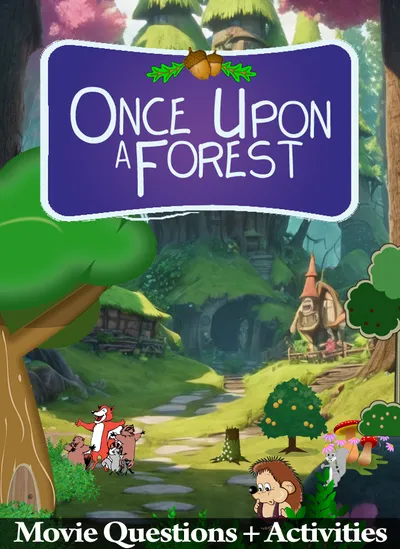
What's Inside the Guide
This is a 12-page classroom-ready resource.
Two full sets of differentiated comprehension questions presented in chronological order. Answer keys are included for both sets.
- 30 question set requiring full sentence answers.
- 30 multiple choice question set with three possible answers each. The multiple choice set works well with ESL and ELL students.
Students use the earlier comprehension questions to guide sequencing.
- A 9-scene storyboard illustrating pivotal events from the movie, with a short description explaining the main idea behind each scene.
- A synopsis of the movie, written using their completed storyboard as a guide.
This part covers two activities.
- Recreating Cornelius's map of the forest from memory, drawing and labeling important locations including dangerous areas.
- Imagining themselves as part of the clean-up crew sent to the forest after the gas spill, writing a report detailing the damage caused and the work done to restore the forest to its natural state.
Students answer three questions about environmental damage: listing and explaining three forms of man-made pollution and why each is a problem, addressing deforestation specifically, and reflecting on why protecting the environment matters.
“Was perfect for my habitat unit! Thank you!”
— Task-it-Teacher (TPT Seller)
“My students needed an activity for the end of year that was fun and they also continued to learn. We are going over animal adaptations and environments. This was a fun way to teach a few lessons.”
— Autumn C.
Why Watch This Movie With Your Students
Here's what your students naturally take away from the movie, whether through themes, values, ideas, or perspectives.
🌫️ Shows environmental damage as a direct, traceable consequence. The forest of Dapplewood is destroyed almost overnight after a truck carrying poison gas overturns nearby. The movie draws a clear, visible line between a single human accident and the collapse of an entire ecosystem, which gives students a concrete case to reason about rather than an abstract warning.
🦔 Follows three young animals through a genuine team effort. Abigail, Edgar, and Russell each bring different strengths and different fears to their journey, and the movie is honest about the fact that none of them could complete the mission alone. Their friendship is tested by real danger, not just disagreement.
🦉 Builds real tension through natural threats, not violence. The Furlings are pursued by a menacing owl and have to cross unfamiliar, damaged terrain to reach the herbs Michelle needs. The suspense comes from the animals' vulnerability and the two-day time limit, giving students something to track and predict.
🏡 Centers loss and recovery without dwelling on either. Michelle loses her parents to the gas and is nursed back to health while the other Furlings are away, and the movie treats her grief honestly without lingering on it. Students see both what was lost and how her uncle and friends step in to support her afterward.
🌱 Complicates a simple 'humans are the villain' narrative. The gas leak that devastates Dapplewood is caused by human carelessness, but the movie doesn't stop there. A human clean-up crew is later shown clearing the gas from the forest, and one worker frees Edgar from an old trap rather than harming him, a moment that shifts Cornelius's view of humans. Dapplewood's full recovery is left as something still ahead, not a resolved happy ending.
🎵 Uses music and mood to carry emotional weight. James Horner's score marks the shift from the forest's peaceful opening to the devastation after the gas leak, and again as the Furlings' journey builds toward Michelle's rescue. Students who respond to tone and pacing get an additional way into the story beyond plot alone.
Age Suitability and Content
This movie is rated G.
⚠️ Things to be aware of:
- Two characters die off-screen from poison gas exposure, and their daughter is shown grieving their loss.
- A menacing owl chases and attempts to attack one of the young animal characters.
- No sexual content, language, or substance use of any kind.
Note for educators: Movie details and age ratings in this post are sourced from IMDb, Common Sense Media, and Wikipedia to help ensure accuracy.
How My Movie Guide Helps You Teach It
Click your subject below to see how this guide supports it:
📚 English Language Arts Teachers
🗣️ ESL and ELL Teachers
🔬 Science Teachers
🌐 Social Studies Teachers
🎬 Substitute Teachers and Cover Lessons
🏠 Homeschool Parents
💙 SEL Teachers
🌟 Supporting All Learners A movie gives students a story to follow, and the guide gives them questions to work through as they watch. For students with autism, learning difficulties, and mild to severe disabilities, that combination provides a clear focus for the lesson and a concrete way to show understanding. The format can be useful in special education and learning support classrooms, where teachers need activities that give students a defined task during viewing. Find out more about why movies work for diverse learners.
How These Guides Work: From Movie to Lesson
Watching a movie is not a break from learning. It reaches students through sight, sound, and story at once, engaging the brain in ways text alone does not, and the structured work around it is what turns the viewing into a genuine lesson. You can read the research behind this on the Why Movies Work page.
- A Teacher Notes and General Directions page opens the guide with a brief overview of everything inside: what the movie is about, then each part of the guide in order with a short description of what it entails. You know what to expect from the whole resource before you hand out a single page, so you can pick up the guide cold and teach it the same day.
- Answer keys are included for the comprehension question sets, so grading is quick and you are not rewatching the movie to check answers. Some guides also include example answers for the creative and written activities.
- Print and go: classroom ready, with no additional preparation needed. Print one the morning you need it and the lesson is ready.
- Substitute and first-timer friendly. A guide can be handed to a substitute or picked up by a teacher covering the topic for the first time. Nobody running the session needs to have seen the movie.
- Differentiated comprehension sets. Most guides include two or three question sets at different difficulty levels, and most include a multiple-choice option that works well for ESL and ELL students. One class set covers your strongest readers, your strugglers, and your language learners without separate prep.
- Activities that go beyond recall. Each guide includes structured activities that ask students to engage with the movie, not just watch it, ranging from creative and written tasks to discussion and critical thinking questions depending on the guide. That variety matters in a mixed classroom: a student who freezes on a written question set may show real understanding through a drawing or a creative task, and a confident writer gets room to go beyond recall. For the teacher, it turns a movie session into work you can grade: comprehension questions show whether students followed the plot, and the activities beyond them show whether they understood it.