
By Mr Hull's Movie Guides
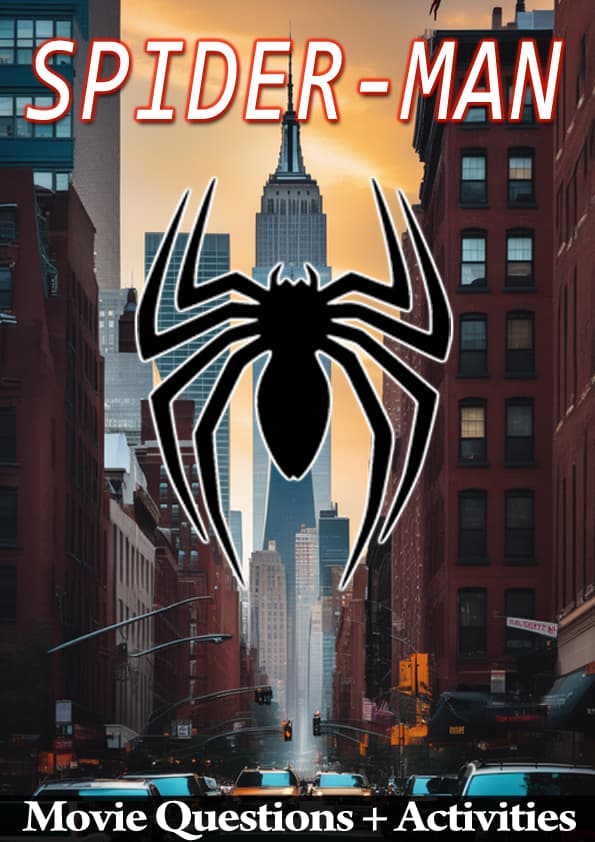
Watch the Trailer

Why Watch This Movie With Your Students
Here's what your students naturally take away from the movie, whether through themes, values, ideas, or perspectives.
🕷️ Shows what it means to get power you didn't ask for. Peter never sought out his abilities, and the movie spends real time on how he first reacts to them before he decides what to do with them. Students see a character figuring out an identity in real time, not one who is simply handed a heroic destiny.
💔 Puts guilt over inaction front and center. Peter's failure to stop a thief he could have caught leads directly to his uncle's death. This gives students a concrete example of how choosing not to act can carry as much weight as choosing to act wrongly.
🎭 Explores a genuine father-son dynamic gone wrong. Norman Osborn's transformation into the Green Goblin is driven by pressure to succeed and a chemical experiment that pushes him past his limits, and it directly damages his relationship with his son Harry. Students can examine how ambition and instability affect the people closest to a person.
⚖️ Frames responsibility as an ongoing cost, not a one-time decision. Peter's choice to protect the people he loves by staying distant from them, even Mary Jane, shows that taking on responsibility for others often means giving something up. It is a clear, repeatable example students can return to when discussing sacrifice.
🦹 Gives students a villain shaped by real pressure, not simple evil. Norman Osborn is not depicted as inherently cruel. His descent is tied to specific professional and chemical pressures, giving students a fuller picture of how a person can become dangerous.
🧭 Centers a clear, quotable moral framework. Uncle Ben's line about power and responsibility gives students a specific, memorable idea to test against every decision Peter makes throughout the movie, from small choices to the final confrontation.
Age Suitability and Content
This movie is rated PG-13.
⚠️ Things to be aware of:
- Contains frequent comic book style violence, including fights, explosions, and a character's death by impalement.
- Language includes mild profanity throughout the movie.
- One scene shows a woman's wet clothing as visible through rain; no sexual content beyond passionate kissing occurs.
- A character is shot off screen and another falls to his death, both without graphic detail shown.
- No drinking, drug use, or smoking is present.
📋 A free editable parent permission slip is available for this movie. It explains the educational benefits of watching movies in class and includes a space for parental consent. → Download Free Permission Slip on TpT (Free resource)
Note for educators: Movie details and age ratings in this post are sourced from IMDb, Common Sense Media, and Wikipedia to help ensure accuracy.
How My Movie Guide Helps You Teach It
📚 English Language Arts Teachers. Spider-Man gives students a tightly constructed origin story with a stated moral framework and a protagonist whose choices carry direct consequences he has to live with. The guide is built for ELA, with comprehension work at different difficulty levels and character writing tasks that go beyond simple recall.
🗣️ ESL and ELL Teachers. The dialogue in Spider-Man stays clear and direct even in its more dramatic scenes, which makes it accessible without losing its emotional stakes. The guide's multiple choice questions work well for ESL and ELL students building comprehension at their own pace.
🎬 Substitute Teachers and Cover Lessons. Hand this one to a substitute and walk away. Everything needed is included, with organized materials and answer keys for the comprehension question sets, so a sub can run the session without having seen the movie.
🏠 Homeschool Parents. Spider-Man works well for a home learning session built around a clear moral question, what do you owe other people once you have the power to help them. The guide's differentiated comprehension sets, storyboard, and character writing task give a single student plenty to work through independently.
💙 SEL Teachers. Spider-Man traces a specific arc of guilt over inaction, grief after loss, and a decision to sacrifice personal happiness to protect others, dynamics an SEL teacher can build directly into a lesson. The guide does not include a dedicated SEL activity, but the comprehension questions keep students accountable and engaged with these emotional beats as they watch.
🌟 Supporting All Learners Movie guides can be a wonderfully calm fit for students with autism, learning difficulties, and mild to severe disabilities. The structured format gives every student a clear purpose during viewing, easing uncertainty and allowing them to engage at their own pace. If you teach in a special education or learning support setting, you may find this guide a gentle and practical resource. Find out more about why movies work for diverse learners.
What's Inside the Guide
This is a 15-page classroom-ready resource.
Part 1: Comprehension Questions
Three differentiated sets of chronological comprehension questions. Set one has 50 questions requiring full sentence answers. Set two has 35 questions requiring full sentence answers. Set three has 34 multiple choice questions with three possible answers each, plus one final full sentence question. Answer keys are included for all three sets.
Part 2: Storyboard and Synopsis
Students draw a nine-scene storyboard of what they consider the most important parts of the movie, with a brief description for each scene, then use that storyboard to write a synopsis of the movie.
Part 3: Character Writing
Students write about Spider-Man and the Green Goblin following guided question prompts, including a drawing of both characters. This can serve as a stepping stone for a group analysis of the two characters.
How These Guides Work: From Movie to Lesson
Watching a movie is not a break from learning. It reaches students through sight, sound, and story at once, engaging the brain in ways text alone does not, and the structured work around it is what turns the viewing into a genuine lesson. You can read the research behind this on the Why Movies Work page.
- A Teacher Notes and General Directions page opens the guide with a brief overview of everything inside: what the movie is about, then each part of the guide in order with a short description of what it entails. You know what to expect from the whole resource before you hand out a single page, so you can pick up the guide cold and teach it the same day.
- Answer keys are included for the comprehension question sets, so grading is quick and you are not rewatching the movie to check answers. Some guides also include example answers for the creative and written activities.
- Print and go: classroom ready, with no additional preparation needed. Print one the morning you need it and the lesson is ready.
- Substitute and first-timer friendly. A guide can be handed to a substitute or picked up by a teacher covering the topic for the first time. Nobody running the session needs to have seen the movie.
- Differentiated comprehension sets. Most guides include two or three question sets at different difficulty levels, and most include a multiple-choice option that works well for ESL and ELL students. One class set covers your strongest readers, your strugglers, and your language learners without separate prep.
- Activities that go beyond recall. Each guide includes structured activities that ask students to engage with the movie, not just watch it, ranging from creative and written tasks to discussion and critical thinking questions depending on the guide. That variety matters in a mixed classroom: a student who freezes on a written question set may show real understanding through a drawing or a creative task, and a confident writer gets room to go beyond recall. For the teacher, it turns a movie session into work you can grade: comprehension questions show whether students followed the plot, and the activities beyond them show whether they understood it.


