By Mr Hull's Movie Guides
Watch the Trailer

What's Inside the Guide
This is a 15-page classroom-ready resource.
Comprehension questions in chronological order, in three sets for differentiation. The multiple-choice questions may also work well with ESL and ELL students. Answer keys are included.
- 37 questions requiring full sentence answers.
- 30 questions requiring full sentence answers (7 removed from the 37-question set).
- 30 multiple choice questions with 3 possible answers.
Students create a storyboard and then use it to write a synopsis.
- A 9-scene storyboard illustrating pivotal events from the movie, with each scene including a short description of the main idea it represents. The movie questions guide the sequencing.
- A synopsis of the movie written using the storyboard as a guide.
Two creative writing tasks.
- Three diary entries, written from the perspectives of Lady Eleanore during her imprisonment, Sir Simon as a ghost, and Ginny upon arriving at Canterville Hall.
- A newspaper article recounting Sir Simon's background, his years as a ghost, and how he was finally laid to rest.
Why Watch This Movie With Your Students
Here's what your students naturally take away from the movie, whether through themes, values, ideas, or perspectives.
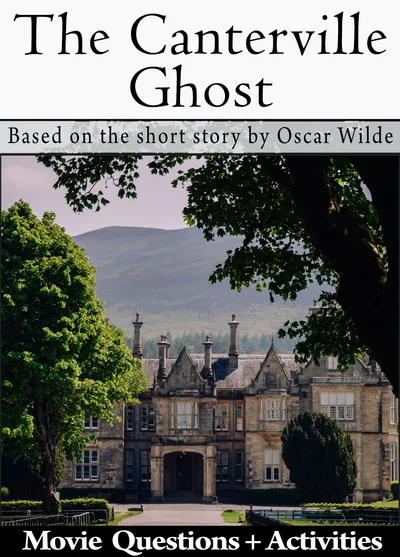
📖 A Classic Story to Compare. The movie is based on Oscar Wilde's short story of the same title, a tale that has reached the screen more than once. That gives teachers a ready route into a classic author and a chance to compare a written story with its screen version.
👻 A Ghost With a Past. Sir Simon's haunting traces back to the loss of his wife and the guilt he carries over how it came about. The story brings that past out gradually as Ginny uncovers it, so students watch a feared figure become someone she befriends.
🤝 Empathy Over Fear. Ginny weeps for Sir Simon after she learns what happened to him, and that counts toward fulfilling the prophecy tied to the house. She then goes with him to plead his case before the Angel of Death. Compassion, not scaring people off, is what moves his situation forward.
🔍 A Skeptic Changes His Mind. Ginny's father refuses to believe in ghosts and blames her for what the family experiences. He starts to believe after he hears Ginny's voice and sees her image in Sir Simon's portrait. The story gives students a clear case of how disbelief can shape the way a family treats one of its own.
💞 Love Stronger Than Death. In the closing scene, Ginny thanks Sir Simon for what he taught her about life and death, and about love being stronger than either. Ghostly voices are then heard, implying that he has been reunited with his wife. The ending ties the story's grief to the idea of love that lasts.
🏰 A Family Settling In. Ginny arrives in England missing her friends and dreading the boredom of life in a centuries-old mansion. By the end of the story the family decides to stay at Canterville Hall indefinitely, with Lord Canterville's blessing. That shift from a temporary stay to a decision to stay gives students a way to talk about adjusting to a new place.
Age Suitability and Content
This movie is rated PG.
⚠️ Things to be aware of:
- Mild ghost scares with suspenseful music, thunder, and lightning.
- Very mild slapstick violence.
- Themes of death, grief, and the afterlife.
- Chaste teen romance limited to kissing and hand-holding, with no sexual content or nudity.
- No profanity or strong language.
- Adults drink alcohol, including wine and ale, with no one shown intoxicated.
📋 A free editable parent permission slip is available for this movie. It explains the educational benefits of watching movies in class and includes a space for parental consent. → Download Free Permission Slip on TpT (Free resource)
Note for educators: Movie details and age ratings in this post are sourced from IMDb, Common Sense Media, and Wikipedia to help ensure accuracy.
How My Movie Guide Helps You Teach It
Click your subject below to see how this guide supports it:
📚 English Language Arts Teachers
🗣️ ESL and ELL Teachers
🎬 Substitute Teachers and Cover Lessons
🏠 Homeschool Parents
💙 SEL Teachers
🌟 Supporting All Learners A movie gives students a story to follow, and the guide gives them questions to work through as they watch. For students with autism, learning difficulties, and mild to severe disabilities, that combination provides a clear focus for the lesson and a concrete way to show understanding. The format can be useful in special education and learning support classrooms, where teachers need activities that give students a defined task during viewing. Find out more about why movies work for diverse learners.
How These Guides Work: From Movie to Lesson
Watching a movie is not a break from learning. It reaches students through sight, sound, and story at once, engaging the brain in ways text alone does not, and the structured work around it is what turns the viewing into a genuine lesson. You can read the research behind this on the Why Movies Work page.
- A Teacher Notes and General Directions page opens the guide with a brief overview of everything inside: what the movie is about, then each part of the guide in order with a short description of what it entails. You know what to expect from the whole resource before you hand out a single page, so you can pick up the guide cold and teach it the same day.
- Answer keys are included for the comprehension question sets, so grading is quick and you are not rewatching the movie to check answers. Some guides also include example answers for the creative and written activities.
- Print and go: classroom ready, with no additional preparation needed. Print one the morning you need it and the lesson is ready.
- Substitute and first-timer friendly. A guide can be handed to a substitute or picked up by a teacher covering the topic for the first time. Nobody running the session needs to have seen the movie.
- Differentiated comprehension sets. Most guides include two or three question sets at different difficulty levels, and most include a multiple-choice option that works well for ESL and ELL students. One class set covers your strongest readers, your strugglers, and your language learners without separate prep.
- Activities that go beyond recall. Each guide includes structured activities that ask students to engage with the movie, not just watch it, ranging from creative and written tasks to discussion and critical thinking questions depending on the guide. That variety matters in a mixed classroom: a student who freezes on a written question set may show real understanding through a drawing or a creative task, and a confident writer gets room to go beyond recall. For the teacher, it turns a movie session into work you can grade: comprehension questions show whether students followed the plot, and the activities beyond them show whether they understood it.