By Mr Hull's Movie Guides
What's Inside the Guide
This is a 9-page classroom-ready resource.
Two sets of chronological comprehension questions for differentiation. Answer keys are included for both sets.
- 10 question set requiring full sentence answers.
- 10 multiple choice question set with 3 possible answers per question. The multiple choice set also works well for ESL and ELL students.
Students use the comprehension questions to help with sequencing.
- A 6 scene storyboard of what they believe are the most important parts of the story, with a brief description for each scene.
- A synopsis of the story, written using their completed storyboard as a guide.
Five inference questions for students to complete in pairs, which can then be discussed as a class.
A listening and drawing task requiring a pencil and four coloring pencils in red, blue, green, and yellow. The teacher reads out instructions for students to draw dots and lines in a grid, and students then use those dots and lines as a creative starting point to draw anything they like using their imagination, coloring the result with the four chosen colors. A finished example is included.
Why Watch This Movie With Your Students
Here's what your students naturally take away from the movie, whether through themes, values, ideas, or perspectives.
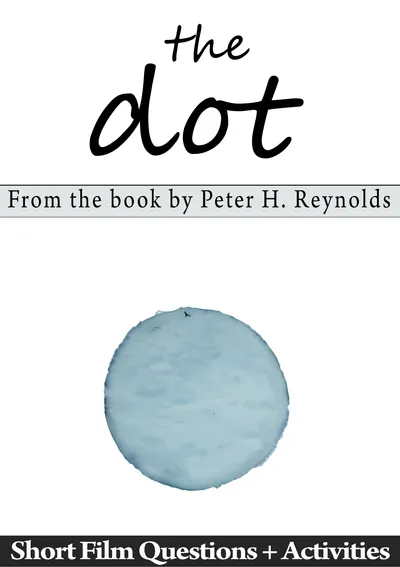
😤 A story that starts with a refusal, not a triumph. Vashti doesn't want to draw at all, and the story doesn't rush past that resistance, it treats her frustration as the actual starting point of the story rather than something to skip over. Students see that not wanting to try is a normal, even useful place to begin.
✍️ Encouragement shown as a specific, deliberate act. Vashti's teacher doesn't tell her she's talented or praise her drawing, she asks Vashti to sign a single angry dot and hangs it up. It gives students a concrete example of what encouragement looks like in practice, rather than a vague idea of being supportive.
🎨 A visible before and after in someone's confidence. The short film shows Vashti's shift from refusing to make a single mark to filling an entire school art show with her own dot paintings. Students can track exactly what changed and when, rather than being told she simply found her confidence.
🤝 The same gesture passed from one person to another. By the end, Vashti offers a younger boy the same encouragement her teacher once gave her, asking him to sign a line he insists he can't draw straight. It shows students that the effect of one small act of encouragement doesn't stop with the person who received it first.
⚫ A story built entirely around one small, ordinary object. The entire short film is centered on a dot, the simplest possible mark someone could make, and uses it to carry a much bigger idea about creativity and self-belief. Students get to see how a story can find meaning in something small rather than needing anything dramatic to make its point.
Age Suitability and Content
This movie is rated G.
⚠️ Things to be aware of:
- There is no violence, scary content, or peril of any kind in the short film.
- There is no language, sexual content, or substance use in the short film.
Note for educators: Movie details and age ratings in this post are sourced from IMDb, Common Sense Media, and Wikipedia to help ensure accuracy.
How My Movie Guide Helps You Teach It
Click your subject below to see how this guide supports it:
📚 English Language Arts Teachers
🗣️ ESL and ELL Teachers
🎬 Substitute Teachers and Cover Lessons
🏠 Homeschool Parents
🎨 Art Teachers
💙 SEL Teachers
🌟 Supporting All Learners A movie gives students a story to follow, and the guide gives them questions to work through as they watch. For students with autism, learning difficulties, and mild to severe disabilities, that combination provides a clear focus for the lesson and a concrete way to show understanding. The format can be useful in special education and learning support classrooms, where teachers need activities that give students a defined task during viewing. Find out more about why movies work for diverse learners.
How These Guides Work: From Movie to Lesson
Watching a movie is not a break from learning. It reaches students through sight, sound, and story at once, engaging the brain in ways text alone does not, and the structured work around it is what turns the viewing into a genuine lesson. You can read the research behind this on the Why Movies Work page.
- A Teacher Notes and General Directions page opens the guide with a brief overview of everything inside: what the movie is about, then each part of the guide in order with a short description of what it entails. You know what to expect from the whole resource before you hand out a single page, so you can pick up the guide cold and teach it the same day.
- Answer keys are included for the comprehension question sets, so grading is quick and you are not rewatching the movie to check answers. Some guides also include example answers for the creative and written activities.
- Print and go: classroom ready, with no additional preparation needed. Print one the morning you need it and the lesson is ready.
- Substitute and first-timer friendly. A guide can be handed to a substitute or picked up by a teacher covering the topic for the first time. Nobody running the session needs to have seen the movie.
- Differentiated comprehension sets. Most guides include two or three question sets at different difficulty levels, and most include a multiple-choice option that works well for ESL and ELL students. One class set covers your strongest readers, your strugglers, and your language learners without separate prep.
- Activities that go beyond recall. Each guide includes structured activities that ask students to engage with the movie, not just watch it, ranging from creative and written tasks to discussion and critical thinking questions depending on the guide. That variety matters in a mixed classroom: a student who freezes on a written question set may show real understanding through a drawing or a creative task, and a confident writer gets room to go beyond recall. For the teacher, it turns a movie session into work you can grade: comprehension questions show whether students followed the plot, and the activities beyond them show whether they understood it.